Showing posts with label Waste-management. Show all posts

Wednesday, July 26, 2023

Zero Waste Life - TV series

 Meet people around Japan who strive for a life without waste under the traditional philosophy of "MOTTAINAI," which values cherishing the things we have.

Link to the series: https://www3.nhk.or.jp/nhkworld/en/tv/zerowaste/

Thursday, December 2, 2021

Reduce Global Ocean Plastic Wastes

 Link: https://www.nap.edu/resource/other/dels/plastics-in-the-ocean/

The United States should substantially reduce solid waste generation (absolute and per person) to reduce plastic in the environment and the environmental, economic, aesthetic, and health costs of managing waste and litter. There is no single solution to reducing the flow of plastic waste to the ocean. However, a suite of actions (or “interventions”) taken across all stages of the path from source to ocean could reduce ocean plastic waste and achieve parallel environmental and social benefits.


Decrease Waste Generation.
Actions at this stage reduce unnecessary use of plastics such as some single use applications.  Types of interventions can include product limits and targets for recycling and reuse.


Improve Waste Management (Prevent or Reduce Disposal/Discharge).
Action within this stage improves solid and other waste infrastructure, collection, treatment and management, including leakage control and accounting.


Capture Waste (to Remove Plastic Waste from the Environment.)
Improving waste capture from the environment before or after it enters the ocean is another intervention strategy.  This can include re-capturing wastes from stormwater or directly from waters where it accumulates, such as during river or beach cleanups or using retention booms.


Minimize Ocean Disposal.
This category reduces inputs of plastic waste into the ocean directly from vessels, point sources, or platforms and includes actions under specific laws and treaties relevant to ocean pollution. 

Other Activities (to Support Above Interventions)
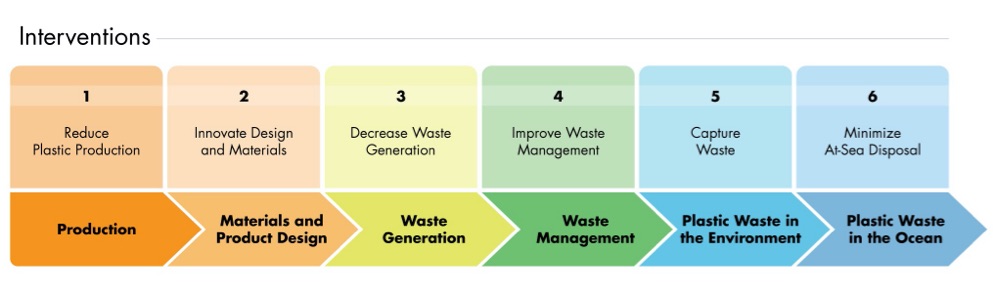
Flow diagram of available plastic waste interventions from plastic production to recapture of plastics in the ocean. SOURCE: Modified from Jambeck et al. (2018).

Flow diagram of available plastic waste interventions from plastic production to recapture of plastics in the ocean.

SOURCE: Modified from Jambeck et al. (2018).

Thursday, April 27, 2017

Rise Up - Climate Change Education Initiative

Rise Up is an IDB climate change education initiative that seeks to encourage children and youth to use their creativity and energy to come up with feasible, sustainable, long-term strategies to mitigate climate change.

Explore Rise Up themes 

We present instruction videos, a Green School Tool Kit and Videogames. These are all materials that teachers and students will be able to use in schools to turn children into brave superheroes with the mission of saving the planet!


Tuesday, November 10, 2015

Why You Should Not Throw Away Used Tea Bags

By Top home remedies

Prepackaged tea bags make it so easy to enjoy a cup of tasty tea. Whether it is green tea, black tea, chamomile tea, peppermint tea or any other herbal tea, drinking a few cups daily provides many health benefits.

Herbal teas have antioxidant, anti-inflammatory, astringent and antibiotic properties.

But did you know you can get many additional benefits from those little tea bags after you’ve had your tea? Instead of just throwing them away, you can use the damp, small tea bags in your beauty regimen and even gardening.

how to use used tea bags
Here are the top 10 uses of used tea bags.

1. Treat Mild Acne

Used green tea bags can help protect and beautify your skin in a number of ways. In fact, they are one of the best home remedies for mild acne. The catechins in green tea have antibacterial properties that help fight acne-causing bacteria.
A 2009 study published in the Journal of Drugs in Dermatology suggests that green tea lotion can be an effective and safe treatment for mild acne.
Another study, published in the Journal of Investigative Dermatology in 2012, concluded that epigallocatechin-3-gallate (EGCG) in green tea helps modulate intracellular molecular targets and inhibit p. acnes bacteria that causes acne.
  1. Brew a cup of green tea and set the tea bag aside for 30 minutes.
  2. Place the used tea bag directly on the affected skin for 5 to 10 minutes.
  3. Rinse off your skin with cool water.
  4. Do this twice daily until you have acne-free skin.

2. Fight Aging Signs

Green tea has anti-aging and antioxidant properties that help improve skin complexion and elasticity. It even delays signs of skin aging, such as sagging skin, sun damage, age spots, fine lines and wrinkles.
A 2003 study by the Medical College of Georgia notes that green tea aids skin rejuvenation. It can be used to treat skin diseases and wounds.
  1. Transfer the contents of 2 used green tea bags into a bowl.
  2. Mix in 1 to 2 teaspoons of raw honey and a little lemon juice.
  3. Apply it on your face and neck area.
  4. Allow it to sit for 5 to 10 minutes, then rinse it off with lukewarm water.
  5. Use this face mask once or twice a week.
Note: This face mask may not be suitable for people with sensitive skin.

3. Eliminate Bad Breath

You can enjoy fresh, minty breath using a soothing and mild mouthwash made with peppermint and green tea bags. The antiseptic and antibacterial properties in these teas help fight bad bacteria in the mouth that cause bad breath.
Also, a 2014 study published in the International Journal of Oral and Maxillofacial Surgery noted that a green tea mouth rinse could be an appropriate and effective choice for controlling pain associated with acute pericoronitis.
  1. Steep 2 or 3 used tea bags in a cup of hot water for 10 to 15 minutes to brew a weak tea.
  2. Let the tea cool down.
  3. Mix in a few drops of tea tree oil.
  4. Use it as a mouthwash 2 times a day to fight bad breath.

4. Make Your Hair Shiny

Used black or green tea bags can add shine to dry and dull hair. The antioxidants in the tea promote hair growth as well as prevent common problems like dry scalp and dandruff.
  1. Rebrew 2 or 3 used tea bags in 2 cups of water and allow it to cool.
  2. After shampooing your hair, use the weak tea as a final hair rinse.
  3. Massage your scalp for 5 minutes, then rinse your hair with plain water.
  4. Allow your hair to air dry to enjoy smooth and shiny hair.
  5. Use this hair treatment 2 times a week.

5. Soothe Puffy and Irritated Eyes

Any kind of tea bags can help soothe puffy and irritated eyes. Tea has anti-irritant and antioxidant properties that help reduce swelling around your eyes and relieve tiredness and inflammation.
Furthermore, it helps restore the natural glow and spark of your eyes.
  1. Put 2 used tea bags in the refrigerator for 30 minutes.
  2. Lie down and put the chilled tea bags over your closed eyelids.
  3. Leave them in place for 10 to 15 minutes.
  4. Repeat a few times a day.

6. Soothe Sunburns and Razor Burns

Moist green teabags can soothe sunburns as well as razor burns. Green tea contains tannins with astringent and mild anesthetic properties that can help combat itching and pain.
A 2001 study published in the Journal of American Academy of Dermatology notes that the polyphenolic extracts of green tea help reduce the number of sunburn cells and protect epidermal Langerhans cells from damage caused by ultraviolet sunrays.
  1. Put 10 to 12 used green tea bags in your bathwater.
  2. Soak in this healing water for about 20 minutes.
  3. Do this once daily for a few days.
You can also try used chamomile tea bags for their anti-inflammatory qualities.

7. Fight Toenail Fungus

fungal nail infection
Instead of discarding used tea bags, you can use them to treat toenail fungus. The tannins in tea help kill the fungi responsible for fungal infections, while its antibiotic and astringent properties relieve symptoms like burning sensations, swelling and skin irritation.
  1. Chill some used tea bags in the refrigerator for 20 to 30 minutes.
  2. Put the cold tea bags on the affected toenails for 15 minutes.
  3. Use this remedy 2 or 3 times daily until the infection clears up completely.

8. Exfoliate Your Skin

used tea bags to exfoliate skin
The slight rough texture of the contents of used tea bags is great for exfoliating your skin. This helps get rid of dead skin cells, dirt and other impurities.

Plus, its antioxidant and anti-inflammatory properties help soothe your skin and give your skin an incredible glow.
  1. Transfer the contents of 1 or 2 used green tea bags into a bowl.
  2. Add a little olive oil and honey to make a paste.
  3. Apply it on your face and neck and allow it to sit for 10 minutes.
  4. Gently rub off the paste using circular motions.
  5. Rinse off your skin with warm water.
  6. Use this facial scrub once or twice a week.

9. Protect Plants from Pests and Infections

spray plants tea solution
Whether you grow plants in pots or lush green gardens, used tea bags can help keep pests and fungal infections at bay.
  • Make a mild brew from your used tea bags. Allow it to cool and transfer the solution into a spray bottle. Spray it on the leaves of your indoor or garden plants.
  • Also, place a few used teabags in the bottom of a pot. They help the soil retain water in addition to adding valuable nutrients to it.

10. Add to Organic Compost

organic compost
As long as the bags are made of paper or muslin, rather than polypropylene, used tea bags can be composted to speed up the decomposition process in plant material. They also encourage friendly bacteria to grow, which helps prevent fungal and pest problems.

Collect your used bags in a jar and add them to your compost at your convenience.

Resources:

http://www.ncbi.nlm.nih.gov/pubmed/19363854
http://www.nature.com/jid/journal/v133/n2/full/jid2012292a.html
http://www.sciencedaily.com/releases/2003/04/030425071800.htm
http://www.ijoms.com/article/S0901-5027%2814%2900210-0/abstract
http://www.ncbi.nlm.nih.gov/pubmed/11209110


Source: http://www.top10homeremedies.com/kitchen-ingredients/not-throw-used-tea-bags.html

Wednesday, May 20, 2015

New toolkits to help students love food, hate waste

students in lecture hall
Food waste is a complex environmental, social and economic problem. In NSW alone, households are throwing away $2.5 billion worth of edible food each year and businesses in NSW send a staggering amount of food waste to landfill. In Sydney 300,000 tonnes of food waste is thrown away each year. Most of this food could have been sold and eaten.
The problem with food waste going to landfill is that when organic waste (including food waste) breaks down it results in the production of methane – a greenhouse gas 25 times more potent than carbon dioxide. Wasting food also wastes the energy, water and natural resources used to grow, package, transport and market that food.
Food waste is not only a big burden on the environment – the 300,000 tonnes of food waste disposed of at Sydney’s landfills in 2007–2008 cost business approximately $36 million in disposal fees alone.
ISF researchers have been involved with several projects for the Love Food Hate Waste program managed by the NSW Environment Protection Authority (EPA). These include theLove Food Hate Waste short film competition and last year’s Zero food waste masterclass and cook-off.
This month, researchers and lecturers from ISF and the UTS Business School have developed three teaching toolkits to introduce food sustainability into the higher education curriculum.
The teaching toolkits contain all that is required for the development of tutorials/workshops focusing on commercial responses to food waste, food waste as a household issue and global food waste.
“It’s about getting the idea of not wasting food front-and-centre for students,” says ISF senior researcher Jade Herriman.
The teaching toolkits contain: learning objectives; suggested lesson format; some quick statistics; reports; infographics; multimedia; responses to the issue; class discussion questions and interactive activities; assessment questions and other possible assessment tasks; and a suggested reading list for students.
The Business School began a process four years ago to integrate sustainability into every subject, rather than treating the subject as an optional extra so UTS Business School students focus on environmental and social dilemmas as an integral part of their studies. The Business School coordinates the  Learning & Teaching Sustainability website,www.sustainability.edu.au where these new toolkits are located.

Sunday, October 26, 2014

Sweden Is Now Recycling 99 Percent Of Its Trash. Here’s How They Do It


trashhhhh

Everyone produces waste, and the Swedes are no different. It’s what they do with it that is unusual. Sweden recycles and sorts its waste so efficiently that less than 1 percent ends up in landfills. But perhaps even more interesting, and somewhat controversial, is that Sweden burns about as much household waste as it recycles, over 2 million tons, and converts this to energy. But even with this amount of domestic waste, the country’s 32 waste-to energy (WTE) incineration plants can handle even more. And when Sweden runs out of its own garbage, it offers a service to the rest of garbage-bloated Europe: importing excess waste from other countries.

Source: Truth Theory

Wednesday, October 9, 2013

A Zero Waste Hierarchy for Developing Countries in Asia

Developing countries in Asia are struggling with the increasing amounts of waste generated and disposed. Those countries without the proper waste infrastructure and collection services often resort to open dumping or burning, thus causing environmental pollution and health problems.

What is Zero Waste?

Zero Waste is a concept that could be adopted in these developing countries in Asia. Zero Waste challenges the old way of thinking about waste as something that has no value and to be thrown away.

According to the Zero Waste Alliance: “Zero waste suggests that the entire concept of waste should be eliminated. Instead, waste should be thought of as a “residual product” or simply a “potential resource” to counter our basic acceptance of waste as a normal course of events. Opportunities such as reduced costs, increased profits, and reduced environmental impacts are found when returning these “residual products” or “resources” as food to either natural and industrial systems.”

Zero Waste is a whole system approach that changes the way materials flow through society and ultimately results in no waste. It involves reducing consumption, minimising wastage, maximising recycling and composting, and ensuring that products and materials are designed to use less resources and made to be reused, recycled or biodegradable.

Nature is the best Zero Waste model. There is no waste in nature and by-products produced become resources for others or are assimilated harmlessly back to the surroundings.

The Zero Waste Hierarchy

The Zero Waste hierarchy refers to the following options for managing waste (in order of priority):

1. Right in the beginning, waste should be prevented or reduced through redesign, reduced packaging and material use, and less consumption.

2. Waste should be reused, repaired or refurbished for their original use or for another purpose.

3. Waste should be recycled, reprocessed or composted into raw materials and useful resources.

4. Waste should be recovered for their energy content through waste-to-energy or incineration facilities.

5. After all of the above have been done, waste should be landfilled in a safe and sustainable manner.

Developing countries in Asia could adopt this Zero Waste hierarchy when planning and implementing waste policies, instead of focusing mainly on landfilling or incineration. Infrastructure, services, technologies and funding should be sourced and put in place to fulfill this hierarchy.

Benefits of Zero Waste

The benefits of Zero Waste is that it helps to conserve resources, reduce pollution, create jobs in waste management, reduce waste costs, increase the lifespan of landfills and incineration plants, and mitigate climate change.

Environmentalist and author, Paul Hawken, said that: “Zero Waste is an extraordinary concept that can lead society, business, and cities to innovative breakthroughs that can save the environment, lives, and money. Through the lens of Zero Waste, an entirely new relationship between humans and systems is envisaged, the only one that can create more security and well being for people while reducing dramatically our impact upon planet earth. The excitement is on two levels: it provides a broad and far-reaching vision, and yet it is practical and applicable today.”

Can Asia Achieve Zero Waste?

Zero is the goal but it is important not to be over-focused on the word ‘zero’. What matters is the concept behind Zero Waste. The road to Zero Waste for Asia is a long journey and it requires the efforts of individuals, communities, organisations, businesses and governments, working closely together towards Zero Waste.

Image credit: Recycle 1 by jaylopez

- See more at: http://www.asiaisgreen.com/2013/10/08/a-zero-waste-hierarchy-for-developing-countries-in-asia/?utm_source=feedburner&utm_medium=email&utm_campaign=Feed%3A+AsiaIsGreen+%28AsiaIsGreen%29&utm_content=Yahoo%21+Mail#sthash.luPSUjcJ.dpuf

Source: http://www.asiaisgreen.com/2013/10/08/a-zero-waste-hierarchy-for-developing-countries-in-asia

Monday, September 30, 2013

Releasing the Organic Composting Manual for kids; "Organic Composting - How Great!"

  • Kitakyushu Urban Centre (KUC) has just released an organic composting manual for kids, which is titled "Organic Composting - How Great!".

    The pamphlet, which is in the style of a comic, shows a family that tries to grow vegetables in their home garden. It doesn't go well at first, but by getting some advice from an imaginary character named "the fairy of the soil" they learn that composting is made from household garbage and makes nutritious soil for growing delicious vegetables.

    This 16 page booklet was planned as supplementary reading material for the Junior Science School (JSS) seminar which was jointly organised by the Kyushu Institute of Technology and IGES this summer. KUC took advantage of this opportunity to introduce our research activities on community-based solid waste management in Asian countries/cities. Japanese elementary school children from age 6 to 11 attended the series of lectures and learned about composting and resource recycling.

  • The Contents of "Organic Composting - How Great!"

    1. Soil that is Friendly for Microorganisms
    2. Reducing Waste at Home
    3. How to Make Compost Part 1
    4. How to Make Compost Part 2
    5. Let's Use Compost
  • This booklet is mainly for lower grades of elementary school, however it is useful for teachers/adults who are trying to learn how to make compost technically.
    The English and Japanese versions are available here.

    1. English version »
    2. Japanese version »


Source: http://www.iges.or.jp/en/sustainable-city/201309_compostmanual.html

Wasting Less - A Consumer's Guide


Reduce

True waste reduction starts with, well, reduction, the first R. Avoiding buying something, or buying less of it, uses the fewest resources and saves you from having to seek out end-of-life options. Granted, waste reduction is harder to measure than recycling – you can’t see the things you didn’t buy in the same way as you can see how much you’ve filled up your recycling bin. But it’s real all the same. So how do you reduce?

  • Don’t browse in stores. Identify what you need before you make the trip, or even order it – that way you don’t get caught buying other things you don’t really need. Retailers are skilled at displaying items to encourage impulse buying  – resist! A rule of thumb – if you didn’t go to the store with the intention of buying it, consider the possibility that you don’t really need it.
  • Simplify your life – declutter (give it away!), and remember “he who dies with the most toys still dies – and leaves his kids to deal with all the junk!” As Oprah said, if you don’t need it or love it, get rid of it! Just because you get rid of a memento doesn’t mean you lose the memories!
  • Look for ways to use fewer things, and thus create less waste. You’ll save yourself time and money.
    Buy only what you need. Before you buy any item, ask yourself if you really need it, or could you make do with what you already have?
  • Choose products that do as many jobs as possible – printers that also scan and fax (if you need all three functions), all-purpose cleaners, rather than specialized ones for each surface or type of room. This reduces the number of products you have to deal with, decreases packaging and cuts down on clutter! 

Recyclables

Many items can be recycled in Saskatchewan, such as beverage containers (cans, glass, plastic, milk jugs and juice boxes) through SARCAN, used oil through the Sask. Association for Resource Recovery Corp, Paint at SARCAN, just to name a very few.  See our “Where do I recycle my…?” database to check out options in your community.

Disposables

The "throw-away" convenience of some products is not worth the environmental price that is paid. Whenever you can, look for non-disposable options. Avoid paper towels, plates and cups, throw-away lighters and razors, and disposable diapers. Purchase the multi-use alternatives instead. Advertisers would have us believe that our busy lives demand items that we use once and throw away. But disposables have time costs too. You have to go and buy more things to replace all the ones you’ve thrown away and you have more garbage to take out. Even if you are someone who recycles, disposable items will have more packaging to deal with because each item is used only once. Most disposable items have a reusable counterpart -- washable floor pads for Swiffer-type mops, reusable coffee filters, cloth towels, razors where you just replace the blade... they’re out there and they reduce a lot of waste.

Also, consider reducing or eliminating your purchase of disposable fast food packaging.

Buy Quality

Buy durable, long-lasting goods. Initially the cost may be higher, but in the long run you can save. Consumer magazines and organizations can help you make an informed choice.  If you don’t need an item for its full life-span, no doubt someone else can make use of it when you’re done with it.

Rent

Rent seldom used items, such as tools or party ware.

Replace Hazardous Household Products With Non-Toxic Alternatives

Baking soda can be used as a scouring powder on tubs, sinks and ovens. Warm water and vinegar can be used to clean windows and mirrors, using an 8-to-1 solution. Twice weekly rinses with boiling water will keep drains open. Use a metal snake or plunger to unclog drains. For more suggestions, click here.

Be A Packaging Watchdog

  • Buy for the contents, not the container. Some packaging is necessary — you can't carry flour home in your hand — but these days many products have unnecessary or excessive packaging.
  • Buy fruits and vegetables "loose" rather than on a plastic-covered tray. If only buying one or two, they don’t even need the ubiquitous plastic bags.  Pencils and pens are examples of items that can be purchased "loose" at stationary stores, rather than in a bubble pack at the corner store.
  • Buy larger size packages of regularly used items. Buying two small jars of peanut butter creates more garbage than one large jar. Buy a large container of juice and send single servings in a thermos for school lunches.
  • Buy in bulk to reduce packaging, but only for those items that you use frequently and in quantity. It doesn’t reduce waste if you buy a bigger package then end up tossing it out.
  • Reuse plastic bags or containers from home for produce and bulk items.
  • Avoid packaging made with two or more different materials, such as juice containers made of a paper laminated with plastic or foil.
  • Ask store clerks not to double bag your purchases. Better yet, bring your own shopping bag to the store.

Be A Constructive Nuisance

Manufacturers and retailers are sensitive to consumers' preferences. Write the company to let them know you are rejecting a product because it is environmentally inappropriate. Complain to store owners.

evolution of garbage can

Tips For Reducing Household Garbage...

Reuse

Intro by Joanne Fedyk

As I write this, I am wearing a shirt that used to belong to my sister-in-law (very comfortable, one of my favourites), and a pair of sandals a friend gave me because they no longer fit. I've got a book borrowed from the library in my bag, a remanufactured toner cartridge in my laser printer, a used (donated) computer as our second work-station, paper with one side used in my laser printer, photocopier and fax machine. My office furniture is second-hand, and my calendar on the wall is the wipe-off kind that we use over and over. You likely can come up with your own reuse examples.
Generally reuse includes any activities that use an item over again without reprocessing.

Reusing benefits us by saving money. It benefits the community by creating businesses. Second hand stores for everything from music to cars, rental outlets, and repair shops all contribute to local economies. Globally, reuse saves resources and prevents pollution. Reuse mostly occurs locally, so transportation costs and effects are reduced. Reuse keeps things in circulation, so it avoids new items being manufactured. It also uses less energy and creates less pollution than recycling.

  • Many things around the house can be saved and reused — string, plastic containers, glass containers, gift wrap, shopping bags. If there are things you can't use, consider giving them to others who can.
  • Magazines can be given to friends, or donated to hospitals, nursing homes, or doctors' offices.
  • Books can be given to hospitals, donated to organizations such as Salvation Army for resale, or resold in used book stores.
  • Yarn and cloth scraps, buttons, wallpaper ends and samples, toilet paper rolls, small boxes, egg cartons, yogurt containers, apple baskets, etc. may be used by nursery or primary schools or day care centres.
  • Eyeglasses can be donated to organizations such as the Lions Clubs International or sent to Operation Eyesight, 759 Warden Avenue, Scarborough, ON, M1L 4B5.
  • Check out Freecycle.org, a great avenue for giving away things you no longer want or need.
  • Use it again — buy used items.
  • Refill — refill bottles and other containers. The same container can be used more than once for many things.
  • Dismantle — dismantle objects into individual components for recycling or reuse.

Websites like Kijiji (and other reuse options) have become essential for selling/ giving things away, with all kinds of categories to list in, and it’s free! We recommend Kijiji frequently, particularly for odd items that don’t have obvious options. One caller to SWRC had four electric typewriters to give away. As they aren’t accepted by the SWEEP program, we suggested Kijiji, and he emailed back a few days later to say someone had taken all four of them for parts! Who knew?!

Mattresses are another item we get frequent calls about – they’re often past the reusable state, and with the bed-bug issue, even charitable groups often don’t want them. But they make excellent dog beds or truck bed liners, so once again – Kijiji!

Donate

Charitable groups such as the Salvation Army, Crisis Nursery and the Saskatoon Refugee Coalition, and organizations who collect for Value Village, (Saskatoon Institute on Community Living and Canadian Diabetes Association) will take many items off your hands, such as old clothes, toys, furniture and appliances. The Refugee Coalition in particular is happy to accept less-than-perfect items. They readily took an excellent folding chair that had a smudge of paint on it and an ugly couch that was in otherwise great shape from a staffer’s parents. Local churches or women’s shelters often need items. Some daycares/preschools/kindergartens take a variety of strange items for their craft centres – thread spools, small jars, good-one- side paper of any size, old calendars and magazines (for their pictures), and the like.

Repair

Instead of throwing it out, fix it up! Repair broken toys, furniture and appliances to extend their useful life.

Share

Share with neighbours and friends those large expensive things that you use only once in a while, such as lawn mowers, other gardening equipment, and tools.

Cut Down on Food Waste

20% of the food we buy ends up in the garbage. Keep track of what you've got on hand so that you use groceries while they're still fresh.

Compost

Start a backyard compost with your kitchen and yard waste — vegetable trimmings, banana peels, egg shells, coffee grounds, leaves, grass clippings, etc. You will reduce your garbage by over one-third and will produce an excellent soil conditioner for your garden. See our composting page for information on how to start composting.

Recycle

Search our "Where do I recycle my…?" database for information on materials that can be recycled in your community or in a community near you.

******************************

Businesses and institutions too can reduce. Study your processes and business practices and ask the question “how can we accomplish our goals using fewer resources?” Can you reduce paper use? Can you switch to non-toxic cleaning products?

One way to identify waste reduction opportunities is to look at what is in your waste stream -- what can be eliminated/used again recycled? Fewer inputs mean saved resources.

Review your equipment and procedures regularly. SaskTel told us a story once of realizing they were still driving large trucks designed to carry big pieces of equipment that were no longer used. They downsized to much smaller vehicles, saving fuel and money.

Mostly, for businesses (and individuals too), it’s about keeping waste reduction in mind, looking for opportunities to accomplish more with less, and then spreading the word to others!

Back to 3Rs main page

Back to Resources main page

Back to Home page

Waste Reduction Week in Canada October 21-27, 2013

Top R4R Picks

http://www.wrwcanada.com/

Individual Resources

Non-Profit Resources


Resources for extending the learning

Teachers! Why not involve your students in an important week-long campaign that promotes waste reduction by encouraging Canadians to reduce, reuse and recycle. Built on the theme, Too Good To Waste, this week-long campaign is intended to help us all better appreciate the richness and beauty of our planet and understand the role that waste reduction can play in solving many of our environmental problems.

During Waste Reduction Week students and teachers from across Canada are encouraged to explore the social, economic and environmental impacts of waste and to participate in action projects within their own communities to make a positive difference.

Why Care about Waste Reduction? 
  • Across Canada it costs more than $1.5 billion per year to dispose of garbage
  • There are well over 10,000 landfill sites in Canada.
  • Landfill sites account for about 38% of Canada's total methane emissions
  • A plastic bag will take approximately 400 years to break down in a landfill
  • 70% of land-filled waste could be either reused or recycled
  • 5 billion drink boxes are thrown away each year in North AmericaIn a lifetime, the average Canadian will throw away 600 x his or her adult weight in garbage.
  • A 68 kg adult will leave a legacy of 40,825 kg of trash.
  • By the age of 6 months the average Canadian has consumed the same quantity of resources as the average person in the developing world consumes in a lifetime.

  • E-waste is the fastest growing source of waste in North America

  • Only 11% of e-waste is recycled

  • Most e-waste is shipped overseas or land-filled, where chemicals such as lead and mercury can leach into the groundwater and soil.

Resources 4 Rethinking encourages students and teachers to participate in Waste Reduction Week and offers the following suggestions to support this year’s theme.

For more information and activities be sure to check out the Waste Reduction Week in Canada website at http://www.wrwcanada.com/

Source:http://r4r.ca/en/theme/waste-week-2013