By Donella Meadows
The Dance
1. Get the beat.
2. Listen to the wisdom of the system.
3. Expose your mental models to the open air.
4. Stay humble. Stay a learner.
5. Honor and protect information.
6. Locate responsibility in the system.
7. Make feedback policies for feedback systems.
8. Pay attention to what is important, not just what is quantifiable.
9. Go for the good of the whole.
10. Expand time horizons.
11. Expand thought horizons.
12. Expand the boundary of caring.
13. Celebrate complexity.
14. Hold fast to the goal of goodness.
People who are raised in the industrial world and who get enthused about systems thinking are likely to make a terrible mistake. They are likely to assume that here, in systems analysis, in interconnection and complication, in the power of the computer, here at last, is the key to prediction and control. This mistake is likely because the mindset of the industrial world assumes that there is a key to prediction and control.
I assumed that at first too. We all assumed it, as eager systems students at the great institution called MIT. More or less innocently, enchanted by what we could see through our new lens, we did what many discoverers do. We exaggerated our own ability to change the world. We did so not with any intent to deceive others, but in the expression of our own expectations and hopes. Systems thinking for us was more than subtle, complicated mindplay. It was going to Make Systems Work.
But self-organizing, nonlinear, feedback systems are inherently unpredictable. They are not controllable. They are understandable only in the most general way. The goal of foreseeing the future exactly and preparing for it perfectly is unrealizable. The idea of making a complex system do just what you want it to do can be achieved only temporarily, at best. We can never fully understand our world, not in the way our reductionistic science has led us to expect. Our science itself, from quantum theory to the mathematics of chaos, leads us into irreducible uncertainty. For any objective other than the most trivial, we can’t optimize; we don’t even know what to optimize. We can’t keep track of everything. We can’t find a proper, sustainable relationship to nature, each other, or the institutions we create, if we try to do it from the role of omniscient conqueror.
For those who stake their identity on the role of omniscient conqueror, the uncertainty exposed by systems thinking is hard to take. If you can’t understand, predict, and control, what is there to do?
Systems thinking leads to another conclusion–however, waiting, shining, obvious as soon as we stop being blinded by the illusion of control. It says that there is plenty to do, of a different sort of “doing.” The future can’t be predicted, but it can be envisioned and brought lovingly into being. Systems can’t be controlled, but they can be designed and redesigned. We can’t surge forward with certainty into a world of no surprises, but we can expect surprises and learn from them and even profit from them. We can’t impose our will upon a system. We can listen to what the system tells us, and discover how its properties and our values can work together to bring forth something much better than could ever be produced by our will alone.
We can’t control systems or figure them out. But we can dance with them!
I already knew that, in a way before I began to study systems. I had learned about dancing with great powers from whitewater kayaking, from gardening, from playing music, from skiing. All those endeavors require one to stay wide-awake, pay close attention, participate flat out, and respond to feedback. It had never occurred to me that those same requirements might apply to intellectual work, to management, to government, to getting along with people.
But there it was, the message emerging from every computer model we made. Living successfully in a world of systems requires more of us than our ability to calculate. It requires our full humanity–our rationality, our ability to sort out truth from falsehood, our intuition, our compassion, our vision, and our morality.
I will summarize the most general “systems wisdom” I have absorbed from modeling complex systems and from hanging out with modelers. These are the take-home lessons, the concepts and practices that penetrate the discipline of systems so deeply that one begins, however imperfectly, to practice them not just in one’s profession, but in all of life.
The list probably isn’t complete, because I am still a student in the school of systems. And it isn’t unique to systems thinking. There are many ways to learn to dance. But here, as a start-off dancing lesson, are the practices I see my colleagues adopting, consciously or unconsciously, as they encounter systems.
1. Get the beat.
Before you disturb the system in any way, watch how it behaves. If it’s a piece of music or a whitewater rapid or a fluctuation in a commodity price, study its beat. If it’s a social system, watch it work. Learn its history. Ask people who’ve been around a long time to tell you what has happened. If possible, find or make a time graph of actual data from the system. Peoples’ memories are not always reliable when it comes to timing.
Starting with the behavior of the system forces you to focus on facts, not theories. It keeps you from falling too quickly into your own beliefs or misconceptions, or those of others. It’s amazing how many misconceptions there can be. People will swear that rainfall is decreasing, say, but when you look at the data, you find that what is really happening is that variability is increasing–the droughts are deeper, but the floods are greater too. I have been told with great authority that milk price was going up when it was going down, that real interest rates were falling when they were rising, that the deficit was a higher fraction of the GNP than ever before when it wasn’t.
Starting with the behavior of the system directs one’s thoughts to dynamic, not static analysis–not only to “what’s wrong?” but also to “how did we get there?” and “what behavior modes are possible?” and “if we don’t change direction, where are we going to end up?”
And finally, starting with history discourages the common and distracting tendency we all have to define a problem not by the system’s actual behavior, but by the lack of our favorite solution. (The problem is, we need to find more oil. The problem is, we need to ban abortion. The problem is, how can we attract more growth to this town?) 2. Listen to the wisdom of the system.
Aid and encourage the forces and structures that help the system run itself. Don’t be an unthinking intervener and destroy the system’s own self-maintenance capacities. Before you charge in to make things better, pay attention to the value of what’s already there.
A friend of mine, Nathan Gray, was once an aid worker in Guatemala. He told me of his frustration with agencies that would arrive with the intention of “creating jobs” and “increasing entrepreneurial abilities” and “attracting outside investors”. They would walk right past the thriving local market, where small-scale business people of all kinds, from basket-makers to vegetable growers to butchers to candy-sellers, were displaying their entrepreneurial abilities in jobs they had created for themselves. Nathan spent his time talking to the people in the market, asking about their lives and businesses, learning what was in the way of those businesses expanding and incomes rising. He concluded that what was needed was not outside investors, but inside ones. Small loans available at reasonable interest rates, and classes in literacy and accounting, would produce much more long-term good for the community than bringing in a factory or assembly plant from outside.
3. Expose your mental models to the open air.
Remember, always, that everything you know, and everything everyone knows, is only a model. Get your model out there where it can be shot at. Invite others to challenge your assumptions and add their own. Instead of becoming a champion for one possible explanation or hypothesis or model, collect as many as possible. Consider all of them plausible until you find some evidence that causes you to rule one out. That way you will be emotionally able to see the evidence that rules out an assumption with which you might have confused your own identity.
You don’t have to put forth your mental model with diagrams and equations, though that’s a good discipline. You can do it with words or lists or pictures or arrows showing what you think is connected to what. The more you do that, in any form, the clearer your thinking will become, the faster you will admit your uncertainties and correct your mistakes, and the more flexible you will learn to be. Mental flexibility–the willingness to redraw boundaries, to notice that a system has shifted into a new mode, to see how to redesign structure — is a necessity when you live in a world of flexible systems. 4. Stay humble. Stay a learner.
Systems thinking has taught me to trust my intuition more and my figuring-out rationality less, to lean on both as much as I can, but still to be prepared for surprises. Working with systems, on the computer, in nature, among people, in organizations, constantly reminds me of how incomplete my mental models are, how complex the world is, and how much I don’t know.
The thing to do, when you don’t know, is not to bluff and not to freeze, but to learn. The way you learn is by experiment–or, as Buckminster Fuller put it, by trial and error, error, error. In a world of complex systems it is not appropriate to charge forward with rigid, undeviating directives. “Stay the course” is only a good idea if you’re sure you’re on course. Pretending you’re in control even when you aren’t is a recipe not only for mistakes, but for not learning from mistakes. What’s appropriate when you’re learning is small steps, constant monitoring, and a willingness to change course as you find out more about where it’s leading.
That’s hard. It means making mistakes and, worse, admitting them. It means what psychologist Don Michael calls “error-embracing.” It takes a lot of courage to embrace your errors.
5. Honor and protect information.
A decision maker can’t respond to information he or she doesn’t have, can’t respond accurately to information that is inaccurate, can’t respond in a timely way to information that is late. I would guess that 99 percent of what goes wrong in systems goes wrong because of faulty or missing information.
If I could, I would add an Eleventh Commandment: Thou shalt not distort, delay, or sequester information. You can drive a system crazy by muddying its information streams. You can make a system work better with surprising ease if you can give it more timely, more accurate, more complete information.
For example, in 1986 new federal legislation required U.S. companies to report all chemical emissions from each of their plants. Through the Freedom of Information Act (from a systems point of view one of the most important laws in the nation), that information became a matter of public record. In July 1988 the first data on chemical emissions became available. The reported emissions were not illegal, but they didn’t look very good when they were published in local papers by enterprising reporters, who had a tendency to make lists of “the top ten local polluters.” That’s all that happened. There were no lawsuits, no required reductions, no fines, no penalties. But within two years chemical emissions nationwide (at least as reported, and presumably also in fact) had decreased by 40 percent. Some companies were launching policies to bring their emissions down by 90 percent, just because of the release of previously sequestered information.
6. Locate responsibility in the system.
Look for the ways the system creates its own behavior. Do pay attention to the triggering events, the outside influences that bring forth one kind of behavior from the system rather than another. Sometimes those outside events can be controlled (as in reducing the pathogens in drinking water to keep down incidences of infectious disease.) But sometimes they can’t. And sometimes blaming or trying to control the outside influence blinds one to the easier task of increasing responsibility within the system.
“Intrinsic responsibility” means that the system is designed to send feedback about the consequences of decision-making directly and quickly and compellingly to the decision-makers.
Dartmouth College reduced intrinsic responsibility when it took thermostats out of individual offices and classrooms and put temperature-control decisions under the guidance of a central computer. That was done as an energy-saving measure. My observation from a low level in the hierarchy is that the main consequence was greater oscillations in room temperature. When my office gets overheated now, instead of turning down the thermostat, I have to call an office across campus, which gets around to making corrections over a period of hours or days, and which often overcorrects, setting up the need for another phone call. One way of making that system more, rather than less responsible, might have been to let professors keep control of their own thermostats and charge them directly for the amount of energy they use. (Thereby privatizing a commons!).
Designing a system for intrinsic responsibility could mean, for example, requiring all towns or companies that emit wastewater into a stream to place their intake pipe downstream from their outflow pipe. It could mean that neither insurance companies nor public funds should pay for medical costs resulting from smoking or from accidents in which a motorcycle rider didn’t wear a helmet or a car rider didn’t fasten the seat belt. It could mean Congress would no longer be allowed to legislate rules from which it exempts itself.
7. Make feedback policies for feedback systems.
President Jimmy Carter had an unusual ability to think in feedback terms and to make feedback policies. Unfortunately he had a hard time explaining them to a press and public that didn’t understand feedback.
He suggested, at a time when oil imports were soaring, that there be a tax on gasoline proportional to the fraction of U.S. oil consumption that had to be imported. If imports continued to rise the tax would rise, until it suppressed demand and brought forth substitutes and reduced imports. If imports fell to zero, the tax would fall to zero.
The tax never got passed.
Carter was also trying to deal with a flood of illegal immigrants from Mexico. He suggested that nothing could be done about that immigration as long as there was a great gap in opportunity and living standards between the U.S. and Mexico. Rather than spending money on border guards and barriers, he said, we should spend money helping to build the Mexican economy, and we should continue to do so until the immigration stopped.
That never happened either.
You can imagine why a dynamic, self-adjusting system cannot be governed by a static, unbending policy. It’s easier, more effective, and usually much cheaper to design policies that change depending on the state of the system. Especially where there are great uncertainties, the best policies not only contain feedback loops, but meta-feedback loops–loops that alter, correct, and expand loops. These are policies that design learning into the management process.
8. Pay attention to what is important, not just what is quantifiable.
Our culture, obsessed with numbers, has given us the idea that what we can measure is more important than what we can’t measure. You can look around and make up your own mind about whether quantity or quality is the outstanding characteristic of the world in which you live.
If something is ugly, say so. If it is tacky, inappropriate, out of proportion, unsustainable, morally degrading, ecologically impoverishing, or humanly demeaning, don’t let it pass. Don’t be stopped by the “if you can’t define it and measure it, I don’t have to pay attention to it” ploy. No one can precisely define or measure justice, democracy, security, freedom, truth, or love. No one can precisely define or measure any value. But if no one speaks up for them, if systems aren’t designed to produce them, if we don’t speak about them and point toward their presence or absence, they will cease to exist.
9. Go for the good of the whole.
Don’t maximize parts of systems or subsystems while ignoring the whole. As Kenneth Boulding once said, Don’t go to great trouble to optimize something that never should be done at all. Aim to enhance total systems properties, such as creativity, stability, diversity, resilience, and sustainability–whether they are easily measured or not.
As you think about a system, spend part of your time from a vantage point that lets you see the whole system, not just the problem that may have drawn you to focus on the system to begin with. And realize, that, especially in the short term, changes for the good of the whole may sometimes seem to be counter to the interests of a part of the system. It helps to remember that the parts of a system cannot survive without the whole. The long term interests of your liver require the long term health of your body, and the long term interests of sawmills require the long-term health of forests.
10. Expand time horizons.
The official time horizon of industrial society doesn’t extend beyond what will happen after the next election or beyond the payback period of current investments. The time horizon of most families still extends farther than that–through the lifetimes of children or grandchildren. Many Native American cultures actively spoke of and considered in their decisions the effects upon the seventh generation to come. The longer the operant time horizon, the better the chances for survival.
In the strict systems sense there is no long-term/short-term distinction. Phenomena at different time-scales are nested within each other. Actions taken now have some immediate effects and some that radiate out for decades to come. We experience now the consequences of actions set in motion yesterday and decades ago and centuries ago.
When you’re walking along a tricky, curving, unknown, surprising, obstacle-strewn path, you’d be a fool to keep your head down and look just at the next step in front of you. You’d be equally a fool just to peer far ahead and never notice what’s immediately under your feet. You need to be watching both the short and the long term–the whole system.
11. Expand thought horizons.
Defy the disciplines. In spite of what you majored in, or what the textbooks say, or what you think you’re an expert at, follow a system wherever it leads. It will be sure to lead across traditional disciplinary lines. To understand that system, you will have to be able to learn from–while not being limited by–economists and chemists and psychologists and theologians. You will have to penetrate their jargons, integrate what they tell you, recognize what they can honestly see through their particular lenses, and discard the distortions that come from the narrowness and incompleteness of their lenses. They won’t make it easy for you.
Seeing systems whole requires more than being “interdisciplinary,” if that word means, as it usually does, putting together people from different disciplines and letting them talk past each other. Interdisciplinary communication works only if there is a real problem to be solved, and if the representatives from the various disciplines are more committed to solving the problem than to being academically correct. They will have to go into learning mode, to admit ignorance and be willing to be taught, by each other and by the system.
It can be done. It’s very exciting when it happens.
12. Expand the boundary of caring.
Living successfully in a world of complex systems means expanding not only time horizons and thought horizons; above all it means expanding the horizons of caring. There are moral reasons for doing that, of course. And if moral arguments are not sufficient, then systems thinking provides the practical reasons to back up the moral ones. The real system is interconnected. No part of the human race is separate either from other human beings or from the global ecosystem. It will not be possible in this integrated world for your heart to succeed if your lungs fail, or for your company to succeed if your workers fail, or for the rich in Los Angeles to succeed if the poor in Los Angeles fail, or for Europe to succeed if Africa fails, or for the global economy to succeed if the global environment fails.
As with everything else about systems, most people already know about the interconnections that make moral and practical rules turn out to be the same rules. They just have to bring themselves to believe that which they know.
13. Celebrate complexity.
Let’s face it, the universe is messy. It is nonlinear, turbulent and chaotic. It is dynamic. It spends its time in transient behavior on its way to somewhere else, not in mathematically neat equilibria. It self-organizes and evolves. It creates diversity, not uniformity. That’s what makes the world interesting, that’s what makes it beautiful, and that’s what makes it work.
There’s something within the human mind that is attracted to straight lines and not curves, to whole numbers and not fractions, to uniformity and not diversity, and to certainties and not mystery. But there is something else within us that has the opposite set of tendencies, since we ourselves evolved out of and are shaped by and structured as complex feedback systems. Only a part of us, a part that has emerged recently, designs buildings as boxes with uncompromising straight lines and flat surfaces. Another part of us recognizes instinctively that nature designs in fractals, with intriguing detail on every scale from the microscopic to the macroscopic. That part of us makes Gothic cathedrals and Persian carpets, symphonies and novels, Mardi Gras costumes and artificial intelligence programs, all with embellishments almost as complex as the ones we find in the world around us.
14. Hold fast to the goal of goodness.
Examples of bad human behavior are held up, magnified by the media, affirmed by the culture, as typical. Just what you would expect. After all, we’re only human. The far more numerous examples of human goodness are barely noticed. They are Not News. They are exceptions. Must have been a saint. Can’t expect everyone to behave like that.
And so expectations are lowered. The gap between desired behavior and actual behavior narrows. Fewer actions are taken to affirm and instill ideals. The public discourse is full of cynicism. Public leaders are visibly, unrepentantly, amoral or immoral and are not held to account. Idealism is ridiculed. Statements of moral belief are suspect. It is much easier to talk about hate in public than to talk about love.
We know what to do about eroding goals. Don’t weigh the bad news more heavily than the good. And keep standards absolute.
*****
This is quite a list. Systems thinking can only tell us to do these things. It can’t do them for us.
And so we are brought to the gap between understanding and implementation. Systems thinking by itself cannot bridge that gap. But it can lead us to the edge of what analysis can do and then point beyond–to what can and must be done by the human spirit. Source: http://donellameadows.org/archives/dancing-with-systems
Tools for Systems Thinkers: Designing Circular Systems
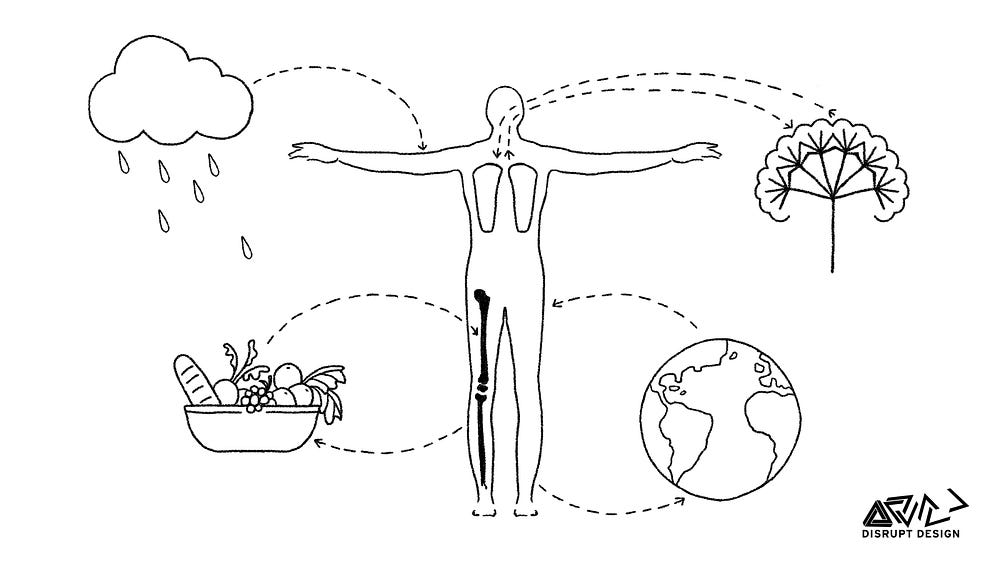
Everything
is Interconnected, our lungs and plants share the same fractal design
and our bodies are made of the same organic material that is in
our food.
Over the last five chapters in this series on tools for systems thinkers, I have looked at fundamental concepts, feedback loops, dominant archetypes and shared systems mapping tools.
I have worked on synthesizing the critical tools that assist with the
development of a more three-dimensional perspective of how the world
works. By no means have I covered it all, but I hope to have helped
ignite curiosity around the power of a systems-based perspective and the
opportunity that we all have in learning to love complex problems and
embrace challenges in more proactive ways.
In
the final chapter of this series, I cover some of the ways that
thinking in systems can transition us to a circular economy.
Specifically, I discuss how we can design circular systems that
facilitate sustainable and regenerative outcomes. For a more detailed
introduction to these concepts, take a look at the Circular Systems Design Activation Pack we created.
On Design
First
let me say that while I am a designer and advocate for professionals to
make intentional sustainability and systems based contributions through
their creative productions, when I say ‘design’ in this piece, I am
referring to design as the common practice of producing ‘things’. This
can be anything — artifacts, conversations, or policies, all of which
have impacts on the world. From supermarket designs, to government
regulations, to how we design our own lives, these are all the product
of design — the intent to direct or construct the world in a particular
way.
Design
is a conscious and intuitive effort to impose meaningful order. Design
is both the underlying matrix of order and the tool that creates it. — Victor Papanek
I
have written and spoken extensively on the role that design plays in
scripting out lives, influencing our minds and curating our experience
of the world (see here, here, here and here).
In
some cases ‘designs’ have massive impacts, and in others, only minor
roles. Nonetheless, everyday design is the act of creating something
new, so let’s dive into how we can design circular systems that build in
intentionally for positive impacts on people and the planet.
“You
never change things by fighting the existing reality. To change
something, build a new model that makes the existing model obsolete.” ― R. Buckminster Fuller
The Circular Economy
For many people the term ‘circular economy’
is still new, so allow me to briefly explain what this is all about.
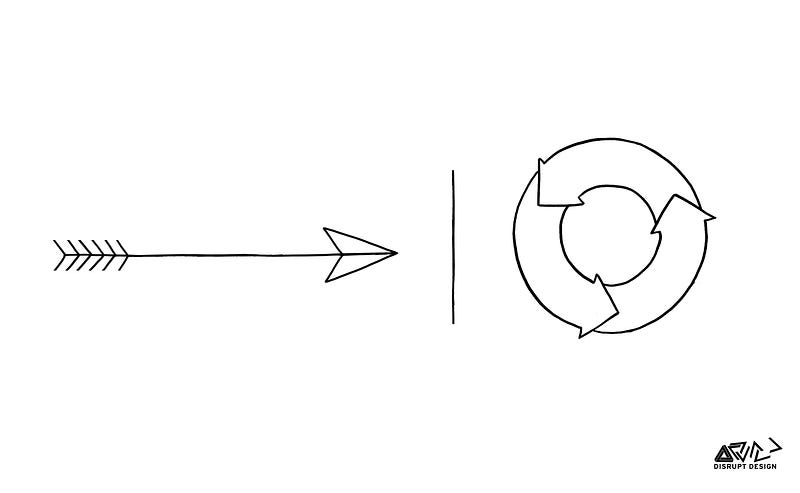
Our current economy is based on a linear system of production where we
take raw materials and natural resources out of nature, process them
into usable goods to meet human needs, and then discard them back into
giant holes in the ground that, ironically, were often where we took the
raw materials from to begin with.
This
entire system is in opposition to the natural systems that sustain life
on Earth — which are circular and regenerative — and it’s
counterintuitive to the way we function as living organisms (for example
we all require nutrients to survive, which is part of the beautifully
designed system of nutrients cycling through bodies and back into the
ground to grow the next generation of food, this nutrient cycle is one
of the fundamental ecosystems that sustain life on Earth).
Basically
humans designed a broken system that creates waste and constantly loses
value through the economy. Our linear economy does not fit in a
circular world.
The
opposite to a linear system is a circular one. When you use the natural
world as a design reference, you quickly see that everything not only
plays a role, but also puts back in what it took out.
Most
organisms in nature, as well as the principles that nature plays by,
are regenerative; humans, however, design systems that are the exception
to this rule. Herein lies the problem that the circular economy
movement, and many other attempts (cleaner production, eco design, life
cycle assessment, industrial ecology etc.), that have come before, have
tried to address.
These
attempts have all worked hard to solve the complex puzzle of meeting
humanity’s growing needs while not screwing up the life support systems
that both nourish all living organisms (thank you food, air, and water)
but work effortlessly in amazingl complex ways to make life happen on
this magical ball of water and soil that we all share.
I
could go on and on about this missing link in our current economic and
social structures, the design mistakes that perpetuate it, how our
education system devalues circularity and prioritizes reductionism… But
right now I’m going to invest this time in the more interesting part,
where we figure out how to not make
a mess of this beautiful planet and instead, start to design out waste
and find unique ways of being a productive contributor to the planet (to
this end I am working on a project for a post disposable future, check it out here).
Everything is Interconnected
All
of this all boils down to the simple reality that we all have an
intuitive understanding of — everything is interconnected to everything
else in some way. Nothing living is in isolation, and we are require
other systems to survive—thus we are all in an interconnected,
interdependent relationship with everything else. I say this in a
non-hippy way, look at the design of a tree and you will see the same
fractile patterns in your lungs, your life is reinforced every few
seconds as you breath in oxygen that was produced free of charge by a
bunch of trees and phytoplankton.
We
live of a closed ecosystem that is perfectly calibrated for success.
Our bodies are small versions of this, and we benefit every second of
the day from the services that this giant ecosystem provides us.
Many
of the human-created systems that we have, such as cities, factories,
governments and industrial food production, are failed emulations of the
way nature designs things because they have not been designed as a
system that nests within other systems. They are isolated and siloed,
linear and reductive.
This
is where humans have really messed up: we have made things based on our
reductive one-dimensional perspective of the world, rather than taken
on the more detailed, systemic and creative perspective of what makes
everything work on Earth.
So
when we are seeking to solve and evolve some of the more complex
problems humanity faces, we must start first with a shift in mindset
from the one dimension of a linear plane to a three-dimensional
perspective of the interconnected and dynamic nature of systems at play
in the world around us.
This
requires not only developing systems thinking skills, but also
understanding sustainability sciences and developing reflexivity,
creativity and fostering more divergent neurological practices that
enhances creativity. These 3 things form the pillars of a practice in
creative systems change and can be applied by anyone who has invested
the energy in learning the practice tools.
We
are not born ignorant to the systems that sustain us (hang out with a
curious 5-year-old to learn all about how nature works), and we know creativity is a learned skill that
maximizes the hidden potential of the human brain. We have the building
blocks for designing a circular and regenerative future.
Circular Systems Design
Designing
for circular systems is about considering the full-picture perspective
of how the status quo of the natural, industrial, and social systems
play out, and then uncovering ways of shifting these to facilitate
circular and regenerative outcomes.
In
some cases this is extremely complicated (like how to circularize spent
nuclear rods, for example), and in others, it’s a no- brainer (like how
to change our collective addiction to disposable items like coffee
cups). But all of the systems changes we need to design have the same
basic elements: people, products, places, and processes. They can all be
redesigned to maximize benefits and minimize negative externalities.
Yes,
there is a level of complexity to this approach. But everything worth
doing requires work, and purpose-driven creatives in this world are at
the forefront of helping to activate this change from linear to circular
design. I will work on more content (additional to what I have already produced
for this new field) to help fuel this shift in the future, but for now I
encourage you to seek out resources that help you start to circularize
your thinking and doing in the world, from how you consume products
through to the decisions you make in your professional role.
There
are many narratives of the future being all f*$cked up, but I
personally refuse to believe in a dystopian future as nothing is
actually defined about what will happen next. We are all making up the
future based on our collective individual actions today.
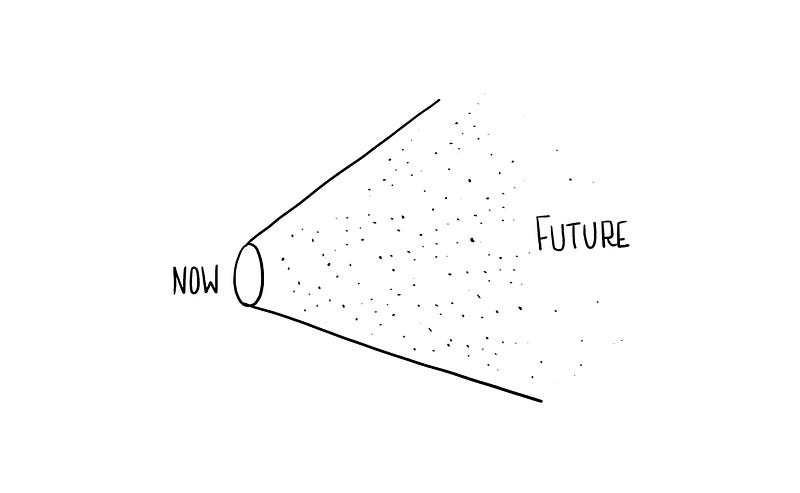
The futures funnel concept (Candy, 2014)
There
is no definite fact that robots will take over our jobs and that
presidents will push the big red button, just as there is no reason why
we can’t rapidly change the way we get the goods and services we desire
and need. I am completely confident in our capacity as a species to
figure out how to be a sustainable and regenerative contributor to the
magic that is life on Planet Earth.
— —
If this is your thing, check out my 4-week advanced training in circular systems design,
an online rapid learning journey and mentorship program for
professionals wanting to level up their skills in circular systems
design (starting in Jan 4. 2018). I offer one-on-one mentorship and
tailored content to help get you to a confident knowledge and leadership
position.
Beautiful illustrations by the talented Emma Segal
In this series on systems thinking, I share the key insights and tools needed to develop and advance a systems mindset for dealing with complex problem solving and transitioning to the Circular Economy.
I have taught thousands of hours of
workshops in systems, sustainability and design, and over the years
refined ways of rapidly engaging people with the three dimensional
mindset needed to think and work in circular systems. My motivation for
writing this online toolkit is to help expand the ability of
professionals to rapidly adopt to a systems mindset for positive impact.
Words
have power, and in systems thinking, we use some very specific words
that intentionally define a different set of actions to mainstream
thinking. Words like ‘synthesis,’ ‘emergence,’ ‘interconnectedness,’ and
‘feedback loops’ can be overwhelming for some people. Since they have
very specific meanings in relation to systems, allow me to start off
with the exploration of six* key themes.
*There are way more than six, but I picked the most important ones that you definitely need
to know, and as we progress through this systems thinking toolkit
series, I will expand on some of the other key terms that make up a
systems mindset.
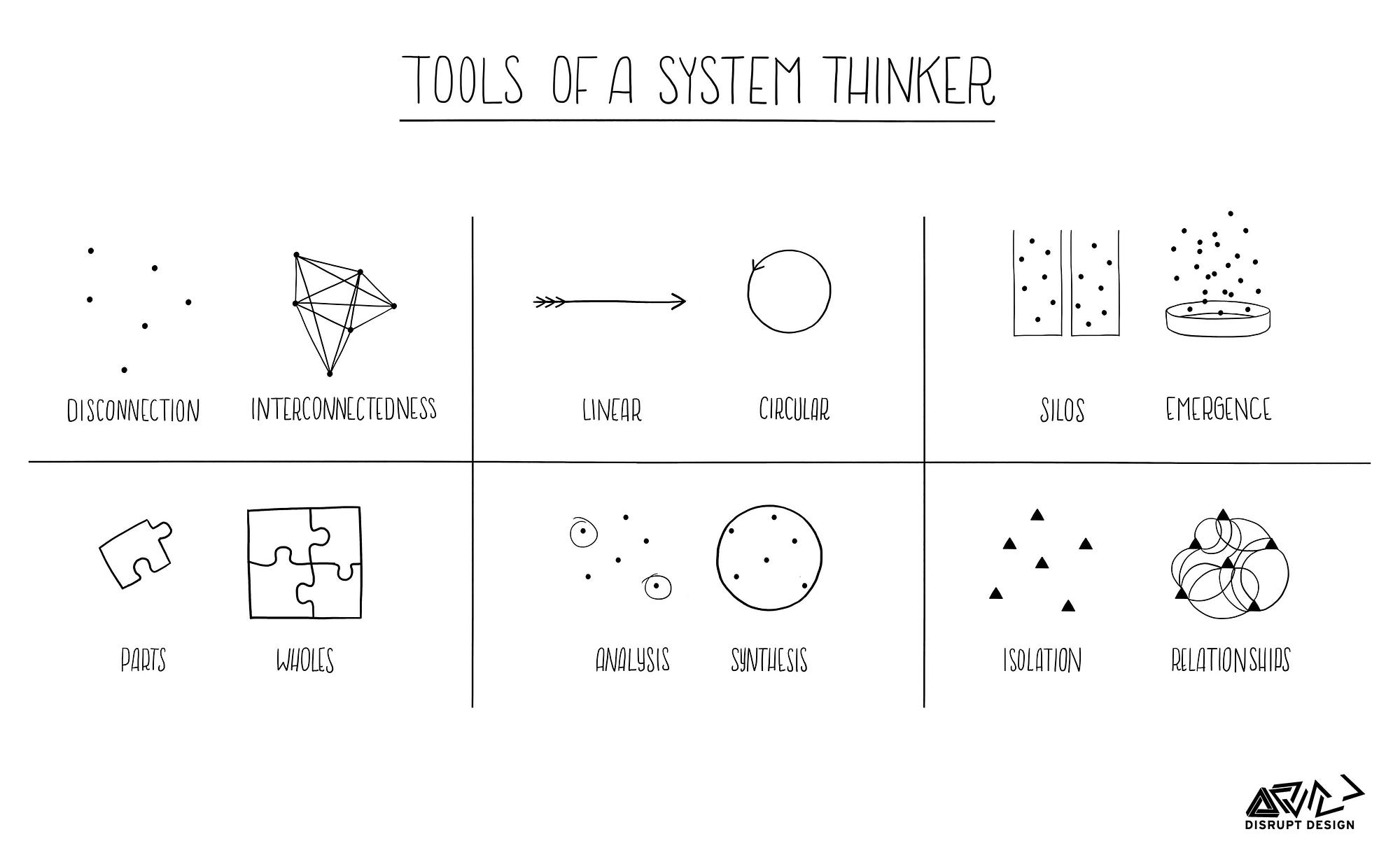
1. Interconnectedness
Systems thinking requires a shift in mindset,
away from linear to circular. The fundamental principle of this shift
is that everything is interconnected. We talk about interconnectedness
not in a spiritual way, but in a biological sciences way.
Essentially,
everything is reliant upon something else for survival. Humans need
food, air, and water to sustain our bodies, and trees need carbon
dioxide and sunlight to thrive. Everything needs something else, often a
complex array of other things, to survive.
Inanimate
objects are also reliant on other things: a chair needs a tree to grow
to provide its wood, and a cell phone needs electricity distribution to
power it. So, when we say ‘everything is interconnected’ from a systems
thinking perspective, we are defining a fundamental principle of life.
From this, we can shift the way we see the world, from a linear,
structured “mechanical worldview’ to a dynamic, chaotic, interconnected
array of relationships and feedback loops.
A systems thinker uses this mindset to untangle and work within the complexity of life on Earth.
2. Synthesis
In
general, synthesis refers to the combining of two or more things to
create something new. When it comes to systems thinking, the goal is
synthesis, as opposed to analysis, which is the dissection of complexity
into manageable components. Analysis fits into the mechanical and
reductionist worldview, where the world is broken down into parts.
But
all systems are dynamic and often complex; thus, we need a more
holistic approach to understanding phenomena. Synthesis is about
understanding the whole and the parts at the same time, along with the
relationships and the connections that make up the dynamics of the
whole.
Essentially, synthesis is the ability to see interconnectedness.
3. Emergence
From
a systems perspective, we know that larger things emerge from smaller
parts: emergence is the natural outcome of things coming together. In
the most abstract sense, emergence describes the universal concept of
how life emerges from individual biological elements in diverse and
unique ways.
Emergence
is the outcome of the synergies of the parts; it is about non-linearity
and self-organization and we often use the term ‘emergence’ to describe
the outcome of things interacting together.
A
simple example of emergence is a snowflake. It forms out of
environmental factors and biological elements. When the temperature is
right, freezing water particles form in beautiful fractal patterns
around a single molecule of matter, such as a speck of pollution, a
spore, or even dead skin cells.
Conceptually,
people often find emergence a bit tricky to get their head around, but
when you get it, your brain starts to form emergent outcomes from the
disparate and often odd things you encounter in the world.
There is nothing in a caterpillar that tells you it will be a butterfly — R. Buckminster Fuller
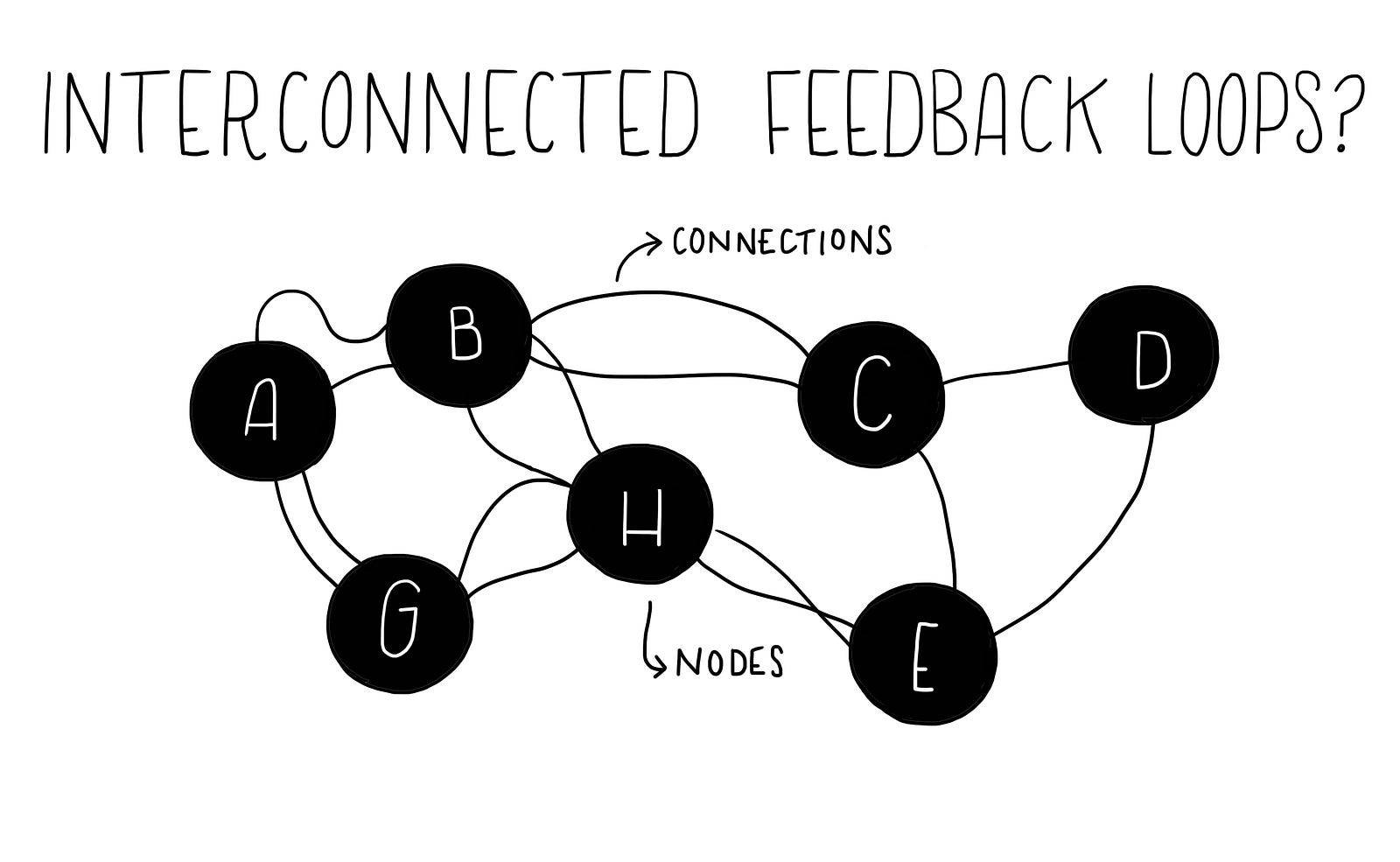
4. Feedback Loops
Since
everything is interconnected, there are constant feedback loops and
flows between elements of a system. We can observe, understand, and
intervene in feedback loops once we understand their type and dynamics.
The two main types of feedback loops are reinforcing and balancing. What can be confusing is a reinforcing feedback loop is not usually a good thing. This happens when elements in a system reinforce more of the same, such as population growth or algae growing exponentially in a pond. In reinforcing loops, an abundance of one element can continually refine itself, which often leads to it taking over.
A balancing feedback loop, however, is where elements within the system balance things
out. Nature basically got this down to a tee with the predator/prey
situation — but if you take out too much of one animal from an
ecosystem, the next thing you know, you have a population explosion of
another, which is the other type of feedback — reinforcing.
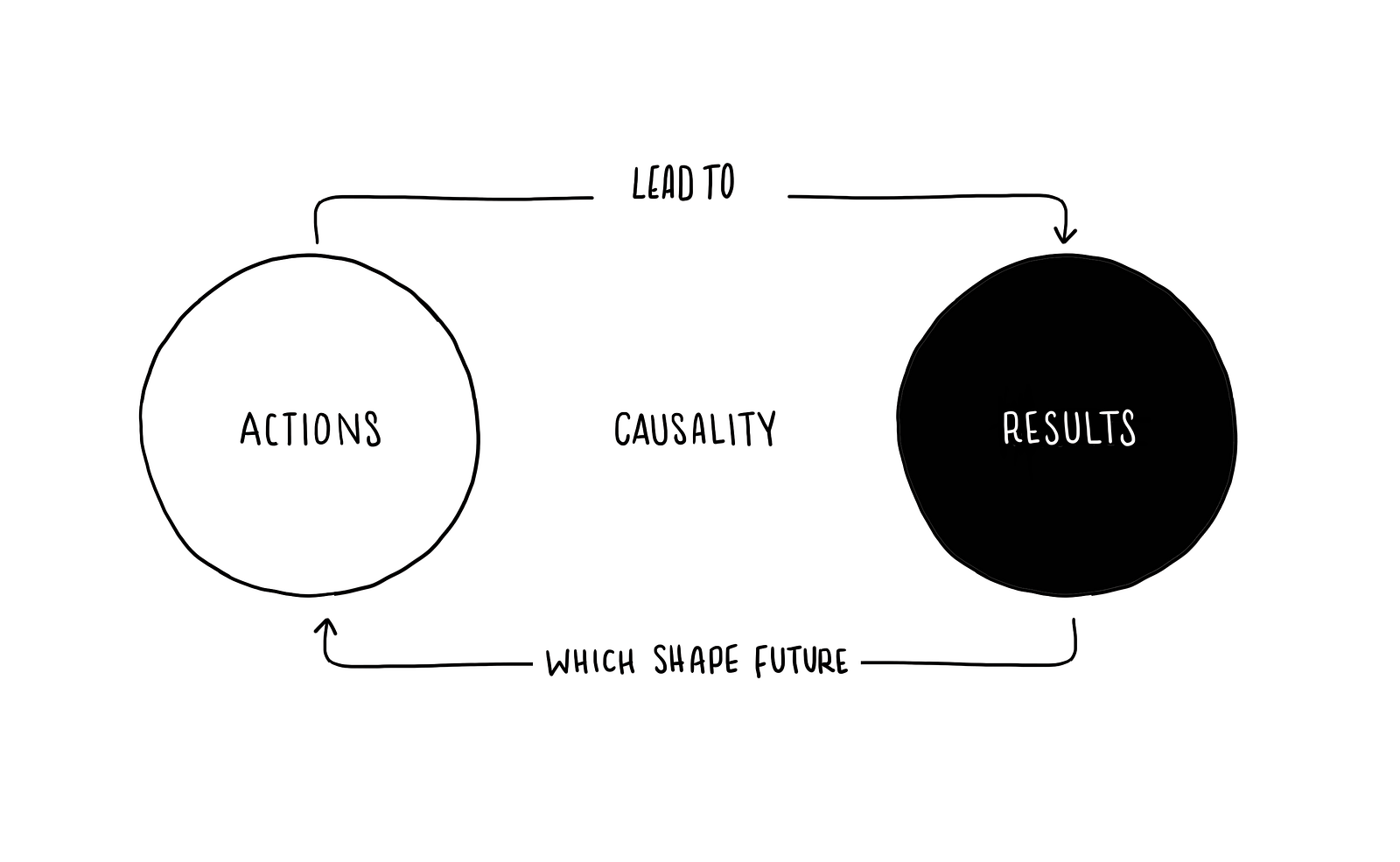
5. Causality
Understanding
feedback loops is about gaining perspective of causality: how one thing
results in another thing in a dynamic and constantly evolving system
(all systems are dynamic and constantly changing in some way; that is
the essence of life).
Cause
and effect are pretty common concepts in many professions and life in
general — parents try to teach this type of critical life lesson to
their young ones, and I’m sure you can remember a recent time you were
at the mercy of an impact from an unintentional action.
Causality
as a concept in systems thinking is really about being able to decipher
the way things influence each other in a system. Understanding
causality leads to a deeper perspective on agency, feedback loops,
connections and relationships, which are all fundamental parts of
systems mapping.
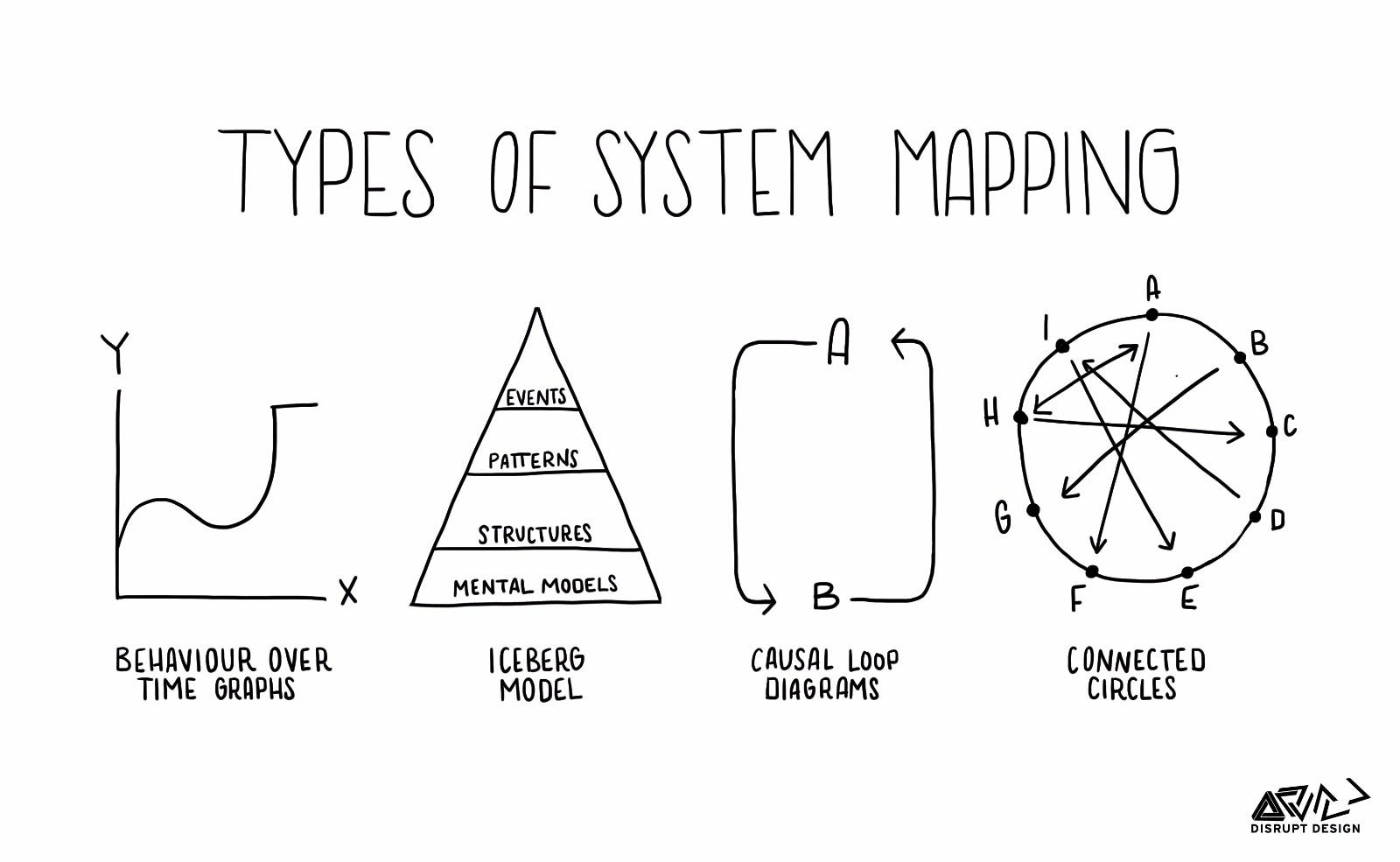
6. Systems Mapping
Systems
mapping is one of the key tools of the systems thinker. There are many
ways to map, from analog cluster mapping to complex digital feedback
analysis. However, the fundamental principles and practices of systems
mapping are universal. Identify and map the elements of ‘things’ within a
system to understand how they interconnect, relate and act in a complex
system, and from here, unique insights and discoveries can be used to
develop interventions, shifts, or policy decisions that will
dramatically change the system in the most effective way.
This
introduction to six key concepts are critical building blocks for
developing a detailed perspective of how the world works from a systems
perspective and will enhance your ability to think divergently and
creatively for a positive impact.
Working
and teaching systems thinking for years has led me to develop
additional new tools, as well as employ these time-honored concepts from
the pioneers.
What
stands out to me as critical in order to make a positive impact, is the
ability to develop your own individual agency and actions. To do that,
you first have to wrap your head around the core concepts. I have an
online class where I explain all of this here.
Here are 11 key principles of systems thinking. For a fantastic introduction, please check out this article.
Everything is interconnected: We
live on a closed ecosystem called planet Earth where everything is
connected to everything else. Otherwise, it ceases to survive and
thrive.
The easy way out often leads back in: If the solution were easy then it should have already been found.
Today’s problems are yesterday's solutions: We need to make sure we don't accidentally create tomorrow problems through today's solutions.
There is no blame in complex systems: Everything
is interconnected. Thus, it's impossible to ever find one culprit for a
problem. Systems have both the issue and the solution embedded within.
Parts are elements of a complex whole: Everything is part of something else; there are no isolated elements in a complex system.
There are no simple solutions to complex problems: We
need to embrace complexity in order to truly address complex issues.
Otherwise, we just deflect the problem to somewhere else in the system.
Small, well-placed interventions can have big impacts:
A well-designed, small intervention can result in significant and
enduring systems change if it is in the right place – this is called a
leverage point.
Humans make linear systems – nature makes circular ones: We can learn to create regenerative products and services through understanding nature's design principles.
Time changes complexity: Over
time, things naturally get more complex. Simplicity and efficiency are
very different things, yet we always think we can oversimplify
complexity or reduce it down to the sum of its parts.
‘Failure’ is discovery in disguise: If there is no blame, then there is always an opportunity to discover through failure.
Cause and effect are not related in time nor space: There
is a mismatch and often a delay in the relationship between the cause
of a problem in complex systems and the result (or symptom) appearing
obvious.
How to clearly and creatively teach students about living systems to help them make better decisions in the world.
When
not swimming in Walden Pond, Linda Booth Sweeney, a systems educator and
writer, focuses on how to clearly and creatively teach students of all
ages about living systems to help them make better decisions in the
world.
She spoke with Lisa Bennett, communications director for the Center for Ecoliteracy and coauthor of Ecoliterate: How Educators Are Cultivating Emotional, Social, and Ecological Intelligence,
about leaving a career in advertising for education, teaching her own
children about living systems, and feeling hope for the future.
LISA BENNETT: You live in Concord, Massachusetts —
home of Henry David Thoreau, Ralph Waldo Emerson, and Walden Pond. I
assume that you did not end up there by accident.
LINDA BOOTH SWEENEY: When I was a little girl, I
marched in a fife and drum corps, and we came here. I just loved the
energy. Then after graduate school in Cambridge, we had a couple of kids
and needed to spread out a bit, and I remembered Concord. We live
within running distance to the train. We have chickens. We walk
everywhere. And we swim in Walden Pond, which definitely has its own
magic. When I swim there, I'm put into a state of immediate experience.
No thinking, just experiencing. I'm working on a children's book about
Bucky [Buckminster] Fuller, and he says, "Questions... must be answered
only in terms of experience.... Hearsay, beliefs, axioms, superstitions,
guesses, opinions were and are all excluded as [my] answer resources."
That's Walden for me: it reminds me not to take anything for granted and
to stay with firsthand experience.
LB: How did you come to do the work you do?
LBS: At 28, I was working in advertising, for Ogilvy
and Mather. It was a wonderful New York experience. I learned so much
about communicating with people, which is all about making your message
accessible. I wrote a speech for the chairman, Bill Phillips, who was
also chairman of Outward Bound. As a thank you, he sent me on an Outward
Bound course. I spent three days and four nights alone in Canyonlands
National Park in Utah. All you get is a tarp and water, and maybe a
handful of Gorp. During that experience of rising with the sun, going to
bed as it went down, watching ecosystems in front of you, lizards
trying to get lunch, I really got that there was a natural rhythm in a
small plot of land and, eventually, I got that I was part of that, too.
Within a few weeks, The Fifth Discipline, by Peter Senge,
landed on my desk. Peter was teaching some of what I experienced on the
solo trip, and it hit me that this was what I wanted to be doing — only I
wanted to teach living systems across the lifespans, not just to
adults. My guess was that young people could learn it, that everyone
could learn it. That's when I went and got a doctorate in education.
LB: What is your driving motivation in teaching about living systems today?
LBS: Joseph Campbell said, "People who don't have a
concept of the whole, can do very unfortunate things…." That sums up my
driving focus. I believe we all make better decisions if we learn about
living systems.
LB: In your work, you write about teaching your own
children about living systems. Can you share a time when one of your own
children first grasped what a living system is?
LBS: When my oldest son, Jack, was six and his
brother was four, we were reading Aesop's Fables and came to the story
of Hercules. In the story, Hercules and [the monster] Strife are locked
in a mounting battle of wills. When we finished, I asked Jack if this
sounded familiar. He nodded and pointed to his four-year-old brother and
said, "When he bumps me, I push him back." Intuitively, he got that
pattern we call "escalation" — that in a closed loop system, things loop
back on themselves. It was an awesome insight: a shift from being in
the conflict, to seeing the pattern of the conflict. It's one of the
things a systems perspective lets you do, shift away from the personal
view to see the pattern.
LB: In the Center for Ecoliteracy's book Ecoliterate,
we write about the practice of understanding how nature sustains life,
which is another way of saying understanding living systems principles.
In your book Connected Wisdom, you identify 12 living system
principles or laws of nature. Let's talk about a few, beginning with
interdependence. How can educators help young people understand this
basic law of nature?
LBS: I recently did something with kids in which I
took the story of wolves in Yellowstone and made cards representing
aspen trees, beavers, wolves, birds that migrate through, moose, the
ranchers that were annoyed at the wolves for attacking their flock. Then
the kids took yarn and started to make the connections, looking at
cause and effect. In that particular story, a true story, wolves are
removed and a whole set of cause-and-effect relationships happens. Then
it really hits home — the connections you can't see. Most connections
you can't see. In real life, you have to imagine them. A lot of what I
do is about stoking imagination, so we're more able and more likely to
see beyond the obvious.
When I was in school, math was one class, science another, history
another, geography another and never the twain shall meet. But you get
out in the world and see that issues like climate change are a mix of
all those, and you need to look across those seemingly separate subjects
to make sense of it.
LB: But if you look at how many of these kinds of
issues are discussed in our culture, in the news, they are not
represented in their complexity.
LBS: No, we see the tip of the iceberg. Our media
tends to be event-focused, not on patterns of behavior over time, and
certainly not looking at what set of interrelationships might be causing
those patterns and events. It is the opposite in many ways from what we
are trying to teach young people and adults to do. But the good news is
that in K–12 education, the idea of systems thinking is beginning to
grow now. If you look at the state standards, there are some really
exciting systems-related standards showing up.
LB: Perhaps one of the least considered living
systems principles is systems integrity — by your definition, what a
system has when all the parts and processes essential to its ability to
function are present. How can an educator make this real for young
people?
LBS: I put up a picture of a cow and ask, "If you
cut a cow in half, do you get two cows?" Even four-year-olds will shout
out, "No way!" They understand the cow has parts that belong together.
They have to be arranged in a certain way to live. You can't have the
tail in front and the nose in back. It's getting to the notion that the
way the parts are arranged matters in order for the cow to function, to
live. It's an important part of system integrity. It's about having a
worldview of the systems around us, including social systems, and you
first have to understand that systems integrity before you mess with it.
LB: Let's talk about the commons — the idea that
each of us depends on and is responsible for our shared resources,
including air, water, land, and even energy.
LBS: My take on the commons is that you get into
this situation where each individual action is defensible on its own: "I
need to use plastic water bottles because there's no water fountain
nearby." But those individual actions combine to have a really
devastating impact on the larger whole. To understand this, there has to
be a leap from the individual to the larger whole. I believe we need to
put that leap onto kids and have them think about how to magnify
individual actions into collective ones and imagine what the
consequences would be. Give that challenge to tech-savvy, smart kids,
and tell me they can't find a way to magnify those individual actions so
that we all can see the larger impact.
LB: A final question: While you were in Hungary in
2012 for talks about the state of the planet, you wrote your children a
letter that said, "In many ways, these talks were filled with what Dana
[Donella] Meadows called 'unpleasant truths.' The realities of not
living within the means of our planet are quite serious. Yet, when I
think about the three of you, I feel hopeful." Why do you?
LBS: I come back to the Joseph Campbell quote —
"People who don't have a concept of the whole, can do very unfortunate
things.…" — and I flip it: People who have a concept of the whole can do
very fortunate things. If we raise young people who have a concept of
the whole, of how systems work, and who know how to make systems
visible, they will be geared toward seeing a system and will not, by
nature and training, see things in isolation. They won't stand for silos
but will reach out over silos because they know better. They will get
itchy when things aren't connected and look for the connections. So much
in our culture forces us into compartments. But just as we teach kids
not to be victims of advertising, we can teach them to see beyond the
obvious, to see the systems all around us.
Exploring the links between food systems and our changing climate from a systems thinking perspective.
Understanding Food and Climate Change: A Systems Perspective explores the links between food systems and our changing climate with an emphasis on systems thinking. A systems approach helps to illuminate how seemingly disconnected phenomena are often dynamically linked and can be understood best when viewed in a larger context. This collection of essays contains an extensive bibliography that provides resources for further investigation.
"Engaging. Smart. Comprehensive. Understanding Food and Climate Change is what our nation’s youth need to face the challenges of our changing planet."
Pam Koch, EdD, RD
Executive Director, Laurie M. Tisch Center for Food, Education & Policy, Teachers College, Columbia University
"The food and wellness movement and the movement to foster awareness and understanding of climate change are among the most powerful social movements in today’s global civil society. And yet, there is hardly any connection between the two, either conceptually or organizationally, even though a thorough understanding of the multiple links between agriculture and climate change seems critical for the survival and well-being of humanity. Understanding Food and Climate Change promotes such understanding in a lively, multicultural way. It will be an invaluable tool for food and climate educators and change advocates, and I highly recommend it."
Fritjof Capra, Ph.D.
Physicist, Systems Theorist, and Author
"I have spent the last year educating myself about the critical and complex connections between agriculture and climate change. How I wish I had started with this guide!
Whitney Cohen
Education Director, Life Lab and Lecturer, UC Santa Cruz
"Agriculture has a huge impact on the environment—greenhouse gases as well as pollution of air, water, and soil. The Center for Ecoliteracy’s Understanding Food and Climate Change is essential for finding out how this happens and what we can do about it."
Marion Nestle, PhD, MPH
Paulette Goddard Professor of Nutrition, Food Studies, and Public Health, emerita, New York University
"Understanding Food and Climate Change is a much-needed resource for educators everywhere that brings the food system “home" in a lucid and informed publication. The food sector, which includes farming, silvopasture, agroforestry, grazing, food waste, and dietary choices—is one of the two largest contributors to global warming, the other being transport. As a solution, it has the potential to be the largest sector in terms of its contribution because it can not only reduce and stop emissions, but it can also bring carbon back home through regenerative land use practices. "
Paul Hawken
Editor of Drawdown: The Most Comprehensive Plan Ever Proposed to Reverse Global Warming
“We shall require a substantially new manner of thinking if mankind is to survive.” ~Albert Einstein
If you turn on the news, the human species seems to be at a crisis
point. Poverty, racism, political division, ecological destruction,
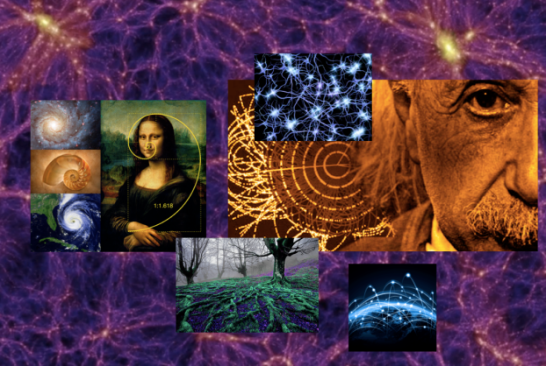
social instability and other seemingly “unsolvable” problems appear to
be getting worse. And yet, when walking in a forest or looking up at the
night sky there is a sense that we live in a Universe of great balance,
mystery and beauty.
The wise among our species have repeatedly offered very simple
solutions to humanity’s difficulties. Walt Whitman and Van Gogh were
overwhelmed by the beauty that surrounds us, and sought to share that in
their poetry and paintings. The Dalai Lama has often said that we just
need to prioritise peace, gratitude, love and wisdom. That the human
family’s problems are caused by closed hearts and minds, and will be
solved as more and more of us open them. Could it be that simple?
“If there is love, there is hope to have real families,
real brotherhood, real equanimity, real peace. If the love within your
mind is lost, if you continue to see other beings as enemies, then no
matter how much knowledge or education you have, no matter how much
material progress is made, only suffering and confusion will ensue.”
~Dalai Lama
The Dalai Lama’s advice aligns with what Jesus taught, what Charlie
Chaplin spoke of in the 1930s (see video below) as Hitler’s popularity
was rising in Germany. At that time, both Chaplin and Einstein stressed
our need for more compassion, imagination and kindness, less of an
emphasis on technology, materialism and knowledge.
They believed that humanity’s problems stem from a lack of love
rooted in a crisis of thinking, the dominant world view of warrior
civilizations that promote fear, aggression and attention to problems
instead of gratitude, love and attention to creative solutions.
The sad truth is that modern people see the world in simplistic ways,
much as our ancestors did 2000 years ago. Our secular institutions
(media, government, education) train us to categorise and
compartmentalise reality, to focus on differences, rather than
relationships and connections.
We seem to see life as a struggle, identifying ourselves (and others)
by race, religion, nationality, political affiliation, gender, sexual
preference (gay/straight), education level and/or career status. We
separate the world in our minds, setting ourselves into constant battle
with each other.
The recent election in the United States shows how such thinking can
feed polarisation, anger and conflict. These distinctions and
comparisons keep us boxed in “us vs. them” narratives of nationalism,
racism, elitism and identity politics. This feeds a perpetual warrior mentality, political conflict, militarism, a sense of competition, fear and division.
To become wiser as a species, Einstein believed that we need to
develop a broader and deeper sense of identity, one that focuses on our
relationship with the Universe (and one another) rather than cultural
differences. He encouraged us to transcend our human identifications (of
race, politics, gender, nationality, religion), focusing on our
connection to the Cosmos and the planet. Understanding ourselves to be
Earth residents, children of Nature (or God) and the Universe, points us
in the right direction. He said:
“A human being is a part of the whole called by us
universe, a part limited in time and space. He experiences himself, his
thoughts and feeling as something separated from the rest, a kind of
optical delusion of his consciousness. This delusion is a kind of prison
for us, restricting us to our personal desires and to affection for a
few persons nearest to us. Our task must be to free ourselves from this
prison by widening our circle of compassion to embrace all living
creatures and the whole of nature in its beauty.”
What is missing in mainstream consciousness is an awareness of
ourselves as members of the human family, the Universe and the Earth
community. We tend to ignore that our cells and bodies are part of the
creative history of evolution. That our atoms are part of the history of
the Cosmos.
Peace and gratitude arise naturally in our hearts when we take time
to celebrate and reflect upon how we are each a part of a much greater
whole. Such awareness dawned on a wide scale for humanity during the
1960’s, and we need it to rise again. As Alan Watts expressed:
“If you see yourself in the correct way, you are all as
much extraordinary phenomena of nature as trees, clouds, the patterns in
running water, the flickering of fire, the arrangement of the stars,
and the form of a galaxy. You are all just like that.”
What Einstein, Watts, Gandhi, Martin Luther King Jr., the Dalai Lama
and many others believed is that our species has the potential to grow
wiser, more creative and loving as a species. We just need to be mindful
of our connection to the rest of humanity, to Nature and the Cosmos. We
need to be more rooted in a spiritual view, rather than a materialistic
one.
Most modern people are so preoccupied with economic status, social
ranks and cultural identities that we ignore the Universe that brought
us into being, the systems of Nature that we belong to, and that sustain
our lives. Because of this we get caught up in petty human dramas,
militarism, nationalism, economics and global games of politics.
Our species needs to understand how we are a living part of Nature,
to stop us from falling into the deluded thinking patterns and emotional
dramas we create. We need to see how our compartmentalised world
views create conflict (both inner and outer), limiting our ability to
cooperate with those who think differently than we do, suppressing our
potential for deeper peace, balance, wisdom, compassion and joy.
Spiritual traditions (together with a more unified vision of science)
can help remind us that we belong to the greater community of life.
That we live in a creative Universe, and belong to the natural world.
“Who would deny that when I am sipping tea in my tearoom I
am swallowing the whole universe with it and that this very moment of
my lifting the bowl to my lips is eternity itself transcending time and
space?” ― D.T. Suzuki
Lao Tsu’s Tao Te Ching and the Dharma of the Buddha
point in this direction. It’s there in the mystic traditions of
Judaism, Christianity, Zen and Islam as well. Abraham Isaac Kook
describes this view (below) from the perspective of the Kabbalah and
Jewish mysticism:
“An epiphany enables you to sense creation not as
something completed, but as constantly becoming, evolving, ascending.
This transports you from a place where there is nothing new to a place
where there is nothing old, where everything renews itself, where heaven
and earth rejoice as at the moment of creation.”
Many Indigenous cultures identify daily with the Source of Life, with
Nature and the Earth community. This identification is
important, understanding the greater whole (and feeling gratitude in
their hearts) guides the community with problem-solving and decision
making.
Indigenous cultures have practices to help them stay conscious of their
Earth identity and responsibility to the planet, as well as human
generations into the future. Because of this native cultures have
lived more in balance and harmony with the Earth.
“Growth comes with an increasing awareness of and respect
for Great Mystery in all people and things, with an awareness that this
force of mystery is at work in all events. Growth comes through
tolerance for the infinite variety of ways in which Great Spirit, the
Infinite,may express itself in this Universe.” ~Ed McGaa, Oglala Lakota
Can civilization’s people grow wiser and more aware of our connection
to the Earth, more compassionate to other creatures and fellow human
beings? We must, because the Earth really is at a crisis point. The
struggle now of Native Americans trying to stop an oil pipeline at
Standing Rock, is indicative of the challenge we face, as a species. We
need to come together and challenge those still caught up in mindsets of
fear, materialism and greed. But will be more successful if our efforts
are grounded in a different way of thinking, guided by wisdom,
gratitude and love.
If we don’t learn to live in harmony with Nature (and be generous
with each other) all future generations will suffer. The future will be
dystopian, violent, poverty stricken and sorrowful, as it already is in
ghetto communities around the planet, in places like Syria, Yemen, Gaza
and Iraq.
We need to understand how cultural narratives and scientific
paradigms influence our world views. How beliefs shape our thinking, how
thoughts influence feelings, how emotions regulate our actions, the
way we view problems and experience our lives.
As we grow wiser, and learn to love more deeply, the human
community will be in a better position to solve our problems. Because
we’ll have identified and corrected (in our hearts and minds) the source
of our difficulties, our disconnection with wisdom and love (within
us), Nature, Life and the Universe (all around us).
Understanding how rare and beautiful our planet is (and how precious
our lives are) can open our hearts, fill us with gratitude, guide our
creativity, lead us to new ways of thinking, and more humane ways of
being.
By Christopher Chase, December 2016
“Recognize that the very molecules that make up your
body, the atoms that construct the molecules, are traceable to the
crucibles that were once the centers of high mass stars that exploded
their chemically rich guts into the galaxy, enriching pristine gas
clouds with the chemistry of life. So that we are all connected to each
other biologically, to the earth chemically and to the rest of the
universe atomically. That’s kinda cool! That makes me smile and I
actually feel quite large at the end of that. It’s not that we are
better than the universe, we are part of the universe. We are in the
universe and the universe is in us.” ― Neil deGrasse Tyson
“Over the course of the last hundred years, Western scientists have
given us a deeper view of the Universe, of Life & Nature as a
creative and unified self-organizing process. Unfortunately, most modern
societies are still operating with outdated ideas and assumptions, that
do not reflect this new paradigm. Albert Einstein understood this, as
have many others. In order to survive as a species, it is essential that
we shift paradigms, developing ways of thinking (and behaving) that are
more aligned with how human life and Nature’s systems actually work.” ~Paradigms are Made for Shifting
“What is needed to launch our societies along the humanistic path is
some sort of evolutionary compass. Some way of guiding our efforts so
that they are in tune with, aligned with, the general evolutionary
processes of which we are a part… So
rather than seek to dominate the planet, the quest becomes one of
dynamic harmonization, of evolutionary consonance, in short, of syntony.
The evolutionary compass, then, would be one that points our way toward
syntonious pathways for future creation.” ~Alexander Laszlo
“The greatest revolution of our time is in the way we see the world.
The mechanistic paradigm underlying the Industrial Growth Society gives
way to the realization that we belong to a living, self-organizing
cosmos.” ~Joanna Macy
“You are not IN the universe, you ARE the universe, an intrinsic part
of it. Ultimately you are not a person, but a focal point where the
universe is becoming conscious of itself. What an amazing miracle.” ~Eckhart Tolle




 When
not swimming in Walden Pond, Linda Booth Sweeney, a systems educator and
writer, focuses on how to clearly and creatively teach students of all
ages about living systems to help them make better decisions in the
world.