Showing posts with label Electronics. Show all posts

Wednesday, November 19, 2008

8 Ways to Green Your Battery Use

This story is part of Earth911’s “Green Eight” series, where we showcase eight ways to green your life in various areas.

You may not realize how often you use batteries until you have to operate for a few hours without electricity. Batteries are great at keeping a charge in our mobile devices, but the components that help generate these charges wreak havoc in landfills.

You can use Earth911 to find out where to recycle batteries. Here’s eight ways to optimize your battery use so you’ll create less waste in the first place:

1. Replace One at a Time

So your device stopped working, and it takes four AA batteries. Looks like you’ve got to buy four new batteries and dispose of four as well. Actually, only one of the batteries may be dead. If you invest in a battery-tester, you can find out which batteries have no charge left and only replace those. Some batteries even come with a tester on the cell itself.

2. Embrace Heavy Metal

In most circumstances, searching for a product with less hazardous materials is more eco-friendly. In the case of batteries, hazardous ingredients increase your chances of finding recycling options. Consider:

  • Car batteries contain lead and sulfuric acid and have a recycling rate around 90 percent.
  • Single-use dry cell batteries have been gutted of mercury in recent years, and it’s now much more difficult to find locations that recycle them than rechargeables (which contain cadmium).

If your batteries have elements like lead, mercury or lithium, there will be more value to a recycler that can reprocess these metals. Just make sure they are kept out of the reach of children and pets in the meantime.

3. Laptops Aren’t for Laps

You already know that batteries and heat do not get along together. Well, your computer generates a fair amount of heat internally, which is why your notebook computer comes with a fan. Using your laptop on a soft surface (such as your lap) restricts air flow and actually heats up your battery. You can also invest in a cooling pad if you want to use a notebook on soft surfaces.

4. Keep Your Batteries Cool

You may have heard that putting batteries in the fridge or freezer will make them last longer. While this may be the case, you’ll have to let the batteries thaw before using them to avoid condensation in your devices. Regardless, you should avoid storing batteries in hot places, because they could leak fluid.

5. Wait for Good Reception

“Can you hear me now?” That’s good for more than just your phone manners. When your cell phone has low reception, it uses more battery power to search for stronger signals. Waiting for better reception will allow your cell phone battery to last longer.

6. Insulate Your Car Battery

Think about it: your car experiences more temperature fluctuations than anything else in your life. It deals with hot and cold driving weather, gets heated up and cooled down on every trip and ends up stored in a poorly-insulated garage for the night (if it’s lucky).

You can find insulation blankets to allow car batteries to adjust better to all kinds of temperatures. The next time you’re under the hood, check to see if your battery is insulated or have a qualified professional check for you.

7. Crank Up Your Batteries

The days of hand cranks to generate power went out with draft cards and freedom marches. Or did they? You can actually find hand-cranks to charge up all sorts of devices, such as cell phones and mp3 players. You’ll also get a little exercise. Another option is charging your gadgets with solar power. These are both forms of renewable energy so you won’t have to use non-renewable electricity to power your batteries.

8. Opt for Plugging In

Many devices will come equipped with battery compartments and an A/C power adapter, including some alarm clocks and lamps. You may be saving energy by working off batteries, but you’re also producing waste when the batteries die. Don’t forget you have to spend energy to recharge batteries as well. If you have the option, plugging in will use less resources.

Friday, November 14, 2008

Following The Trail Of Toxic E-Waste

60 Minutes Follows America's Toxic Electronic Waste As It Is Illegally Shipped To Become China's Dirty Secret

http://www.cbsnews.com/stories/2008/11/06/60minutes/main4579229.shtml


Do you know where your e-waste is going?

Hi, don't know how many of you saw 60 Minutes last Sunday on the horrors of exporting e-waste and the harm it does to people and the environment, but my parent company, Premier Farnell, has started an awareness initiative to address this massive horror that impacts everyone.

The bottom line is that it is cheaper to export to countries such as India, and China than to properly recycle the waste in the US.

Among the dangers of what is called "backyard ecycling " is that, in order to extract valuable metals in countries such as India, China and Africa, children and adults heat electronic waste over open fires and the strip of cables and PCBs in acid baths is commonplace. This can release arsenic, chromium, lead, mercury and other toxins directly into the atmosphere, with significant impact on both the health of those recycling the waste and the local environment. Research has shown that regular handling of electronic waste and inhalation of toxic fumes can result in damage to the brain, the nervous system, the lungs and kidneys and is also linked to certain types of cancer.

Janice Fleisher

Janice Fleisher

PR/Communications at Newark

Free Energy from Tesla’s Wireless Electricity

http://newilluminati.blog-city.com/free_energy_from_teslas_wireless_electricity.htm


An instant solution to the planetary energy ‘crisis’

By Thomas Valone, PhD, PE
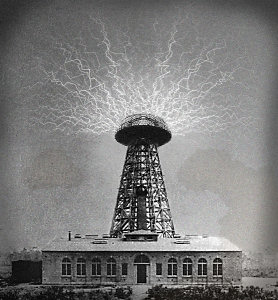
“The first World System power plant can be in operation in nine months.”

– Nikola Tesla, 1904

The Wireless electricity transmission system pioneered by Dr Nikola Tesla has the potential to meet our future global energy needs, if only the funding and organizational structures can be put in place as a matter of urgency.

Nikola Tesla, the father of AC electricity, is responsible for recognising that an atmospheric and a terrestrial storage battery already exists everywhere on Earth, for the benefit of mankind. A century later, only a few visionary scientists recognise the untapped renewable reservoir of terawatts of electrical power (3,000 gigawatts) that sits dormant above us, waiting to be utilised.

The fateful decision in 1905 by J.P. Morgan to abandon Tesla’s Wardenclyffe Tower project on Long Island (after investing US$150,000 – in 1905 dollars) was the result of learning that it would be designed mainly for wireless transmission of electrical power rather than for telegraphy. No more money was forthcoming for the project that Morgan initiated, even when the equipment alone cost about US$200,000. Morgan believed that he would “have nothing to sell except antennas [and refused] to contribute to that charity.”

Tesla tried and tried for years until, in 1917, the US government blew up the abandoned Wardenclyffe Tower because suspected German spies were seen ‘lurking’ around it. With Edison as his willing ally, Morgan even publicly discredited Tesla’s name, so that all of the five school textbook publishers of the time removed any reference to him. Is it any wonder why, even today – more than 100 years later – hardly anyone knows who Tesla is?

The rest of this article will present a physics and electrical engineering argument for a subsequently forgotten engineering alternative for energy generation and transmission.

As Tesla experimented with a 1.5 megawatt system in 1899 at Colorado Springs, he was amazed to find that pulses of electricity he sent out passed across the entire globe and returned with “undiminished strength”. He said; “It was a result so unbelievable that the revelation at first almost stunned me.” [Compared with this ‘undiminished strength”, more than two-thirds of current-day electrical power disappears and is totally wasted, due to transmission losses and other factors between current-day power stations and the electricity consumer – Ed]

This verified the tremendous efficiency of his peculiar method of pumping current into a spherical ball to charge it up, before discharging it as a pulse of electrical energy: a ‘longitudinal’ acoustic type of compression wave, rather than an electromagnetic Hertzian type of transverse wave. It was therefore more akin to electrostatic discharge than wave mechanics.

Tesla also planned to include a stationary resonant wave creation globally, within the Earth-ionosphere cavity, as part of the wireless transmission of power. Examining the pair of 1900 patents, #645,576 and #649,621 (each using the same figure on the first page), we find in the first patent that Tesla designed a quarter-wave antenna (fifty miles of secondary wire for a 200-mile long wavelength). More important is the sphere on the top which is supposed to be a conductive surface on a balloon, raised high enough to be radiating in “rarified air”.

As Tesla stated: “That communication without wires to any point on the globe is practical with such apparatus would need no demonstration, but through a discovery which I made I obtained absolute certitude. Popularly explained, it is exactly this: When we raise the voce and hear an echo in reply, we know that the sound of the voice must have reached a distant wall, or boundary, and must have been reflected from the same. Exactly as the sound, so an electrical wave is reflected, and the same evidence which is afforded by an echo is offered by an electrical phenomenon known as a ‘stationary’ wave – that is, a wave with fixed nodal and ventral regions. Instead of sending sound vibrations toward a distant wall, I have sent electrical vibrations toward the remote boundaries of the Earth, and instead of the wall the Earth has replied. In place of an echo I have obtained a stationary electrical wave, a wave reflected from afar.” [Reflected from the antipodean point on the far side of the globe – Ed]

Nikola Tesla’s discovery of pulsed propagation of energy does not resemble the standard transverse electromagnetic waves so familiar to electrical engineers everywhere. Many engineers and physicists have dismissed Tesla’s wireless energy transmission as unscientific, without examining the unusual characteristics and benefits of longitudinal waves – which are the z-component solutions of Maxwell’s equations.

Tesla wrote: “That electrical energy can be economically transmitted without wires to any terrestrial distance, I have unmistakably established in numerous observations, experiments and measurements, qualitative and quantitative. These have demonstrated that it is practicable to distribute power from a central plant in unlimited amounts, with a loss not exceeding a small fraction of one percent in the transmission, even to the greatest distance, 12,000 miles – to the opposite end of the globe.”

Tesla was an electrical genius who revolutionized our world with AC power in a way that DC power could never have accomplished, since the resistance of any transmission lines (except, perhaps for superconductive ones) is prohibitive for direct current. He deserved much better treatment from the tycoons of his age, than to spend the last forty years of his life in abject poverty. However, he was too much of a gentleman to hold a grudge. Instead, regarding the magnifying transmitter, Tesla wrote in his autobiography: “I am unwilling to accord to some small-minded and jealous individuals the satisfaction of having thwarted my efforts. These men are to me nothing more than microbes of a nasty disease. My project was retarded by laws of nature. The world was not prepared for it. It was too far ahead of time. But the same laws will prevail in the end and make it a triumphal success.”

Tesla’s World System

Tesla’s ‘world system’ was conceptually based on three of his inventions:

1. The Tesla Transformer (Tesla coil);

2. The Magnifying Transmitter (transformer adapted to excite the Earth);

3. The Wireless System (efficient transmission of electrical energy without wires).

Tesla stated: “The first World System power plant can be in operation in nine months. With this power plant it will be practicable to attain electrical activities of up to ten million horsepower (7.5 billion watts), and it is designed to serve for as many technical achievements as are possible without due expense.”

Tesla’s calculated power levels have been conservatively estimated and recently updated with contemporary physics calculations by Dr Elizabeth Rauscher. For example, Professor Rauscher shows that the Earth’s ionosphere and magnetosphere contain sufficient potential energy, at least three billion kilowatts (three terawatts) respectively, so that the resonant excitation of the Earth-ionoshere cavity can reasonably be expected to increase the amplitude of natural ‘Schumann’ frequencies, facilitating the capture of useful electrical power.

Tesla knew that the earth could be treated as one big spherical conductor and the ionosphere as another, bigger, spherical conductor, so that together they have parallel plates and thus comprise a “spherical capacitor”. Rauscher calculates the capacitance to be about 15,000 microfarads for the complete Earth-ionosphere cavity capacitor. In 1952, W. O. Schumann predicted the ‘self-oscillations’ of the conducting sphere of the Earth, surrounded by an air layer and ionosphere, without knowing that Tesla had found the Earth’s fundamental frequency fifty years earlier. [Close to 7.83 beats per second; light and other energies traveling at local lightspeed wrap around the globe’s circumference roughly 7.83 times each second, at the level of the ionosphere – Ed]

“All that is necessary,” says Dr James Corum, “is that Tesla’s transmitter power and carrier frequency be capable of round-the-world propagation.” In fact, Tesla (in the Los Angeles Times, December 1904) stated: “With my transmitter I actually sent electrical vibrations around the world and received them again, and I then went on to develop my machinery.” Dr Corum notes in an article on Tesla’s ELF (extremely low frequency) oscillator that the tuned circuit of Tesla’s magnifying transmitter was the whole Earth-Ionosphere cavity.

Corum explains that a mechanical analog of the lumped-circuit Tesla coil is an easier model for engineers to understand. From a mechanical engineering viewpoint, the ‘magnifying factor’ can be successfully applied to such a circuit. “The circuit is limited by only the circuit resistance. At resonance, the current through the circuit rises until the voltage across the resistance is equal to the source voltage. This circuit was a source of deep frustration to Edison because voltmeter readings taken around the loop did not obey Kirchoff’s laws!” As a result, Edison claimed such a circuit was only good for electrocution chairs.

Earth’s Renewable Energy
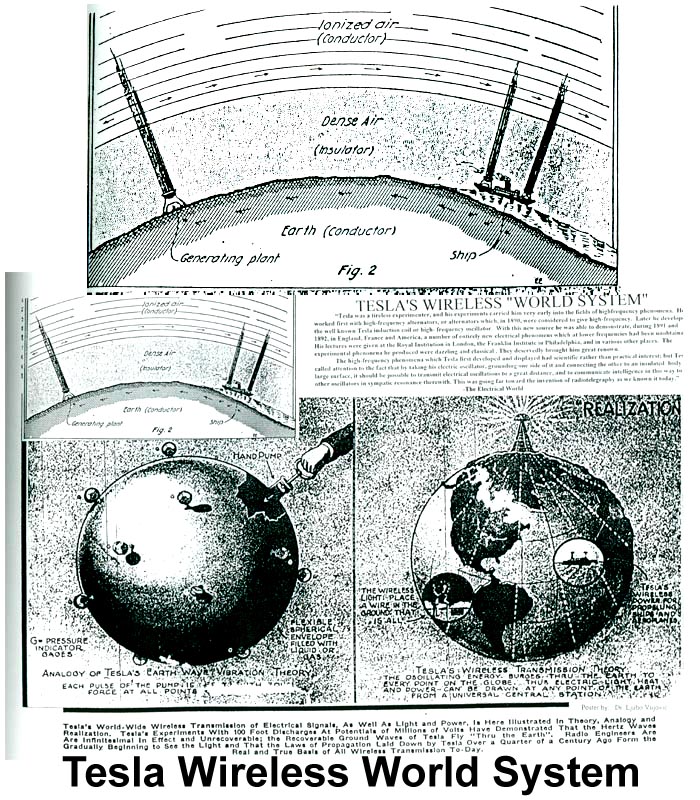
Tesla’s World System activates the Earth’s renewable electrical storage battery, which normally sits dormant except during lightning strikes. Regarding simply the electrostatic storage capacity of the ionosphere, Dr Oleg Jefimenko, author of Electrostatic Motors, explains that during one electrical storm, the atmospheric electric field dissipates at least 0.2 terawatts (billion kilowatts), indicating that the entire Earth must have even more total available energy.

Furthermore, the power loss experienced by Tesla’s pulsed electrostatic discharge mode of propagation was less than five percent over 25,000 miles. Dr Van Voorhies states that “path losses are 0.25 dB/Mm at 10 Hz” – which is so minimal it is difficult to believe for engineers who are used to transverse waves, a resistive medium and line-of-sight propagation modes that can dissipate 10 dB/km at 5 MHz.

The capacitive dome of the Wardenclyffe Tower, like the conductive balloon of Tesla’s patent #645,576, is a key to understanding the longitudinal waves. Dr Rauscher quotes Tesla: “Later he compared it to a Van de Graaff generator. He also explained the purpose of Wardenclyffe: ‘…one does not need to be an expert to understand that a device of this kind is not a producer of electricity like a dynamo, but merely a receiver or collector with amplifying qualities.”

Only a few great physicists, like Dr Elizabeth Rauscher, Dr James Corum and Dr Konstantin Meyl, have realised that Tesla was very practical when he proposed the resonant generation and wireless transmission of useful electrical power. Tesla’s knowledge of atmospheric electricity transduction was so extensive and reliable that, said Jim Corum (who has been funded to continue Tesla’s work): “You just have to do exactly what Tesla did and you will consistently get the same results he did.”

After returning from his experiments in Colorado Springs in 1900, Nikola Tesla stated: “If we use fuel to get our power, we are living on our capital and exhausting it rapidly. This method is barbarous and wantonly wasteful and will have to be stopped in the interests of coming generations.”

In view of our present fossil fuel-caused [or increased] global warming, Tesla seems very prophetic from his vantage point of a century ago.

High Transmission Integrity and Low Loss

Tesla stated: “As to the transmission of power through space, that is a project which I considered absolutely certain of success long since. Years ago I was in the position to transmit wireless power to any distance without limit other than that imposed by the physical dimensions of the globe. In my system it makes no difference what the distance is. The efficiency of the system can be as high as 96 or 97 per cent, and there are practically no losses except such as are inevitable in the running of the machinery.

“When there is no receiver, there is no energy consumption anywhere. When the receiver is put on, it draws power. That is the exact opposite of the Hertz-wave system. In that case, if you have a plant of 1,000 horsepower (750kw), it is radiating all the time whether the energy is received or not; but in my system no power is lost. When there are no receivers, that plant consumes only a few horsepower necessary to maintain the vibration; it runs idle, as the Edison plant when the lamps and motors are shut off.”

These amazing facts are explained by Corum, Spainol and Corum: “…the distinction between Tesla’s system and ‘Hertzian’ waves is to be clearly understood. Tesla, and others to this day, used the term ‘Hertzian waves’ to describe what we call today energy transfer by wireless transverse electromagnetic (TEM) radiation… no-one wants to stand in front of a high-power radar antenna. For these, E and H are in phase, the power flow is a ‘real’ quantity (as opposed to reactive power), and the surface integral of E x H (Poynting vector) is nonzero. The case is not so simple in an unloaded power system, an RF transformer with a tuned secondary; or with a cavity resonator.

“In these situations the fields are in phase quadrature, the circulating power is reactive and the average Poynting flux is zero – unless a load is applied. They deliver no power without a resistive load. These are clearly the power systems which Tesla created. The polyphase power distribution system was created by him in the 1880s and inaugurated at Niagara Falls in 1995. The RF transformer was invented and patented by him in the 1890s. He discovered terrestrial resonances experimentally at the turn of the century, and for the next forty years he tried to bring this global power system through to commercial reality. Today, millions of us have working scale models of it in our kitchens, while the larger version sits idle.” (from “Concerning Cavity Q”, Proceedings of the 1988 International Tesla Symposium, pp. 3-15)

Note that for a spherical electrostatic pulse discharge, E is radial and H is helical since J is radial (longitudinal or irrotational current). This is total anathema to transverse wave physics textbook images of E and H, which are normally perpendicular to each other.

Biological and Economic Impacts

Another common criticism of the Tesla wireless power system is regarding its possible biological effects. Calculating the circulating reactive power, the Corums and Spainol find a density of a microvar per cubic metre at 7.8 Hertz, which is quite small, while it is well known that such a frequency is very biologically compatible. The authors also look at the present 100 V/m Earth-ionosphere field and again find that raising it by a factor of 4 to 10 will pose no ill effects (thunderstorms do it all the time around the world).

In terms of economic theory, many countries will benefit from this service. Only private, dispersed receiving stations will be needed. Just like television and radio, a single resonant energy receiver is required, which may eventually be built into appliances so that no power cord will be necessary! Just think; monthly electric utility bills from old fashioned, fossil-fuelled, high-loss electrified wire-grid delivery services will be optional, much as cable TV is today. In the 21st century, “Direct TV” is the rage, which is an exact parallel of Tesla’s “Direct Electricity”.

Let us fulfill this prophecy of Tesla, making it a “triumphant success” by supporting a philanthropic, international wireless power station installed on a remote island to electrify the whole world. The benefits of immediately making direct electricity available everywhere are too numerous to count.

Thomas Valone

Become educated about Tesla’s wireless energy transmission discovery and the Wardenclyffe Tower’s potential for transforming the world’s generation and delivery of electricity at http://www.integrityresearchinstitute.org .

. Read Harnessing the Wheelwork of Nature: Tesla’s science of Energy by this author for more details about this discovery, and other fascinating aspects of Tesla’s inventions.

About the Author: Thomas Valone received his Master’s in Physics from the State University of New York at Buffalo (1984) and his PhD in General Engineering from Kennedy-Western University in 2003. Click here for his CV.

Editor’s note: For a long, long time, the people of the world have been living in a fundamentally feudal world. Humans have been bludgeoned into accepting the blind dictates of remote (and usually unseen) authority figures for so long that it almost seems like the normal ‘human condition’. Humanity has been trained to prop up a pyramid-shaped society in which nothing comes for free, and all your time and energy is heavily taxed by and for robber barons and corporate gangsters.

Humans have long been told to accommodate themselves to their lot – to work, consume, reproduce and die in an endless rat-wheel of pointless activity – as alternative possibilities of all kinds have been choked off, bought out, ridiculed, hidden and extirpated from view.

For far more than a century, oppressive plutocrats have kept us all in a totally unnecessary state of powerless darkness, promulgating profitable wars, pogroms and technologies to spread hate, terror and generalised fear among us all. While we’ve been blinded by tinsel and addicted to the circus entertainments of idiot boxes, they’ve gotten on with the profitable pastimes of finance, war, famine and pestilence - while their programs brainwash us all into thanking them for the advances in easy credit, technological trinkets, genetically ‘improved’ foods and toxic ‘wonder drugs’.

It’s important to realize that the motivations of those at the pyramid’s capstone are not the same as those of the average wage slave or mid-level management. The inbred families of faceless dictators don’t make plans on a mortal scale and their names don’t appear on the ‘richest men’ lists; most of their dynasties predate such confections. Their motives are rooted in a dominating will for untrammeled power - and an insecure greed that can never be satisfied. As far as they’re concerned, if you’re not part of their family you’re not part of the same species. They view everyone outside their genetically intertwined circles as vermin living in a maze of crass filthy warrens, fit only for enslavement – and ultimate extinction. Their numbers are few, yet everyone who’s part of their system is responsible for the destruction of the ecosystem, and is robbing their own children of their birthright – and almost everyone is part of their system.

A century ago anyone who publicly denigrated rulers, kings and plutocrats called a heap of trouble down on themselves. Times appear to have changed – so lets change them a little more, and create a system that the greedy and pernicious can’t profit from; a system that frees and supports every man, woman and child on the planet. We still have time to create paradise for all on Earth if we seize the day; if we all stop buying their crap, borrowing and using their credit and money and playing their destructive games – if we play and work our way into a truly new millennium of liberty, fraternity, equality and prosperity for all!

Free energy is the crux upon which all possibilities can turn. There are many methods to derive more energy from a system that is required to maintain it; see or instance Free Energy at RamPage. But this is only one part of a complex series of maneuvers we’re going to have to undertake - which we’re going to find are necessary if our species is to truly thrive, or even survive. Changing the world for the better will take whatever you have to give.

If you’ve read this far, you’re the one to do it. You are the change agent, and all real change begins within; time and energy are what you are, and the tools you use to contribute. Look around – great movements are happening right now, at this particular nexus in history. Join in and help turn the wave of change into an unstoppable tide.

If not you – who?

If not now – when?

– R.A.

This is a slightly edited excerpt from an article first published in NEXUS New Times Magazine, Vol. 12. No 3, 2005 – see original for more, along with source footnotes

PS – ALL technological fixes bring new problems that need solving.- but Tesla’s technology is a solvable solution and a pathway to hope and success for us all.


images - http://www.damninteresting.net/content/wardenclyffe_tower.jpg

http://www.reformation.org/tesla-coils.jpg
http://www.teslasociety.com/pictures/wireless.jpg

Wednesday, October 17, 2007

How to Green Your Lighting

What’s the Big Deal?

How we light up the places we live and work makes a big impact on how we feel. It also makes a big impact on the environment. The kind of bulbs, the kind of fixtures, the kind of power, and the habits we keep can all add up to a very significant greening. Start with the fact that a conventional incandescent bulb turns only around five to ten percent of its consumed energy into light, the rest goes out as heat. From there, there’s no limit to how green your lighting can be.

1. CFL: The better bulb

Compact florescent bulbs (CFLs) are those swirley little guys that look like soft-serve ice cream cones. Actually, they come in a myriad of different shapes, sizes, and colors of light. Economically speaking, they’re a great deal, too. CFLs cost a bit more than an incandescent, but use about a quarter as much energy and last many times longer (usually around 10,000 hours). It is estimated that a CFL pays for its higher price after about 500 hours of use. After that, it’s money in your pocket. Also, because CFLs release less heat, not only are they safer, but your cooling load is less in the summer. CFLs aren’t hard to find anymore, and many cities will give them away for free. Wal-Mart has plans to sell 100 million of them.

2. Get the LEDs out

LEDs are a definite TreeHugger favorite. LEDs, or light emitting diodes, are a technology that allows for extremely energy efficient and extremely long-lasting light bulbs. LEDs are just starting to hit the consumer market in a big (read affordable) way and still cost quite a bit more than even CFLs, but use even less energy and last even longer. An LED light bulb can reduce energy consumption by 80-90% and last around 100,000 hours. They even light up faster than regular bulbs (which could save your life it there are LEDs in the brake lights of your car). They are almost always more expensive presently, but we have seen the cost go down steadily. It’s no coincidence that the Millennium Technology Prize went to the inventor of the LED.

Most LED lamps on the market have the bulbs built into them, so you buy the whole unit. For screw-in bulbs, check out Ledtronics, Mule, and Enlux. For desk lamps, check out a few affordable ones from Sylvania and Koncept. For more designer models, look at LEDs from Herman Miller and Knoll. Vessel rechargeable accent lamps represent some of the interesting new things LEDs can do as well.

3. Materials

Light isn’t all about the bulbs, though. Having eco-friendly lamps and light fixtures is key to greening your lighting. When scouting for new gear, keep your eyes out for lamps made with natural, recycled, or reused materials. Lights made from recycled materials include metal, glass, or plastic, and natural materials can include felt, cloth or wood. Interesting lamps that use reclaimed materials include these made from traffic signal lenses, and these made from wine bottles. Also, don’t be shy about borrowing ideas for reuse in your own projects (see DIY).

4. Disposabulb

Fluorescents last a long time, but when they’re dead, they have to be properly disposed of. CFLs, like all florescent bulbs, do contain a small amount of mercury, which means they definitely can’t be thrown in the trash. Every city has different services for recycling, so you’ll need to see what’s offered in your area. LEDs, to our knowledge, do not contain mercury, but the jury may still be out on how to best recycle them.

5. Wall warts

Power adaptors, or “wall warts” as they’re affectionately called, are those clunky things you find on many electrical cords, including those attached to lamps and some light fixtures. You’ll notice that they stay warm even when their device is turned off. This is because they in fact draw energy from the wall all the time. One way to green your lighting is to unplug their wall warts when not in use, attached lights to a power strip and turn off the whole switch when not in use, or get your hands on a “smart” power strip that knows when the devise is off.

6. Daylighting

By far, the best source of light we know is (yes, you guessed it) the sun, which gives off free, full-spectrum light all day. Make the most of daylight by keeping your blinds open (sounds obvious but you might be surprised). If you want to go a little farther, put in some skylights, or, of you are designing a home or doing a renovation, put as many windows on the south-facing side of the house as possible (or north-facing if you live in the southern hemisphere). To take it even further, sunlight can be “piped” inside via fiber optics and other light channeling technologies. [for more on light piping, check out: 1, 2, 3, 4]

7. Good habits

As efficient as your lighting equipment might be, it doesn’t make sense to have lights on when no one’s around. Turn out lights in rooms or parts of the house where no one is. Teach your family and friends about it too and it will become second nature. If you want to get a little more exact, follow these rules:

Standard incandescent: turn off even if you leave the room for just seconds. Compact fluorescent: turn off if you leave the room for 3 minutes. Standard fluorescent: turn off if you leave the room for 15 minutes.

8. Do-It-Yourself

We’re always encouraging people to take matters into their own hands. So much great eco-innovation comes when people create the things they can’t find elsewhere. Lighting is an especially accessible and rewarding thing to tackle. For some inspiration, check out the Cholesterol lamp made from cast-off plastic egg cartons, and the recycled Tube Light. Strawbale building pioneer Glen Hunter made some LED fixtures when he couldn’t find any he liked on the market. Eurolite, the company from which he bought the lighting components, liked his designs so much they decided to sell them.

9. Dimmers and motion sensors

Motion sensors can be a good way to keep lights turned off when they’re not needed, and dimmers can give you just the right amount of life, and timers can be set to turn things on and off when needed.

10. Get green power

A great way to green your lighting is to buy green power. More and more electric utilities are offering customers a green power option on their bill. Signing up for green power usually means paying a few more dollars a month to support energy in the grid that comes from renewable sources like wind, solar, or biogas. For some more info on how to get green juice, look here, and for the greenest grids in the States, look here. More info is also available in How to Green Your Electricity.

stop-light.jpg

Hard Core

Daylight pays

From hockey rinks schools, to Wal-Mart, to euro office buildings, natural lighting is being used to do better business, make people happier, and save energy and dollars. The presence of daylighting often shows increased worker satisfaction and productivity in offices, better test scores in schools, increased sales in retail settings, and, of course, lower energy bills.

Working with the sun

Planning your day around the planet’s great source of free, full-spectrum light is good for the brain and body, and will mean less burning of the midnight oil. Optimization theory takes advantage of the daylight cycle. It’s not just for energy savings and bringing more natural light in your life, but that’s definitely part of it.

By the Numbers

1. According to a report published by the International Energy Agency (IEA), a global switch to efficient lighting systems would trim the world's electricity bill by nearly one-tenth. The carbon dioxide emissions saved by such a switch would, it concludes, dwarf cuts so far achieved by adopting wind and solar power. According to Paul Waide, a senior policy analyst with the IEA and one of the report's authors, "19% of global electricity generation is taken for lighting— that's more than is produced by hydro or nuclear stations, and about the same that's produced from natural gas."

2. Studies by the Heschong Mahone Group found that sales increased 40% in stores with good natural light.

3. Through the use of daylighting in design, builders can meet 25 to 33 percent of the necessary requirements to achieve a Silver LEED rating.

4. According to the federal Energy Star program: “If every American home replaced just one light bulb with an ENERGY STAR, we would save enough energy to light more than 2.5 million homes for a year and prevent greenhouse gases equivalent to the emissions of nearly 800,000 cars.”

Getting Techie

shrrom.jpg

Light emitting diodes (LEDs) are a big deal and we’ll be seeing them pop up in more and more places. Read more about what they are and how they work on Wikipedia’s excellent page.

A heliodon is a devise that allows architects, builders, and engineers to simulate the effects of sunlight on the lighting needs of building designs.

Color temperature is measured in kelvins, and brightness is measured in lumens and footcandles, and the effect of light on colored surfaces in measured in the Color Rendering Index.

How To Green Your Electronics

How To Green Your Electronics

by Jacob Gordon, Nashville, TN on 03.22.07
TH Exclusives (how to green your life)
email this article
htggreen_electronics_banner.jpg

What’s the Big Deal?

Yes, electronic devices are becoming a bigger and bigger part of our lives, especially as they get smaller and smaller. We use them as tools and toys to communicate, work, enjoy media, and be expressive. Being green with electronics doesn’t mean living in a teepee listening to truckers squalk on the old short-wave. Greening your electronics is a matter of knowing what tech to get, how to use it best, and what to do with it when its useful life is done. Many of these best practices aren’t things you’ll read in the instruction manual, either. In this guide we’ll tell you how to stop wasted energy, what gizmos are greener than others, and what to do about e-waste and electronics recycling. We’ll also show you some of the newest green gadgets coming over the horizon.

Guide Navigation

Top 10 Tips

1. Go rechargeable

Of the 15 billion batteries produced and sold each year, most of them are disposable alkaline batteries, and only a fraction of those are recycled. Look for electronics that are rechargeable. For removable batteries, lithium-ion (Li-Ion) and nickel metal hydride (NiMH) are cost-effective, green alternatives. The fastest battery chargers can juice up AAs in as little as 15 minutes, and will pay for themselves quite quickly.

2. Kill vampire power

Just because your cell phone is unplugged from the charger or your TV is off, doesn’t mean these devices aren’t drawing a current and running up your electricity bill. Many AC adapters (or “wall warts”) if left plugged in will continue to pull a current from the wall socket (you may notice they are warm to the touch). Many devices that have a standby mode do the same thing. To make sure you aren’t wasting energy, pull the plug on devices when not in use or put all of your electronics and chargers on a power strip. This way you can simply flip the power strip off when your electronics are not in use. There are also a number of “smart” power strips on the market that sense when electronics are turned off, or that turn off the strip when one main unit (like your PC) is powered down. (Note that some electronics need to be turned off via the on/off switch before cutting the power. Inkjet printers, for example, need to seal the cartridge heads to avoid clogging.)

3. Buy with energy in mind

Some types of electronics suck more than others, at least in energy terms. Doing research on different technologies and their respective energy consumption can save you a lot in the long run. For example, if you want a flat panel television, look into LCD models, which use much less energy than plasmas. The Energy Star site will help you identify energy-saving electronic devices like cordless phones, stereo systems, TVs, DVD players, battery chargers, and a whole bunch more.

4. Treat those batteries right

While battery recycling programs are increasingly common and easy to use, the process of recycling anything still takes energy and resources and should not be overused (one of the most polluted sites on the planet is a battery recycling plant in the Dominican Republic). Knowing how to best use and maintain rechargeable batteries will boost their longevity and performance. See Getting Techie below for more on the specifics.

5. Make it a short circuit

So, you just bought the newest, sleekest cell phone. It takes video, filters out calls from exes, and charts barometric pressure. What should you do with the old one? Whatever you do, don’t just throw it in the trash--this risks releasing chemicals into the ecosystem. There are plenty of organizations and charities that recycle and reuse old electronics. If you want a return on your old gadgets, sell them on an online auction site--people will often buy them even if they are broken. Bonus! A growing number of computer manufacturers are adopting take-back programs as well, under which they will accept and recycle their units when you’re done with them.

6. Buy used

Don’t want to spend a fortune on technology? You can find top quality, totally functional used electronics at sites like Ebay and Craigslist, and even at yard sales and flea markets. This not only cuts down on the amount of new resources being used for the production of more stuff, it also creates a market for sellers to safely recirculate electronics they’re no longer using. Ebay’s Easytradein.com is a good resource for the electronics you are ready to part with. You might even be surprised what comes up on Freecycle.

7. Bright idea: The solar charger

There are an increasing number of options for on-the-go solar power. From handheld to backpack power, solar chargers now come in a spectrum of types for juicing up phones, PDAs, Bluetooth headsets, iPods, and laptops. Many have an onboard battery pack that can charge while the solar cells are in the sun, and then transfer the power to your device when you need it. See “Digging Deeper into TreeHugger” below for a list of solar chargers on the market.

8. Extend use

There’s definitely a cult around replacing our electronic toys and tools every 15 minutes or so when a new model comes out. In some cases, the newest technologies are cleaner and more efficient, but often, the older ones will faithfully do their assigned task for a lot longer than the marketplace would have us believe. In some cases, the older models are even superior. Step back a few paces from the whole technophelia thing and take stock of what your real needs are. It couldn’t hurt to practice some of this in the rest of our lives, as well.

9. Look for EPEAT

EPEAT (electronic product environmental assessment tool) is a new attempt at environmental certification for computers (CPUs, monitors, and notebooks). Released in early 2006, only a limited number of products have been registered with EPEAT so far, however, look for this certification to pick up steam in the near future. (EPEAT homepage)

10. Buy a less toxic system

Europe is making huge inroads on reducing the presence of toxic chemicals in electronics such as lead, cadmium, and mercury with a directive called RoHS (Restriction on Hazardous Substances). Look for companies that are adhering to--and even going beyond--the RoHS compliance in Europe and around the globe. [ROHS UK Homepage, Wikipedia's ROHS page]

Back To Top Λ solar-chargers.jpg (The Solio and FreeLoader solar chargers)

Hard Core

1. Demand product recycling

In a perfect world, product manufacturers would happily take back the products they sold you at the end of their useful life. Many companies do offer to recycle their old products, but plenty still lag behind. Get vocal with manufacturers and your government representatives to improve both voluntary and mandated electronics recycling, and vote with your dollars for companies that take it back.

2. The right tool for the job

Does your computer really need a 3-D graphics card for your email correspondences? Do you need 500 GB of memory for bidding on those limited edition organic cotton Vans on Ebay? A 30“ cinematic display for reading TreeHugger? Most often, the more powerful your computer and the more extra doodads it has, the more energy it will consume, the more it will cost, and the more physical mass it will take up. It’s also a uniquely sad feeling when a piece of hardware or software goes obsolete before you even got to play with it. Itemize your computing needs and then find the computer, PDA, cell phone, stereo, digital camera that is going to best fit your needs. Also keep your eyes peeled for upgradability: the ability to expand or update a device’s capabilities.

3. Offset your energy

Carbon offsets aren’t just for travel. Individual offsets that you purchase can help negate your energy usage, including time on your computer or chatting away on your cell phone. This is particularly valuable if you are a heavy user. For more carbon offsets and renewable energy credits, see How to Green Your Electricity.

4. The digital thermostat

The most energy-saving electronic device you ever buy might be a simple programmable thermostat for your home. For more, see How to Green Your Heating.

5. USB-it

Charge your phone or PDA off your computer’s USB port and never have to worry about leaving your AC adapter plugged in.

6. iPod surgery

Is your iPod’s flagging longevity starting to make you antsy? Battery replacement kits are out there if you’re ready to get hands-on. Don’t forget to recycle the old li-ion battery after you’ve removed it. Apple will also replace any out-of-warranty iPod battery that has lost its ability to hold a charge for around $65 .

7. Battery switcheroo

If you’ve bought a new battery pack for your laptop (because the old one pooped out on you—yes, that’s normal), you can keep the old, weak battery inserted when the computer is plugged in, like when working at a desk. Save the fresh battery for travel. Li-ion batteries are very sensitive to temperature and so keeping the new battery away from the laptop’s heat will prolong its life.

Back To Top Λ

By the Numbers

1. Of the $250 billion spent per year on powering computers worldwide, only about 15% of that power is spent computing-the rest is wasted idling. (link)

2. Electronics make up 70 percent of all hazardous waste. (link)

3. Making the average PC requires 10 times the weight of the product in chemicals and fossil fuels. (link)

4. 15 billion batteries are produced annually worldwide. (link)

5. 40% of the energy used for electronics in your home is used while these devices are turned off.

6. In the US, energy efficient battery chargers could save American consumers more than 1 billion kilowatt hours of power per year, which would save more than $100 million each year, and prevent the release of more than a million tons of greenhouse gasses. (link)

Back To Top Λ Pure-Malt-Speakers.jpg (Pioneer’s “Pure Malt Speakers” made from wood reclaimed from whiskey barrels)

Getting Techie

How to care for your batteries

Knowing how to best maintain rechargeable batteries can help them last longer and perform better. Advice on how to best care for rechargeables does vary depending on the info source, likely because different battery formulas work best under different conditions. There are two main types of rechargeable batteries: lithium-ion and nickel metal hydride, both of which suit different applications.

Lithium Ion (Li-Ion)

Advantages: Li-ion batteries have the advantage of a higher energy density (energy/weight ratio) and higher voltages than other batteries. Lithium-ion batteries are also designed to recharge hundreds of times and hold their charge for long periods when not in use.

Disadvantages: Li-ion batteries (and their chargers) are typically more expensive than other rechargeable batteries. Li-ions also don’t come in standard battery sizes (like AA, D, etc.).

Care: If you plan to store a Li-ion battery, store it with a partial or full charge. It is also typically suggested that you “move the electrons around” every month or so, putting the battery in use. Like all batteries, Li-ions should be recycled when they’re done for.

Nickel Metal Hydride (NiMH)

Advantages: NiMH batteries come in almost all standard sizes (like AA, AAA, 9 Volt, C, and D) so they’re a perfect substitute for conventional disposable batteries. These batteries can also provide power longer than alkaline batteries, especially in some power-hungry electronics like digital cameras.

Disadvantages: NiMH batteries have a relatively fast self-discharge rate and can lose up to 40% of their charge in a month when stored. The higher the temperature, the faster the self-discharge rate will be. Newer NiMH batteries, however, claim to have solved the self-discharge problem. Sanyo's Eneloop batteries, for example, claim to lose only 15% of their charge over the course of a year if unused.

Care: To avoid the risk of permanent voltage depletion, do an occasional full drain and recharge cycle for NiMH rechargeable batteries. NiMH batteries can be stored in the freezer to help retain their charge, just make sure they’re tightly sealed from moisture, and allow batteries to come back to room temperature before use. A “smart charger,” while more expensive, will control the charge of batteries via a microprocessor and will prolong battery life and improve performance.

(many of these battery facts gathered from GreenBatteries.com)