Showing posts with label Ebook. Show all posts

Friday, November 8, 2024

The Holomovement Wave: Co-Creating a Ripple-Effect of Change

 Link: https://issuu.com/lightonlight/docs/theholomovementwave

Written by stewards of the movement, The Holomovement Wave: Co-Creating a Ripple-Effect of Change is an inspiring roadmap for social transformation grounded in joy, love and interconnectedness. Within the pages of this new e-publication is an invitation to join fellow stewards of the Holomovement to create a world that works for All.


Explore how you can be part of the Holomovement’s four-part call to action: Build a Culture of Love, See the Whole, Play Your Role, and Co-Create with Soul to amplify a wave of love-in-action. This e-book serves as a practical guide to building a world where collaboration and interconnectedness can flourish.

Monday, July 10, 2023

Charles Eisenstein's Books and Courses

Charles Eisenstein is a teacher, speaker, and writer focusing on themes of civilization, consciousness, money, and human cultural evolution.

His on-line writings have generated a vast following; he speaks frequently at conferences and other events, and gives numerous interviews on radio and podcasts.

Eisenstein graduated from Yale University in 1989 with a degree in Mathematics and Philosophy, and spent the next ten years as a Chinese-English translator. He currently lives near Harrisburg, Pennsylvania with his wife and four sons.

https://charleseisenstein.org/books/

https://sacred-economics.com/


Sunday, May 22, 2016

Hope for a better world (Ebook - online)


Hope for a Better World
A fresh approach to the creation of a truly viable society in this time of war, religious strife, stifling bureaucracy, and urban decay.

Start Reading


Source: https://www.ananda.org/free-inspiration/books/hope-for-a-better-world/chapter-1/

Sunday, May 15, 2016

Ecovillage: 1001 Ways to Heal the Planet (Ebook)


Ecovillage: 1001 Ways to Heal the Planet full pdf book download from Ursula Noamech

Kosha Joubert and Leila Dregger (editors)
"What a beautifully, lovingly constructed book! It conveys not only the variety and ideals of the ecovillage movement, but the heart of it as well. Kosha and Leila's book affirms the importance of ecovillages not just as an inconsequential alternative in the margins, but as an invitation to transform every place into an ecological collaboration between humans and the rest of nature."  - Charles Eisenstein

During the GEN 20+Summit in Findhorn Kosha Joubert and Leila Dregger presented the new GEN book about ecovillages worldwide, which they had written with the help of many longterm ecovillage members who contributed their very personal stories, thoughts, experiences, adventures, failures, learnings and successes. The book can now be ordered. Everybody interested in social and ecological change and building a global alternative should know this source of experience and wisdom.
This book introduces a selection of ecovillage projects from all over the world. The editors have aimed to give a taste of their richness and diversity with examples from Europe, Latin America, Asia, Africa and North America. Most of the chapters are based on interviews with founders or long-standing members of ecovillage communities; while a few chapters are about regional or national networks of ecovillage transition. The book sets out both to honour successes, but also to learn from difficulties and failure.

As well as serving as an inspiration to its readers, the book is also intended as a learning resource. At the end of each chapter, the editors have given a few keywords, listing some of the best approaches used by each ecovillage, for example, in developing a water treatment facility,  building a straw bale house or supporting groups of people in their endeavours. You can find out more about these solutions in the GEN Solution Library - there are  links in the book.
“Ecovillages have long served a vital function as the laboratories of a resilient future, where solutions are tested, tweaked, adjusted. Sometimes they work, sometimes they don’t, but it’s in the “what if?” spirit that their genius lies. Kosha Joubert and Leila Dregger’s new book celebrates the remarkable diversity to be found in the eco-village movement, and their insights resonate far beyond the ecovillages themselves”. - Rob Hopkins, Founder of the Transition Network
“Your heart will soar as you revel in this treasure trove of evidence that a new and better future is not only possible but happening NOW all over the world where ordinary people have taken matters into their own hands, building vibrant, loving, sustainable communities... even national governments are beginning to take them seriously enough to support their growth... You will be filled with new inspiration and implementable ideas, so spread the book itself as far and wide as you can!”
- Elisabet Sahtouris, PhD, evolution biologist & futurist, author of Gaia’s Dance
Nowadays, ecovillages are widely accepted as living and learning centers, as lighthouses for social and ecological sustainability in their regions, as alternative to the destructive mainstream lifestyle that has brought the planet to the edge of extinction. However, 20 or 30 years ago, nobody knew the word ecovillage. Many intentional communities that existed were regarded as dropout groups, hippie oases and they were, here and there, just beginning to cooperate with other sectors of society such as politics, economy or media. It took some time before the world acknowledged the many solutions that the pioneer generation has been testing in their remote places. It also took a while before the communities, with their different approaches to an alternative lifestyle, started to regard themselves as a global movement - diverse, with different experiences, but with the same aim and principles.
It needed people in the projects who were ready to look at the bigger, the global, picture and not only their own philosophies, situations and challenges. The communities had to come together and start to form community amongst themselves: to share, to learn from each other, even correct each other and form a common platform.

The concept of ecovillages first arose in the late 1980s, with the intention of offering an alternative to a culture of consumerism and exploitation.  Combining a supportive and high-quality social and cultural environment with a low-impact way of life, they have become precious playgrounds in which groups of committed people can experiment to find solutions for some of the challenges we face globally.  Ecovillages are now part of a worldwide movement for social and environmental justice and have become regional and national beacons of inspiration for the social, cultural, ecological and economic revival of both rural and urban areas.

Source: http://gen.ecovillage.org/node/5746


Wednesday, May 27, 2015

We Need New Economics for a New Era of History

 by Peter Barnes

Welcome to the Anthropocene, when humans are the dominant geological force on the planet

By Charamelody under a Creative Commons license.
From a talk given at the Schumacher Center for New Economics, Great Barrington, MA, on July 27, 2014. It first appeared in Kosmos Journal, a print magazine focused on global transformation. Barnes is author of the recent book With Liberty and Dividends For All: How to Save Our Middle Class When Jobs Don’t Pay Enough.  He is co-founder of On the Commons and other of numerous books, including Capitalism 3.0: A Guide to Reclaiming the Commons.
Let me tell you about my career in economics. It started when I was ten and my father, a real economist, hired me to crunch numbers for a book he was writing about the stock market. I used an old Friden mechanical calculator, which literally put the crunch in number-crunching. I had no idea what the numbers meant, but I really enjoyed crunching them.

Later, thinking that I had some aptitude with numbers, I decided to major in math at college. Big mistake. It was way over my head. So I wound up majoring in history and became a journalist for 13 years after I graduated.

But then, in my 30’s, I had the inevitable mid-life crisis. Did I want to spend the rest of my life writing about what other people were doing? Or did I want to do something myself?
So I decided to start a worker-owned solar energy business. Now, bear in mind that there was no solar industry at the time. I didn’t know anything about solar energy and I didn’t know anything about running a business either. It was madness. But it turned out to be wonderful madness, and it worked for six years until Ronald Reagan abolished the tax incentives for solar power. I then co-founded Working Assets, which later became Credo Mobile.

In all, I spent 20 years as an entrepreneur, turning interesting ideas into businesses. And the reason I spent 20 years doing this was not to get rich, but to learn from the inside how capitalism worked, and how far its boundaries could be pushed.

During these years, I road-tested a variety of alternatives to the standard capitalist model: worker-ownership, socially responsible investing, and socially responsible spending. Eventually, I concluded that none of these worthy alternatives, or even all of them put together, will save us from capitalism’s two tragic flaws—its relentless destruction of nature and its equally relentless widening of inequality. These flaws are coded and hard-wired into our current capitalist system. If I wanted to learn how to fix them, I had no alternative but to go back to economics, which, after I retired from business in 1995, is what I did.

An Economy That Works For All

Now, 19 years later, I’ve come to some conclusions and I want to share them with you tonight. These conclusions can be summed up in three sentences:
  • We are entering a new era in which the current way we run our economy won’t work.
  • In this new era, our economy must do two things it doesn’t do now: operate in harmony with nature and provide adequate income for all.
  • The best way to achieve these goals—that is, the way that requires the least involvement of government—is to “propertize” some common wealth and share the income from that wealth equally. (I’ll explain what I mean by ‘propertize’ in a minute.)
Why is this important? It’s important because if we do what I’m proposing, we can have a market economy that does what a 21st century economy needs to do. We can have a market that works for all, including our shrinking middle class, nature, and future generations. We can have the kind of locally rooted economies that many of you are working to build in the Berkshires and elsewhere—economies that will flourish once the global corporate economy is made to pay the costs of using common wealth—costs that it’s not paying today. To get from here to there, the key is to think differently about the wealth we own together, and to organize that wealth in new ways.

Let me ask a question now. How many of you have heard the term “Anthropocene” before? That’s impressive. So most of you know that the term refers to the geological era we are now living in, as opposed to earlier geological eras such as the Jurassic, Cenozoic, and so on. The term was coined in 2000 by chemist Paul Crutzen from the Greek root for human, anthropos, and it means the Current Human Age.

What distinguishes the Anthropocene from the Holocene—the era that began when the last Ice Age ended—is that we humans have become a dominant geological force on our planet, if not the dominant geological force. Our impacts on oceans, forests, fresh water, topsoil, biodiversity, and the atmosphere have been devastating, and they continue getting worse at an accelerating rate. In short, the human species is out of control.

I don’t want to diminish our species’ accomplishments during the Holocene; they’ve been momentous. But we can’t continue doing business in the Anthropocene the way we did in the Holocene. What’s normal today—and I’m speaking here of normal economic behavior—can’t be normal tomorrow. We need a “new economic normal” in which, at a minimum, the two tragic flaws of our current economic system are fixed.

Three Visionary Economic Thinkers

I began my post-entrepreneurial explorations by re-reading three economic thinkers that many of you will be familiar with: E.F. Schumacher, Henry George, and Thomas Paine.
Schumacher’s chief concern was harmonizing our human economy with what he called the meta-economy of nature. With this in mind, he encouraged the development of appropriate technologies, worker-owned businesses, and locally-rooted economies. In my view, these activities describe the kind of world we want to get to. The problem is: we can’t get there from here until we stop the juggernaut that’s devouring our planet and turning our society into a plutocracy. That’s why we need to fix those major systemic flaws.

Henry George’s primary concern was the maldistribution of income. Writing in the 1880’s, he asked why poverty continued, and even grew, as America got richer. His answer was land rent. Land rent, George wrote, was like “an immense wedge being forced, not underneath society, but through society. Those who are above the point of separation are elevated, but those who are below are crushed down.”

I’ve never forgotten George’s image of rent as a wedge between rich and poor. It accurately described reality in 1880 and still does today if we expand the scope of rent beyond land. But in thinking about George’s proposed remedy—a single tax on land—I concluded that it’s insufficient. It would recapture some unearned rent from landowners but would channel that money to government rather than to those crushed by the wedge.

Then I re-read Thomas Paine. Amazingly—since he was writing in the 18th century—I found Paine’s thinking more relevant to the Anthropocene than anyone else’s. Paine’s economic thinking is contained in his essay Agrarian Justice, which, despite its title, isn’t about agriculture but about property rights.

“There are two kinds of property,” Paine wrote. “Firstly, natural property, or that which comes to us from the Creator of the universe—such as the earth, air, water. Secondly, artificial or acquired property—the invention of men.” The latter kind of property must necessarily be distributed unequally, but the first kind rightfully belongs to everyone equally. It is the “legitimate birthright” of every man and woman, “not charity but a right.”

Paine’s genius was to invent a practical way to distribute income from shared ownership of natural property. He proposed a National Fund to pay every man and woman roughly $17,000 (in today’s money) at age 21 and roughly $12,000 a year after age 55. Revenue for the fund would come from ground rent paid by landowners. Paine even showed mathematically how this could work.
Presciently, Paine recognized that land, air, and water could be monetized, not just for the benefit of a few but for the good of all. Further, he saw that this could be done at a national level. This was a remarkable feat of analysis and imagining.

Two Less Familiar But Important Economists

I want to jump now to two less familiar economists: Arthur Pigou and Ronald Coase.
Arthur Pigou, a colleague of Maynard Keynes’ at Cambridge, was the first economist to focus on the market’s failure to incorporate external costs such as pollution. This is capitalism’s Tragic Flaw #1 that is responsible for climate change, among other serious ills. The essence of the problem is that, because markets charge nothing for pollution, companies pollute far more than they would if markets charged a substantial price.

Pigou’s remedy was for government to estimate the costs that are externalized—let’s say the costs of pollution—and to tax polluting activities enough to reduce them. Though Pigou’s fix would work through markets, it isn’t entirely a market fix because it requires government to calculate external costs, and impose appropriate taxes and collect them. This supposes an adept and enlightened government, free from the sway of the externalizing industries—a supposition that’s hard to make these days.

Ronald Coase was a colleague of Milton Friedman at the University of Chicago. His breakthrough was to show that markets could set prices for pollution without government. Markets could do this if—and it’s a big if—polluters and pollutees had property rights and could bargain with each other easily. They’d then arrive at an amount and a cost of pollution that was agreeable to both sides. Pollution would cost more and there’d be less of it—with no Environmental Protection Agency needed.

Coase’s model intrigued me, but I saw a few problems. First, pollutees—which is to say, all of us—presently have no property rights with regard to ecosystems being polluted, and thus no way to bargain with polluters. If Coase’s model is to have any practical use in the real world, that problem must be solved.

A second problem is that, while the agreed amount of pollution would be “optimal” for buyers and sellers of pollution rights, it might not be optimal for nature, which isn’t included in the bargaining.
A third problem lies in the distributional impacts of Coase’s model—which, if it were adopted widely, would be huge. One of the key questions Coase avoided was who should pay whom. Should polluters pay pollutees for the right to pollute? Or should pollutees pay polluters to pollute less than they currently do? Coase argued that for the optimal price and quantity of pollution to be reached, it makes no difference who pays whom. This may be true theoretically, but in the real world, who pays whom makes a big difference. If pollutees have to pay higher prices to polluters, polluting corporations would benefit and ordinary people would see their living standards fall.

While thinking about climate change in the early 2000’s, I saw a way to solve all three problems in Coase’s model. A “sky trust” could be created to hold America’s atmospheric pollution rights in trust for future generations and living pollutees equally. Using peer-reviewed science, the trust would decrease its sales of pollution rights over time until a safe level for nature was reached. Meanwhile, revenue from the sales would be distributed equally to every legal US resident with a Social Security number, offsetting—and in many cases, more than offsetting—the impact of higher fuel prices.
The sky trust model was based on the Alaska Permanent Fund, which since 1982 has been sharing oil-based income with every Alaskan equally. In 2009, the sky trust became known as “cap and dividend” and was considered, though not passed, by Congress. It’s still the best climate change solution out there—and one that Congress is starting to re-visit.

A New School of Economic Thinking

Let me end this brisk tour of economics by mentioning a new school of economic thinking based on systems theory. This school is sometimes called “complexity economics,” and one of its leaders is Eric Beinhocker, director of the Institute for New Economic Thinking at Oxford. The basic idea of complexity economics is that an economy, like nature, is a complex adaptive system whose large-scale patterns emerge from the interaction of autonomous agents following simple, internally-coded rules. Another of its tenets is that if a complex system is to remain near equilibrium, its positive and negative feedbacks must be roughly in balance.

Positive feedback is amplifying—i.e., it reacts to an action by doing more of it. The classic example is the screech you get from a sound system when the microphone is too close to the loud speaker. Negative feedback is corrective; the classic example is the thermostat. The danger in any complex system is that amplifying feedback will outweigh corrective feedback. When that happens, the system will flip into runaway mode and eventually crash.

The trouble with our current economic system is that its agent population and its feedback mechanisms are both out of balance. In terms of feedback, amplifying feedback far outweighs the corrective kind—thus, the exponential growth of human economic activity and the accelerating rise in inequality. In terms of agents, we essentially have a monoculture of profit-maximizing corporations. These corporations are coded to externalize as many costs as possible—to take as much from workers, nature, and society as they can, and pay as little as they can get away with. Hence, climate change, wealth concentration, and the decline of our middle class.

It’s time now to pull all of these pieces together. My thinking about how to fix the two giant flaws of capitalism is essentially a mélange of Paine, Coase, and complexity economics. What holds the mélange together and makes it work is common wealth.

The Power of Common Wealth

Common wealth—which is to say, wealth that rightfully belongs to all of us together—comes in tangible and intangible forms. It includes tangible gifts of nature such as our atmosphere and ecosystems, and intangible human creations such as our financial system. It also includes the value added by complex systems within our economy—the “emergent” value that exceeds the summed value of a system’s parts. Consider what would happen if the Internet, our power system, or our monetary system crashed—the parts of these systems would have little value on their own. It’s the whole that creates most of the value of the parts.

All of this common wealth is hugely valuable. We couldn’t live without it, and we certainly couldn’t have the amazingly productive economy we now have without it. The trouble is that the market doesn’t see this common wealth—it’s like the dark matter of the economic universe. And that’s what needs to change.

We need to make invisible common wealth visible.

The way the market ought to see common wealth is as wealth held in trust for future generations, for other species (when appropriate), and for all living persons equally—or, as legal scholar Carol Rose put it, as “property on the outside and commons on the inside.” For this to happen, common wealth must be embodied in legal entities that the market sees and respects. Outwardly, such entities would look like corporations, but inwardly they’d be coded to protect their assets for future generations and to share current income (if there is any) equally.

In my book Capitalism 3.0, I called this process of legally embodying common wealth propertization — which shouldn’t be confused with privatization, which is the giving or selling of common wealth to private owners. Propertization keeps common wealth common, while at the same time protecting it from private takeover. A great example is the community land trust.

My argument then is that propertization of selected pieces of common wealth, if done to scale, can fix capitalism’s two great tragic flaws. By making invisible common wealth visible, it can make the invisible hand of the market smarter and fairer.
Let me walk you through this flaw by flaw.

Flaw #1 (and a solution): The current version of capitalism overuses nature because the price of taking from nature is exactly zero (as is the price of screwing future generations). Hence, despoliation rolls on. The solution, as every economist knows, is to internalize externalities—to make polluters and depleters pay today. To do that, the market must tell large commercial entities, “No externalization without compensation!” The question is how to do that efficiently and economy-wide.
Propertizing common wealth gives us a way to do it. Right now, externalities are invisible to markets because there are no economic actors that turn them into prices that externalizers have to pay. But suppose that the market was populated by what I’ll generically call common wealth trusts. On the outside, these trusts would be to common wealth what corporations are to private wealth—chartered legal entities that represent defined interests. In the case of corporations, the interest is shareholders. In the case of common wealth trusts, it would be a combination of nature, future generations, and members of society as a whole.

If the market were populated by such trusts, corporations couldn’t just shift costs and pay nothing. They’d have to bargain with representatives of nature, future generations, and members of society as a whole. “No externalization without compensation” would become the rule. This would affect prices throughout the economy, and in the process, flip positive feedback to negative. Instead of having an incentive to externalize more, corporations would be forced to externalize less.

Flaw #2 (and a solution): Propertizing common wealth can also fix the second tragic flaw of capitalism, widening inequality.

Remember Henry George’s image of rent as an economic wedge, continuously widening the gap between rich and poor? The reason this happens is that the rich have powerful agents on their side—namely, corporations—while everyone else has weak or no agents on their side. And it’s simply a fact that in a competitive economic system, wealth will flow disproportionately to those who have the most powerful collection agents.

But remember those common wealth trusts we created to solve the problem of externalities? It turns out they can serve a second function: to represent all living members of society in the marketplace, as Paine argued in 1797 and as the Alaska Permanent Fund has been proving since 1980. When corporations are properly charged for using or depreciating common wealth, the trusts can distribute some or all of the proceeds to all members of the community—one person, one share. If this were done, we’d wind up over time with two parallel systems for distributing income: the highly unequal system based on private wealth that we have today, and the exactly equal system based on common wealth that would run alongside it. That second system wouldn’t eliminate economic inequality altogether, but the bigger it got, the more it would level things out.

Liberty and Dividends For All

Finally, let me say a few words about my new book, With Liberty and Dividends for All. It has now become clear that, thanks to globalization, automation, and the decline of labor unions, there won’t again be enough good-paying jobs to sustain a large middle class in America. This is an inconvenient truth, but it is the truth and we have to face it. Though politicians (and most economists) still talk as if jobs and jobs alone are the answer, the fact is that, if we want to have a large middle class in the future, we have to supplement labor income with non-labor income.

Here there are two possible paths. One is to raise taxes on the rich and distribute the revenue to others using some kind of means test. The other is to pay dividends to all from wealth we own together. For reasons you can now understand, I favor the latter approach. The dividends would come from a nationwide fund similar to Alaska’s Permanent Fund. The fund’s revenue would flow from a variety of common assets, starting with our atmosphere and our financial system. Over time, its dividends could grow to about $5,000 per person per year. These dividends would not be welfare but legitimate property income, and they’d provide much-needed security to our shaky middle class.
This form of non-labor income is appealing because it’s
  • Simple
  • Fair
  • Transparent
  • Inclusive of everyone
  • Direct (no trickle down)
  • About ownership, not redistribution
  • Market-based
  • Easy to administer (a mid-sized computer could do it)
  • Transpartisan (appealing to libertarians and progressives)
But this method for distributing non-labor income is also part of the larger vision I outlined earlier—a first step toward an economy fit for the Anthropocene, an economy in which organized common wealth sustains our planet and our middle class simultaneously. My hope is that, over the next 20 years or so, we can put some of the key pieces of such an economy into place.

I want to close by addressing the question of how this can actually happen. We all know that Washington today is incapable of doing anything, much less fixing the fundamental flaws of capitalism. But let me quote the Nobel Prize-winning economist Milton Friedman here: “Only a crisis—actual or perceived—produces real change. When that crisis occurs, the actions that are taken depend on the ideas that are lying around.”
http://www.plancanada.com/capitalism3.pdf
We didn’t respond very well to the crisis of 2008 because, frankly, we didn’t have any ideas lying around. We can’t waste another opportunity like that.

The way to prepare for the next crisis is to spread the idea of common wealth. Talk about it. Tweet about it. Blog about it. Start saying things like “We own the air together” and “Our monetary system belongs to everyone equally.” In other words, start naming common wealth, and start organizing it locally where possible. If you do that, there’s at least a chance that, after the next crisis, we can fix the fundamental flaws of our current capitalist system. And that’s how we can build a new normal for the 21st century.

Source: http://www.onthecommons.org/magazine/we-need-new-economics-for-a-new-era-of-history

The recent rise of the commons and the sharing economy seems to suggest a growing recognition of the fact that our health, happiness, and security depend greatly on the planet and people around us.
On the Commons highlights the many ways, new and old, that people connect and collaborate to advance the common good and develop greater economic autonomy in our new e-book Sharing Revolution: The essential economics of the commons by Jessica Conrad. You can download the free e-book We are witnessing a significant social shift in which people are rediscovering common connections and recognizing the collaborative power we share for strengthening our communities. 

Monday, July 21, 2014

A Permaculture Design Course Handbook Online

Saturday, June 14, 2014

Compassion Training

What is the difference between empathy and compassion? Is it possible to train compassion? Can it be measured? How useful is compassion training in schools, clinical settings, and end-of-life care? Can the brain be transformed through mental training?

The free eBook: Compassion. Bridging Practice and Science by Tania Singer and Matthias Bolz describes existing secular compassion training programs and empirical research as well as the experiences of practitioners. The state-of-the-art layout of the eBook includes video clips and a selection of original sound collages by Nathalie Singer, and artistic images by Olafur Eliasson.
In addition, the film Raising Compassion by Tania Singer and Olafur Eliasson brings together workshop participants in a remarkable exchange between science, art, and contemplative practice.


Source: http://www.compassion-training.org/

Monday, April 28, 2014

New booklet on building resilience in Social Ecological Systems


Applying resilience thinking - Seven principles for building resilience in social-ecological systems (SES) is a new booklet from the Stockholm Resilience Centre that describes how resilience can be practically applied. The booklet presents examples and case studies that illustrate seven principles for building resilience. Expanding on a previous review paper that emerged from a collaboration among Resilience Alliance Young Scholars (RAYS), this new publications is a summary of the upcoming book "Principles for Building Resilience: Sustaining Ecosystem Services in Social-Ecological Systems" soon to be published by Cambridge University Press. Editors: Oonsie Biggs, Maja Schlüter and Michael Schoon, will lead a panel discussion with some of the contributing authors at Resilience 2014, on Tuesday 6 May, 11:30-12:30.

New working group on collaborative governance and management 
RAYS members, Georgina Cundill and Michael Schoon, are leading a new working group on collaborative governance and management in support of resilience-based ecosystem stewardship. This working group (Christo Fabricius, Lisen Schultz, Chanda Meek and others) is part of a larger research initiative: the Programme on Ecosystem Change and Society (PECS) sponsored by ICSU and UNESCO. The project will carry out a multi-scale assessment of collaborative governance and management. Cundill and Schoon are optimistic that the international-level effort, under the PECS umbrella, will in turn support local efforts at understanding collaboration in environmental management.

Science and Practice of Ecology & Society Award
July 1, 2014 is the deadline for nominations for this year's Science and Practice of Ecology & Society Award. The award is given to the individual or organization that is the most effective in bringing transdisciplinary science of the interactions of ecology and society into practice. More information here.


Artic Resilience Report workshop
In preparation for the final Arctic Resilience Report a workshop and Project Steering Committee meeting were held in Helsinki, on April 8-9. The final report will be published next year May 2015. A session on The Arctic Resilience Report: Progress and Prospects will be held at Resilience 2014 on Tuesday 6 May, 15:40-16:40.

Assessing General Resilience
Brian Walker and colleagues have written a new discussion paper on General Resilience that was informed by a recent workshop in south-eastern Australia. In it they identify twelve components of general resilience and provide "a useful starting point for those considering undertaking this kind of assessment".  Read more here.

Publications
Select recent publications & writing  
Water resilience for human prosperity. 2014. Rockström, J., M. Falkenmark, C. Folke, M. Lannerstad, J. Barron, E. Enfors, L. Gordon, J. Heinke, H. Hoff and C. Pahl-Wostl. Cambridge University Press, Cambridge, United Kingdom.
Early warning signals of ecological transitions: methods for spatial patterns. 2014. Kéfi, S., V. Guttal, W.A. Brock, S.R. Carpenter, A.M. Ellison, V. N. Livina, D. A. Seekell, M. Scheffer, E.H. van Nes, and V. Dakos. PLoS ONE 9(3):e92097.
Water policy reform and innovation: A systematic review. 2014. Moore, M.L., S. von der Porten, R. Plummer, O. Brandes and J. Baird. Environmental Science & Policy 38:263-271.
Invasive plants as drivers of regime shifts: identifying high-priority invaders that alter feedback relationships. 2014. Gaertner, M., R. Biggs, M. Te Beest, C. Hui, J. Molofsky, and D. M. Richardson. Diversity and Distributions: in press.
Forest fragments modulate the provision of multiple ecosystem services. 2014. Mitchell, M.G.E., E.M. Bennett, and A. Gonzalez. Journal of Applied Ecology: in press.

Wednesday, April 9, 2014

Living in Harmony: Inspiring Stories from Ecovillages

The manual “LIVING IN HARMONY: INSPIRING STORIES FROM ECOVILLAGES” is designed as a virtual tour of European ecovillages. Here you will find a collection of short ‘how we did it’ stories that describe different ecovillage models and the main elements of their design and governance. The stories represent the most interesting and effective best practice to be found in the ecovillage movement in Europe, particularly in the Baltic Sea region.

The manual consists of four chapters. Each chapter explores a different stage of the ecovillage life cycle, starting from the establishment stage, when the main characteristics of the ecovillage should be decided, and finishing with the stage when the community becomes stable, has its own traditions and well-functioning governance, and can become a center proliferating knowledge about the ecovillage movement, based on its own experiences.


This life cycle approach helps us to understand the specific problems faced by the ecovillage and gives new founders a sense of perspective, because ecovillages go through different lifecycle stages just as people do. As a baby’s life is different from a teenager’s life, the challenges that a new ecovillage faces are usually markedly different from the challenges being met by older ecovillages.

The ideal ecovillage does not exist. However, thousands of partial successful solutions do exist. Learn from the experience of existing ecovillages and design your own model that is the most suitable for you.

If you are looking for particular solutions, please feel free to treat the chapters of the book as Lego bricks: read the paragraphs covering specific topics you are interested in and select the solutions that best fit your needs and values.


The manual “INSPIRING STORIES FROM ECOVILLAGES: EXPERIENCES WITH ECOLOGICAL TECHNOLOGIES AND PRACTICES” presents a selection of inspiring stories about solutions for ecological living. These stories are told by the inhabitants of ecovillages around the Baltic Sea region. They present solutions to issues concerning planning, construction, energy solutions, waste and waste water management, composting and recycling, food production, and transport and commuting. They provide inspiration to readers already familiar with ecovillages and anyone willing to learn more about a variety of ecological living solutions.

The collection of examples and stories of technologies and practices presented is designed to cover essential themes and aspects relevant to ecologically sustainable ways of living:
  • Planning and design of the ecovillage area
  • Building
  • Energy solutions for households and settlements
  • Waste water management
  • Dry toilets
  • Composting, recycling and ecological consumption
  • Food production
  • Transport and commuting
“Inspiring Stories from Ecovillages: Experiences with Ecological Technologies and Practices” seeks to enable the reader to form a tangible and – hopefully – inspiring view of the Baltic Sea region ecovillages’ variety, particularities and creative innovativeness, on the one hand, and similarities, familiarity and respect for tradition on the other.

The manual is also written in a way that does not presuppose any previous knowledge or firsthand experience of the issues involved. Thus, the manual can also reach out more widely as a source of inspiration to anyone interested in searching for ecological solutions to housing and living issues, wherever they live.


Ecovillage road is a virtual network, which aims to gather valuable knowledge created by the Ecovillage Movement and to make it accessible to a broader public.
We invite you to use this great possibility of Ecovillage road network and gain more knowledge on sustainable living, by visiting and learning from ecovillages of the Baltic Sea Region.
If you are an ecovillage or eco-project and you have valuable ideas, services or products to offer to a broader public, we invite you to use the possibility and join Ecovillage road!

Wednesday, March 19, 2014

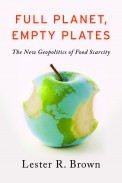
Full Planet, Empty Plates: The New Geopolitics of Food Scarcity

Full Planet, Empty Plates Slideshow Presentation from Earth Policy Institute


With food scarcity driven by falling water tables, eroding soils, and rising temperatures, control of arable land and water resources is moving to center stage in the global struggle for food security. “In this era of tightening world food supplies, the ability to grow food is fast becoming a new form of geopolitical leverage. Food is the new oil,” Lester R. Brown writes.

What will the geopolitics of food look like in a new era dominated by scarcity and food nationalism? Brown outlines the political implications of land acquisitions by grain-importing countries in Africa and elsewhere as well as the world’s shrinking buffers against poor harvests. With wisdom accumulated over decades of tracking agricultural issues, Brown exposes the increasingly volatile food situation the world is facing.

Table of Contents (Chapters available in PDF and html)

Free Download of Book (PDF)

Complete Data Sets
Full Planet Slideshow Presentations
Full Planet, Empty Plates Team
(People who have purchased five or more copies.)
International Publishers
Fact Sheet (PDF)
10 Things to Know About Food on World Food Day (PDF) (Persian)
Press Release

10 Things to Know About Food on World Food Day


October 16 is World Food Day. It offers the opportunity to strengthen national and international solidarity in the fight to end hunger, malnutrition, and poverty. With falling water tables, eroding soils, and rising temperatures making it difficult to feed growing populations, control of arable land and water resources is moving to center stage in the global struggle for food security. Here are some facts to consider:

1. There will be 219,000 people at the dinner table tonight who were not there last night—many of them with empty plates.
Ensuring adequate food supplies was once a rather simple matter, the sole responsibility of the ministry of agriculture. When governments wanted to accelerate growth in the grain harvest, they simply raised the support price paid to farmers. Now that is changing. Securing future food supplies has become incredibly complex. It may now depend more on policies in the ministry of health and family planning or of energy than in the ministry of agriculture itself.

2. Today, with incomes rising fast in emerging economies, there are at least 3 billion people moving up the food chain, consuming more grain-intensive livestock and poultry products.
Today, the growth in world grain consumption is concentrated in China. It is adding over 8 million people per year, but the big driver is the rising affluence of its nearly 1.4 billion people. As incomes go up, people tend to eat more meat. China’s meat consumption per person is still only half that of the United States, leaving a huge potential for future demand growth.

3. In India some 190 million people are being fed with grain produced by overpumping groundwater. For China, there are 130 million in the same boat.
Aquifer depletion now threatens harvests in the big three grain producers—China, India, and the United States—that together produce half of the world’s grain. The question is not whether water shortages will affect future harvests in these countries, but rather when they will do so.

4. In Nigeria, 27 percent of families experience foodless days. In India it is 24 percent, in Peru 14 percent.
The world is in transition from an era dominated by surpluses to one defined by scarcity. Not eating at all on some days is how the world’s poorest are coping with the doubling of world grain prices since 2006. But even as we face new constraints on future production, the world population is growing by 80 million people each year.

5. Water supply is now the principal constraint on efforts to expand world food production.
During the last half of the twentieth century, the world’s irrigated area expanded from some 250 million acres in 1950 to roughly 700 million in 2000. This near tripling of world irrigation within 50 years was historically unique. Since then the growth in irrigation has come to a near standstill, expanding only 10 percent between 2000 and 2010.

6. Nearly a third of the world’s cropland is losing topsoil faster than new soil is forming, reducing the land’s inherent fertility.
Future food production is also threatened by soil erosion. The thin layer of topsoil that covers the earth’s land surface was formed over long stretches of geological time as new soil formation exceeded the natural rate of erosion. Sometime within the last century, the situation was reversed as soil erosion began to exceed new soil formation. Now, nearly a third of the world’s cropland is losing topsoil faster than new soil is forming, reducing the land’s inherent fertility. Soil that was formed on a geological time scale is being lost on a human time scale. Peak soil is now history.

7. The generation of farmers now on the land is the first to face manmade climate change.
In addition to wells going dry and soils eroding, both at an unprecedented pace, the generation of farmers now on the land is the first to face manmade climate change. Agriculture as it exists today developed over 11,000 years of rather remarkable climate stability. It has evolved to maximize production within that climate system. Now, suddenly, the climate is changing. With each passing year, the agricultural system is more and more out of sync with the climate system.

8. At no time since agriculture began has the world faced such a predictably massive threat to food production as that posed by the melting mountain glaciers of Asia.
Mountain glaciers are melting in the Andes, the Rocky Mountains, the Alps, and elsewhere, but nowhere does melting threaten world food security more than in the glaciers of the Himalayas and on the Tibetan Plateau that feed the major rivers of India and China. Ice melt helps sustain these rivers during the dry season. In the Indus, Ganges, Yellow, and Yangtze river basins, where irrigated agriculture depends heavily on rivers, the loss of glacial-fed, dry-season flow will shrink harvests and could create potentially unmanageable food shortages.

9. After several decades of raising grain yields, farmers in the more agriculturally advanced countries have recently hit a glass ceiling, one imposed by the limits of photosynthesis itself.
In Japan, the longtime leader in raising cropland productivity, the rise in the yield of rice that began in the 1880s essentially came to a halt in 1996. Having maximized productivity, farmers ran into the inherent limits of photosynthesis and could no longer increase the amount they could harvest from a given plot. In China, rice yields are now just 4 percent below Japan’s. Unless China can raise its yields above those in Japan, which seems unlikely, it, too, is facing a plateauing of rice yields. Yields of wheat, the world’s other food staple, are also plateauing in the more agriculturally advanced countries. For example, France, Germany, and the United Kingdom—Europe’s leading wheat producers—had been raising wheat yields for several decades, but roughly a decade ago, all three hit plateaus. Corn yields in the United States, which accounts for nearly 40 percent of the world corn harvest, are starting to level off. Yields in some other corn-growing countries such as Argentina, France, and Italy also appear to be stagnating.

10. To state the obvious, we are in a situation both difficult and dangerous.
The world today desperately needs leadership on the food security issue to help the world understand both the enormity of the challenge we face and the extraordinary scope of a response, one that, among other things, requires a total restructuring of the energy economy. The scale of this economic restructuring is matched only by the urgency of doing so. Political leaders talk about cutting carbon emissions 80 percent by 2050, but if we stay on the current trajectory the game will be over long before then. If we want to stabilize climate, we need to cut carbon emissions far more rapidly. President Obama needs to understand both the gravity and urgency of the tightening food situation and the consequences of leaving it unattended. We are not looking at 2030 or 2050. We are looking at an abrupt disruption in the world food supply that could be just one poor harvest away.

What makes Lester Brown an expert on the global food situation? Check out his new memoir Breaking New Ground: A Personal History to find out. To learn more about global food security see Full Planet, Empty Plates: The New Geopolitics of Food Scarcity (W.W. Norton, 2012) by Lester R. Brown.

Tuesday, October 8, 2013

Sharing Power: Learning by Doing in Co-Management Throughout the World

By Grazia Borrini-Feyerabend, Michel Pimbert, M. Taghi Farvar, Ashish Kothari and Yves Renard; with Hanna Jaireth, Marshall Murphree, Vicki Pattemore, Ricardo Ramirez and Patrizio Warren

https://cmsdata.iucn.org/img/sharingpower_4961.jpg

Download entire Book (10 MB), or download by sections:

CONTENTS

Foreword by Juan Mayr Maldonado
Preface and acknowledgements
Introduction

Part I. TOWARDS A CONTEXTUAL FRAMEWORK

Chapter 1. Managing natural resources: a struggle between politics and culture

1.1 From local livelihood strategies to global agro-industrial markets
1.2 The interface between indigenous/ local NRM systems and the modern/ a-local agro-industrial market system: five field examples
1.3 Contemporary indigenous NRM systems and co-management

Chapter 2. Actors, entitlements and equity in natural resource management

2.1 Management actors
2.2 Entitlements to manage natural resources
2.3 Equity in managing natural resources

Chapter 3. Co-management of natural resources

3.1 What is in a name?
3.2 Practising co-management
3.3 The characteristics of co-management systems

Part II. TOWARDS EFFECTIVE PROCESSES

Chapter 4. A point of departure

4.1 What is to be managed? Who is to be involved?
4.2 Is co-management needed? Is co-management feasible?
4.3 Gathering resources and creating a Start-up Team
4.4 The special case of indigenous peoples: can co-management help them assert their rights to land and natural resources?

Chapter 5. Preparing for the partnership

5.1 Gathering relevant information and tools and promoting social communication
5.2 Engaging the partners in participatory action research
5.3 Assisting local communities to organise
5.4 Preparing for the negotiation meetings: procedures, rules, logistics and equity considerations

Chapter 6. Negotiating the co-management agreement and organisation

6.1 Agreeing on the rules and procedures of negotiation
6.2 Developing and "ritualising" a common vision of the desired future
6.3 Developing a strategy to approach the common vision
6.4 Negotiating and legitimising the co-management agreement and organisation

Part III. TOWARDS EFFECTIVE INSTITUTIONS

Chapter 7. Co-management agreements

7.1 Customary and non-notarised agreements
7.2 Formal legal agreements
7.3 The components of a co-management agreement
7.4 Recognition of efforts and commitment
7.5 Crucial issues for indigenous peoples and local communities
7.6 Crucial issues for government agencies

Chapter 8. Co-management organisations

8.1 Types and characteristics of co-management organisations
8.2 Examples of co-management agreements and organisations

Chapter 9. Learning-by-doing in co-management institutions

9.1 Making the agreement functional
9.2 "Learning by doing" through monitoring and evaluation
9.3 Promoting effective and sustainable co-management institutions

Part IV. TOWARDS AN ENABLING SOCIAL CONTEXT

Chapter 10. Natural resource policy and instruments

10.1 Enabling policies at the national level
10.2 Enabling policies at the international level

Chapter 11. Empowering civil society for policy change

11.1 The politics of policy
11.2 Methods and approaches for participatory policy processes
11.3 Strengthening civil society
11.4 The challenge of participatory democracy

Concluding remarks

References

Source: http://www.iucn.org/about/union/commissions/ceesp/ceesp_publications/sharing_power.cfm