Showing posts with label Education. Show all posts

Monday, January 15, 2024

Becoming Global Citizens for a Sustainable Society


This course introduces the SDGs and the notion of Global Citizenship through the series of lectures by renowned experts from all over the world, interviews with scholars, advocates and representatives from all different sectors, and case presentations by active global citizens. 


The course aims to examine and critically reflect on the revolving issues around the globe at local, national, and international levels by providing a platform where learners can virtually meet and learn from one another.


Learners will be able to deepen their understanding of the SDGs and global citizenship, exchange and embrace different perspectives, and challenge their own assumptions.


The course invites those who see themselves as global citizens as well as who aspire to assume active roles in bringing meaningful changes to oneself and to the society they are in.


No.ModuleUnits
1Global Citizenship and the SDGs

1) Understanding global citizenship in the context of the SDGs.

2) Why & What is Global Citizenship?

3) Issues Around Global Citizenship

2Global Citizenship in a Challenging World

Key Challenges to Global Citizenship

- Poverty & Glocal Justice

- Consumerism & Eco Justice

- Peace & Preventing Violent Extremism

- Media Influence and Critical Literacy

- Globalization & Migration

- Gender Equality

3Act to Change: Global Citizenship for Transformation

1) Highlights and Key Issues of the SDGs

2) Global Partnership for Achieving the SDGs

4Meet the Global Citizens Around the WorldCase studies of innovative movements and cases of global citizens
5Plan for Action: Becoming Active Global Citizens

1) How to become active global citizens

2) Advocacy tools and strategies

Tuesday, August 29, 2023

Toolkit for Youth Eco-Activism

 Source: https://learn.ecounesco.ie/courses/toolkit-for-youth-eco-activism/

Nourishing Well-Being and Catalysing Collective Action for Earth

About this Course

Go on a journey of eco-activism using our online Toolkit for Eco-Activism!

This course follows River on her journey of self-discovery and action, building a community of like-minded people on the way, and gaining the skills and confidence to get involved in eco-activism. Whether you are an eco-activist, an educator, or a young person interested in the environment, this toolkit can have implications for your life and help you respond to social-ecological challenges.

This Toolkit is the result of the collaborative project, Youth Action for Nature and Wellbeing, which you can read more about below. In addition to this online course, the toolkit is available as a printed book and in PDF format at yafnaw.eu

How to Use the Toolkit

This course has been designed by young people for young people, aged 16 to 25. The toolkit can be used independently by the youth. It is primarily intended for individuals who wish to establish a collective group of local youth eco-activists. However, if you already have a group to collaborate with, that is fantastic.

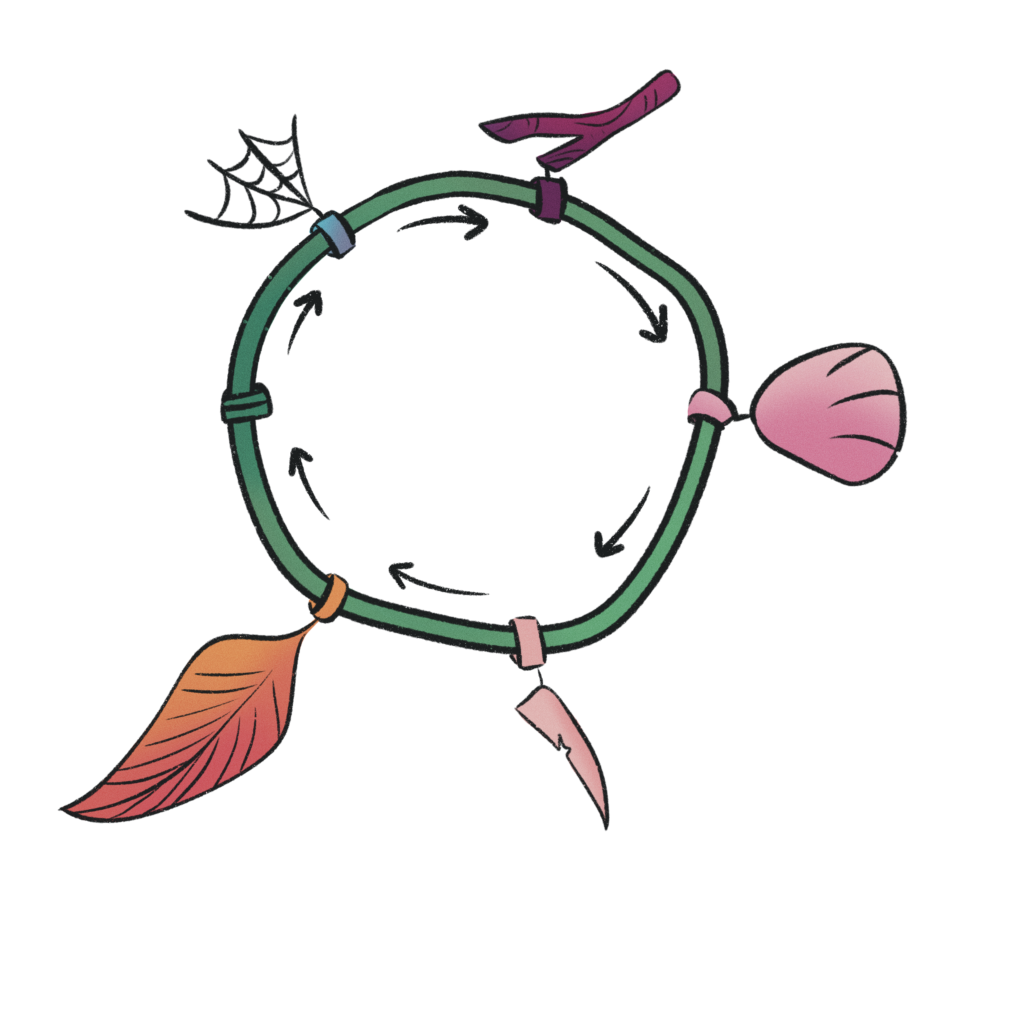
There are two ways to use the toolkit, depending on your needs and interests as an eco-activist. One way is is to follow the toolkit linearly through the 6 Phases of Activism, or alternatively you can follow the Learning Icons, as illustrated below.

The 6 Phases of the Toolkit

The toolkit can be read linearly, from start to finish through 6 Phases of Activism. Along the way, you and River, the main character of the toolkit, will encounter a variety of animals that will present tools and activities for eco-activists to try, getting creative and using nature as a canvas. If you are new to eco-activism, we recommend you work through the 6 phases one after the other. 

The 7 Learning Ions

Another possibility is to navigate your way through the toolkit using the 7 learning icons, following your interests or needs at the time. If you are already engaged with eco-activism, you may find it more helpful to focus on what is needed at the moment or skip certain phases of your journey.

Youth Action for Nature and Wellbeing

The Youth Action for Nature and Well-Being project was funded by Erasmus+ and involved a strategic partnership between six non-governmental organisations: ECO-UNESCO, Resilience.Earth, Gaia Education, The Rural Parliament of Slovakia, Youth for Smile (Jaunatne smaidam), and Ecowellness Consulting.

Monday, July 10, 2023

Charles Eisenstein's Books and Courses

Charles Eisenstein is a teacher, speaker, and writer focusing on themes of civilization, consciousness, money, and human cultural evolution.

His on-line writings have generated a vast following; he speaks frequently at conferences and other events, and gives numerous interviews on radio and podcasts.

Eisenstein graduated from Yale University in 1989 with a degree in Mathematics and Philosophy, and spent the next ten years as a Chinese-English translator. He currently lives near Harrisburg, Pennsylvania with his wife and four sons.

https://charleseisenstein.org/books/

https://sacred-economics.com/


Tuesday, March 7, 2023

New Short Film: Farm to School

Source: Center for Ecoliteracy

The short film Farm to School premiered at the 2023 Watsonville Film Festival. It was co-produced with Esperanza Community Farms and directed by Inspira Studios.

Through our California Food for California Kids® initiative, the Center for Ecoliteracy supports school districts like Pajaro Valley Unified in serving fresh, locally-grown school meals. We are grateful for the support and engagement of this community, and especially for the involvement of the committed students featured in the film.


Sunday, June 5, 2022

School Circles (2021) - documentary

School Circles (2021) - documentary - Short Version (44 min)

School Circles is an independent documentary that explores the practice of democratic schools in the Netherlands. The film shows students, teachers and staff members coming together to dialogue, discuss proposals, mediate conflicts and make decisions about their school life.

These schools not only challenge the mainstream education, but also democracy as we know it. They put into practice Sociocracy, a method for collective organisation based on a systems perspective, in which the decisions are made by hearing all the voices and getting everyone's consent.

School Circles connects the theory of sociocracy to its practice within schools, taking us to new possibilities of organising ourselves and our communities.

MORE INFO:

The directors of the film are trained sociocracy facilitators and offer courses around democratic governance and sociocracy within schools and educational settings. For more info visit: https://www.wonderingschool.org/socio... 


Friday, November 5, 2021

Climate Solutions 101 - Playlist of 6 Units


Source: https://www.youtube.com/playlist?list=PLwYnpej4pQF7UPnt0nkZEa8sxR9TmWR1B

Your climate solutions journey begins now. Filled with the latest need-to-know science and fascinating insights from global leaders in climate policy, research, investment, and beyond, this video series is a brain-shift toward a brighter climate reality.

Climate Solutions 101 is the world’s first major educational effort focused solely on solutions. Rather than rehashing well-known climate challenges, Project Drawdown centers game-changing climate action based on its own rigorous scientific research and analysis. This course, presented in video units and in-depth conversations, combines Project Drawdown’s trusted resources with the expertise of several inspiring voices from around the world. Climate solutions become attainable with increased access to free, science-based educational resources, elevated public discourse, and tangible examples of real-world action. Continue your climate solutions journey, today.

Learn more: www.drawdown.org/climate-solutions-101

#ClimateSolutions101


Thursday, September 30, 2021

Global Citizenship Course

 Source: https://framerspace.com/courses

https://framerspace.com/course/global-citizenship

Modules

Module 1 ~ Getting Curious: Beginning to Question

When Isidore Isaac Rabi, winner of Nobel Prize in Physics was asked why he became a scientist, he replied, “My mother made me a scientist without ever knowing it. Every other child would come back from school and be asked, ‘What did you learn today?’ But my mother used to say, ‘Izzy, did you ask a good question today?’

In this module you will begin to inquire, ask questions and explore the power of inquiry.

Module 2 ~ Displacing homes: Movement and Separation

Albert Einstein once said, "Nothing happens, until something moves"

Shifting base, moving homes, separating from friends and loved ones can be hard, but it may be a precursor to a better life, a better promise!

In this module, you will inquire what movement is, what does it entail and how it may feel like.

Module 3 ~ Co-creating Governance: Active Citizens

"You must be the change you wish to see in the world." - Mahatma Gandhi

Everyone wants a better life and most see it through a better governance.

But, what is a better governance? Can we define it?

In this module, you will inquire for a near to perfect recipe for a successful governance.

Module 4 ~ Blurring Boundaries: Citizens of the World

"You have to take ownership of tomorrow. For that to be possible, you have to strengthen your capacity and widen your vision as a global citizen." Ban Ki-moon, 8th General Secretary of United Nations

In this module, you inquire what it is to be 'a global citizen' and the need for it. You look at stories from the world to broaden your horizon of the constraints that people encounter.

Module 5 ~ Discovering Myself: Who am I?

"Identity is the incredible, invisible force that controls your whole life. It's invisible, like gravity is invisible, but it controls your whole life." Tony Robins

Who are you? Why are you the way you are? Are you really who you are?

In this module, you will study human behaviour. You will understand what governs humans and inquire into who you are and what has shaped you.

Module 6 ~ De-rooting Violence

In this module, you will understand the essential elements of a violent act and identify them in different scenarios. We will explore the types of violence, nature of violence, causes of violence and triggers of violence.

Global Citizenship Education: Topics and learning objectives

 Source: https://en.unesco.org/news/global-citizenship-education-topics-and-learning-objectives

UNESCO has just launched its new publication on Global Citizenship Education (GCED) titled Global Citizenship Education: Topics and Learning Objectives. This is the first pedagogical guidance on GCED produced by UNESCO in an effort to help Member States integrate GCED in their education systems, formal and non-formal.

The guidance, presented during the World Education Forum 2015, suggests ways of translating GCED concepts into age-specific topics and learning objectives based on the three domains of learning – cognitive, socio-emotional and behavioural. It also presents examples of existing practices and implementation approaches in various countries. This pedagogical guidance can be adapted and implemented in an easy and flexible manner in any given context. It will be particularly useful for educators, curriculum developers, trainers as well as policy-makers but also other education stakeholders working in non-formal and informal settings.

The guidance was developed in consultation with experts on GCED from different parts of the world and it was field tested in selected Member States and various stakeholders including teachers, learners and ministry officials in all regions to ensure that the content is relevant and appropriate in various geographical and cultural contexts.  

This publication was produced with technical and financial support from the Asia-Pacific Centre of Education for International Understanding (APCEIU), a UNESCO Category 2 Centre. 

The publication in English is available here .

Global Citizenship Education Guides (Oxfam)

 Source: https://www.oxfam.org.uk/education/who-we-are/global-citizenship-guides/ 

These guides are the foundations of great global citizenship. They outline the key principles of taking a global approach to teaching and learning, as well as practical guidance for embedding it into your lessons.

Each guide has been created with teachers in mind and includes testimonies, teaching ideas and participatory activities to help you on your way. Whether you want to explore the world in the classroom or embed global citizenship across your whole school, we have a guide for you.

EDUCATION FOR GLOBAL CITIZENSHIP

Packed with creative ideas, advice and case studies to support the development of global citizenship in all curriculum areas.

A guide for schools

GLOBAL CITIZENSHIP IN THE CLASSROOM

A practical guide filled with tools and ideas to increase participation and develop a global perspective in the classroom.

A guide for teachers

TEACHING CONTROVERSIAL ISSUES

Young people frequently face making decisions about a wide range of issues on which there are many different views. This guide includes strategies, guidance and activities for teaching controversial issues.

Foster critical thinking

THE SUSTAINABLE DEVELOPMENT GOALS

The UN's Sustainable Development Goals present "a blueprint to achieve a better and more sustainable future for all by 2030."

Deepen your understanding of education about and for the Sustainable Development Goals (SDGs) and see how global citizenship education approaches and methodologies can underpin good practice.

A guide for teachers

MATHS AND GLOBAL CITIZENSHIP

Consider how real world contexts can enrich maths teaching and help unlock how it can be applied.

Make global connections

SCIENCE AND GLOBAL CITIZENSHIP

Deepen learners' understanding and discover practical ideas for adding a global lens to science.

Nurture young scientists

ENGLISH AND GLOBAL CITIZENSHIP

Ideas for learning about the world whilst improving speaking and listening, reading, writing and media literacy skills.

Capture learners' imaginations