Showing posts with label Public Spaces. Show all posts

Wednesday, October 3, 2012

10 Ways to Improve Your City through Public Space


Union Square, New York City.  Image source: http://upload.wikimedia.org/wikipedia/commons/4/4a/1_new_york_city_union_square_2010.JPG
Public spaces are increasingly being recognized as a crucial ingredient for successful cities, and for their ability to revitalize and create economic and social development opportunities. But actually finding ways to build and maintain healthy public space remains elusive to many municipal governments, especially in thedeveloping world. The vast web of streets, parks, plazas, and courtyards that define the public realm is often lacking, too poorly planned, or without adequate citizen participation in the design process.
Recognizing these challenges, the Project for Public Spaces (PPS) released earlier this month a draft of their handbook Placemaking and the Future of Cities. It’s intended to serve as a best practices guide for those wishing to improve the economic, environmental and social health of their communities through the power of successful public space.
10 fundamental principles for placemaking have been identified by PPS as the keys to vibrant, safe, and attractive public spaces:
1. Improve Streets as Public Spaces
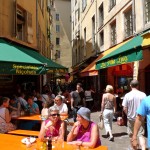
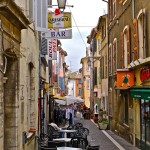
Rue Mouffetard, Paris. Image source: http://www.flickr.com/photos/wallyg/1440461890/sizes/l/in/photostream/
Streets are the most common public spaces, but they are often hostile to pedestrians and cyclists, and end up congested with vehicular traffic. This simple principle is about planning streets for people and places, with the deliberate decision to design streets around all users with a range of street types to help strike the right balance. Creating good public space where it is most prevalent and most accessible adds to the social cohesion of the city – the street.
2. Create Squares and Parks as Multi-Use Destinations
Bryant Park, New York. Image source: http://www.flickr.com/photos/lambertwm/7150136051/sizes/l/in/photostream/
Parks and squares are important places in cities when planned right – building economies, civic pride, social connection and happiness. The great public parks and squares of the world, just like other great places in cities, are multi-use destinations. By collectively deciding on what will make the park or square desirable to come to, they will attract a range of people for a multitude of reasons, coming together for a shared public experience.
3. Build Local Economies Through Markets
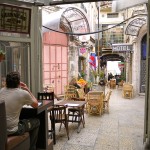
Carmel Market, Tel Aviv, Isreal.
Image source: http://farm4.staticflickr.com/3217/3148419311_36355b8481_b.jpg
Cities originated because of the market – the crossroads for the exchange of goods and knowledge. This principle embraces that history and recognizes that that essential function has not changed. Like parks and squares, they bring together all types of people to share in the space including low income groups who are given an entrepreneurial opportunity with little capital investment. While they declined in the North American context with the rise of the supermarket, urban markets are reemerging across the developed world as viable alternatives that help preserve surrounding farmland, stimulate the local economy, and invigorate surrounding neighbourhoods.
4.  Design Buildings to Support Places
Rapid urbanization around the world is leading to unprecedented building construction. Buildings play an important role in the shaping of the public realm through their visibility and they way they interact at street level. They should be built to be permeable and respond to the block and building fabric around them, built at a human scale, function as multi-use destinations, and enhance the liveliness of the neighbourhoods they are in. These tenants hold true especially for public buildings, as they are the anchors of civic life for the entire community.
5. Link a Public Health Agenda to a Public Space Agenda
Design for Health Bicycle Parking
Image source: http://www.flickr.com/photos/designforhealth/6997870849/in/photostream
Public spaces need to be recognized for their contributions to public health: markets can provide fresh and affordable food, good streets with efficient transit can encourage walking or cycling, and good public parks and squares can relieve stress and reduce the amount of crime through the amount of people out on the street. Equally, public health institutions can serve the public spaces by acting as community centres and providing health and education services.
6. Reinvent Community Planning
Integrated Community Sustainability Planning Course, Toronto
Image credit: http://www.flickr.com/photos/36238874@N02/5179221762/
This principle is about tapping into the collective wisdom of those that know the community best – its citizens. By engaging those with a historical perspective, insights into how the area functions, and an understanding of what is meaningful for locals, it will help to create a sense of ownership and better ensure the success of public space projects. Institutions and key community stakeholders should be brought in as partners to work with locals, and together guide professionals to act as facilitators and resources to help implement their vision. Public space must also be given the ability to evolve and change over time along with the community to ensure it continues to function as a great destination.
7. Power of 10
The Power of 10 aims to develop a critical mass of public space elements that comprise a larger whole that is greater than the sum of its parts.  10 is not a strict number, but is intended to serve as a foundation. The idea is that if you can provide 10 things to do that attract people to one spot, you’ve started to create a great place. Building on that, aim for a neighbourhood to provide 10 of these great places. Further, a city with 10 of these neighbourhoods has now given residents access to quality public spaces within walking distance of their homes. It’s the sort of comprehensive goal that municipal decision makers can strive for while giving citizens something tangible to create at the local level.
8. Create a Comprehensive Public Space Agenda
Comprehensive strategies are required for the development, enhancement, and management public space. An assessment is needed to create a city-side inventory of the performance of existing public spaces across the city. Using this inventory, public space goals can be created for the community that strengthen existing successes and improve areas that are underperforming. This agenda should be linked to new development projects to preserve and enhance public environments and use the economic activity of development to help fund other civic public space improvements.
9. Lighter, Quicker, Cheaper: Start Small, Experiment
West Philly Parklet
West Philly Parklet
Image credit: http://www.flickr.com/photos/philly_bike_coalition/6006670062/
Great spaces are the products of an evolution which have increased in complexity over time, beginning with small, inexpensive improvements. Capatalize on the creativity of citizens who can continuously try new things. Municipal leaders can get the ball rolling by creating demonstration projects of light, quick, and cheap improvements that the public can add to and expand upon to suit their needs. Where there are successes, build upon them. Light, quick, and cheap improvements are low risk and low cost, but with time, money and effort, successes will lead to more successes, and great public spaces will emerge.
10. Restructure Government to Support Public Spaces
The principles listed above are about catalyzing local leaders, funding, and strengthening local resources for the goal of creating great public spaces. However, government is not usually set up to support this. The achievement of this goal requires the development of consensus building, city consultation processes, and institutional reform in order to enhance inclusion and build citizen engagement. Government needs to develop and implement bottom-up policies for this purpose, strengthening inclusion in the process. Removing bureaucratic obstacles helps to make participation monetarily feasible for all and quickly implementable.  Empowering citizens through institutional restructuring helps drive all the other principles necessary to create a positive public realm with health, attractive and well-used public spaces that are a true reflection of the needs and values of the community they are in.
Download a full copy of the draft Placemaking and the Future of Cities here, which features case studies on how cities around the world have employed these principles for public space success. Learn more about the Project for Public Spaces and their work at their website: http://www.pps.org/.

ABOUT 

I'm an Urban Planner/Designer based in Toronto, Canada. My work is focused on commercial/residential/mixed use development, visualizations and urban design studies, preparation of site and master plans, municipal planning, and community engagement. My interests include form-based urban design tools, downtown...

Tuesday, June 14, 2011

Neighbourhoods Green publications and toolkits


"The quality of people's homes is influenced by the spaces around them. There is increasing recognition that well designed, well managed green spaces by and in between housing are crucial to making neighbourhoods livable, and contribute to people's quality of life."
Neighbourhoods Green is a partnership initiative which highlights the importance of open space for residents of social housing and works with social landlords to raise the quality of their design, management and safe use.
The project provides guidance, support and tools for housing associations, local authority housing departments, arms-length management organisations (ALMOs), resident associations, community groups and their partners.
Decent homes need decent spaces is a recently produced action plan which identifies 10 key considerations for improving open space in social housing areas. A copy can be downloaded here.
We will continue to add information and resources to this website so please visit us again.


Publications

Neighbourhoods Green publications

Decent Homes Need Decent Space, CABE Space and the National Housing Federation (2010)
At workshops in London and Sheffield held by CABE Space and the National Housing Federation, a group of social landlords came together to debate the challenges and opportunities around improving open space in social housing. They developed 10 priorities for change which are identified in this practical action plan.

A Natural Estate, Natural England and Neighbourhoods Green (2007)
Evidence suggests that many residents would like to see more nature close to where they live. This guidance provides a toolkit of practical projects and case studies to enable the managers of social housing spaces to undertake simple, worthwhile and successful projects to encourage wildlife.

Areas of Opportunity, Neighbourhoods Green (2005)
Areas or Opportunity reviews the guidance and policy frameworks that surround green and open space and explores the key issues identified through a review of the literature.


Decent Homes, Decent Space, Notting Hill Housing Group and Peabody Trust (2004)
Decent Homes Decent Space follows the inaugural Neighbourhoods Green conference held in London in 2003. It explores the barriers and opportunities for green spaces in the context of social housing and offers case studies and signposting to social landlords with an interest in the design, management and safe use of spaces around residents' homes

CABE Space publications

Managing Green Space, CABE Space (December 2010)
This briefing brings together evidence to assist green space managers, corporate decision makers and advisors on the future of green space services. Seven 'ingredients for success' are outlined to meet the challenge of delivering quality services with reduced resources.


Urban Green Nation, CABE Space (March, 2010)
Compiles and analyses information on the quantity and type of green space in urban areas. The summary presents the main findings of the research and is of interest to anyone looking to understand more about England's urban green spaces. The full report can be downloaded here.

Community Green, CABE Space (July, 2010)
Community Green: using local spaces to tackle inequality and improve health, investigates the relationship between urban green space, inequality, ethnicity, health and well being and is the largest study of it's kind in England.

Community Led Spaces, CABE Space (November, 2010)
A guide to issues involved in transferring ownership and management of public space from local authorities and social landlords to community groups.


It's Our Space, CABE Space (February 2007)
Guidance to help anyone involved in a public space project for the first time. It gives examples of great outdoor spaces led by community groups and highlights lessons from their experiences. It seeks to inspire people to demand better places and in doing so challenges users of this guide to think carefully about leaving a legacy of excellence in the projects that emerge.
Making contracts work for wildlife, CABE Space (June, 2006)
Guidance that advises green space professionals on how to make the most of the potential for biodiversity in our urban parks.


Start with the park, CABE Space (June, 2005)
A good practice guide for people involved in developing and managing sustainable green spaces in housing growth and housing market renewal areas. It aims to inspire strategic decision-makers working in local delivery and partnership bodies, developers, house builders, social landlords and community and voluntary groups. 

Decent parks? Decent behaviour? CABE Space (April, 2005)
A report providing evidence that good design and management, not just heavy handed security measures, are the key ingredients for safer parks .


Other

Public Open Green Space Space Works, Land Restoration Trust
Bite sized information about the benefits of public open space


Making it Home: the power of landscape to create good housing. The Landscape Institute, Position statement (2010)
The Landscape Institute advocates landscape as an integrating framework which will deliver sustainable communities. This position statement looks at how environmental, social and economic needs can be integrated into housing developments and provides case study examples.


Toolkits

Neighbourhoods Green

These toolkits have been developed as part of The Natural Estates project which is working with eight social landlords and residents across London to improve local estates. Read more about Natural Estates

Be Inspired Guides

Get ideas for how natural features can be used to create play spaces by reading the Be Inspired Guide to Natural Play


Get ideas to transform a small patch of ground into a food growing oasis by reading the Be Inspired Guide to Grow Your Own 


Get ideas to create your own community garden by reading the Be Inspired Guide to Community Gardening


Get ideas on how to create wildlife habitats and attract visitors to your green space by reading our Be Inspired by Local wildlife Guide


How to Guides

Download our top 5 tips on how your tenants and residents association or community group can apply for funding to get your project started. How to apply for funding


Download our top 5 tips on how to get started with growing your own fruit and vegetables and enjoy you own fresh produce. How to grow your own fruit and veg


Download our top 5 tips on how to set up a community gardening club to transform a patch of land. How to set up a community gardening club


Download our top 5 tips on how to attract wildlife to your estate to make it a haven for bees, birds and butterflies. How to attract wildlife


CABE Space

Spaceshaper - A tool to help assess the quality of public space before investing time and money into it.
Spaceshaper captures the views of professionals who are running the space as well as those of the people that use the space. Facilitated workshops discuss the results, design quality and how the space works for different people.
Spaceshaper encourages people to demand more from their local spaces.

Monday, June 6, 2011

Inspiring the redefinition of urban public space

Here’s a review and look forward, focused on the expanding redefinition of American urban spaces, such as sidewalks and streets, and a symbiotic recalibration of the flanking private domain.
An April 2010 myurbanist entry, “from ancient Rome to sidewalk Saturdays in America”, observed context and possibilities:
In  several entriesmyurbanist has challenged American placemaking advocates to consider pragmatic approaches when borrowing from qualities of foreign urban spaces, recalling their evolution over thousands of years under different sociocultural circumstances. Likewise, the blog Emergent Urbanism recently cautioned to be mindful of the  “patterns of place”.
In American efforts to move from the food court back to the street, we should consider first our own cultural context, and without  political will, the tendency of traditional street use permitting and related, safety-based regulatory regimes to discourage more expansive public use of rights-of-way for nontraditional street and sidewalk use.
Certainly, policymakers, the development community and community leaders are gaining momentum through focus upon  sidewalk dining ordinances complete streets programming, and compact and walkable  transit oriented developments. But in a time of recession and financial constraint, reinvention will not appear overnight, and allegiance to  traditional regulatory schemes dies hard at the interface of public and private property lines.
We then proposed that every Saturday morning, American cities invoke a “quick win”, and allow temporary and selective sidewalk use for two hours. mindful of safety, yet relaxing of bureaucracy.
In the interim, American cities have  continued to experiment with redefinitions of traditional uses of the public domain, including street closures, “parklets” in parking spaces and bicycle-oriented suspensions of ordinary traffic.
In particular, the mainstream press has  featured coverage of the expansion of streetside dining in the Pacific Northwest premised on relaxed permitting requirements, and urbanist blogs have referenced growing American experimentation with the  street as a dining venue.
What else is possible? Here, from afar, is more evidence that street and square, beach and byway all have a greater and unrealized multipurpose capacity, ripe for recalibration in ever-evolving America.
 
This article also appeared on SustainableCitiesCollective here, on November 4.