Showing posts with label Happiness. Show all posts

Thursday, October 3, 2019

Ten Keys to Happier Living

The Ten Keys to Happier Living are based on a review of the latest research from psychology and related fields. Everyone's path to happiness is different, but the evidence suggests these Ten Keys consistently tend to have a positive impact on people's happiness and well-being.
The first five keys (GREAT) are about how we interact with the outside world in our daily activities. They are based on the Five Ways to Wellbeing developed by nef as part of the Foresight Project. The second five keys (DREAM) come from inside us and depend on our attitude to life.
Giving icon
Caring about others is fundamental to our happiness. Helping other people is not only good for them and a great thing to do, it also makes us happier and healthier too. Giving also creates stronger connections between people and helps to build a happier society for everyone. And it's not all about money - we can also give our time, ideas and energy. So if you want to feel good, do good! Read more...
Relating icon
Relationships are the most important overall contributor to happiness. People with strong and broad social relationships are happier, healthier and live longer. Close relationships with family and friends provide love, meaning, support and increase our feelings of self worth. Broader networks bring a sense of belonging. So taking action to strengthen our relationships and create new connections is essential for happiness. Read more...
Exercising icon
Our body and our mind are connected. Being active makes us happier as well as being good for our physical health. It instantly improves our mood and can even lift us out of a depression. We don't all need to run marathons - there are simple things we can all do to be more active each day. We can also boost our well-being by unplugging from technology, getting outside and making sure we get enough sleep! Read more...
Appreciating icon
Ever felt there must be more to life? Well good news, there is! And it's right here in front of us. We just need to stop and take notice. Learning to be more mindful and aware can do wonders for our well-being in all areas of life - like our walk to work, the way we eat or our relationships. It helps us get in tune with our feelings and stops us dwelling on the past or worrying about the future - so we get more out of the day-to-day. Read more...
Trying Out icon
Learning affects our well-being in lots of positive ways. It exposes us to new ideas and helps us stay curious and engaged. It also gives us a sense of accomplishment and helps boost our self-confidence and resilience. There are many ways to learn new things - not just through formal qualifications. We can share a skill with friends, join a club, learn to sing, play a new sport and so much more. Read more...

Direction icon
Feeling good about the future is important for our happiness. We all need goals to motivate us and these need to be challenging enough to excite us, but also achievable. If we try to attempt the impossible this brings unnecessary stress. Choosing ambitious but realistic goals gives our lives direction and brings a sense of accomplishment and satisfaction when we achieve them. Read more...
Resilience icon
All of us have times of stress, loss, failure or trauma in our lives. But how we respond to these has a big impact on our well-being. We often cannot choose what happens to us, but we can choose our own attitude to what happens. In practice it's not always easy, but one of the most exciting findings from recent research is that resilience, like many other life skills, can be learned. Read more...
Emotion icon
Positive emotions - like joy, gratitude, contentment, inspiration, and pride - are not just great at the time. Recent research shows that regularly experiencing them creates an 'upward spiral', helping to build our resources. So although we need to be realistic about life's ups and downs, it helps to focus on the good aspects of any situation - the glass half full rather than the glass half empty. Read more...
Acceptance icon
No-one's perfect. But so often we compare our insides to other people's outsides. Dwelling on our flaws - what we're not rather than what we've got - makes it much harder to be happy. Learning to accept ourselves, warts and all, and being kinder to ourselves when things go wrong, increases our enjoyment of life, our resilience and our well-being. It also helps us accept others as they are. Read more...
Meaning icon
People who have meaning and purpose in their lives are happier, feel more in control and get more out of what they do. They also experience less stress, anxiety and depression. But where do we find 'meaning and purpose'? It might be our religious faith, being a parent or doing a job that makes a difference. The answers vary for each of us but they all involve being connected to something bigger than ourselves. Read more...
About the Ten Keys
The Ten Keys to Happier Living framework was jointly developed by Vanessa King and the Action for Happiness team in 2010, based on an extensive review of the latest research evidence relating to psychological/mental wellbeing.
Ten Keys Questions for Discussion
Ten Keys Action Ideas
  • Do three extra acts of kindness today. Offer to help, give away your change, pay a compliment, or make someone smile.
  • Reach out to help someone who's struggling. Give them a call or offer your support. Let them know you care.
  • Make more time for the people who matter. Chat with a loved one or friend, call your parents or play with the kids.
  • Make three extra connections today. Stop to chat in the shop, wave at a neighbour, learn the name of someone new.
  • Be more active today. Get off a bus a stop early, take the stairs, turn off the TV, go for a walk - anything that gets you moving.
  • Eat nutritious food, drink more water, catch up on sleep. Notice which healthy actions lift your mood and do more of them.
  • Give yourself a bit of head space. At least once a day, stop and take 5 minutes to just breathe and be in the moment.
  • Notice and appreciate good things around you every day, big or small. Trees, bird song, the smell of coffee, laughter perhaps? 
  • Do something for the first time today. Sample sushi, try a new route, read a different newspaper or visit a local place of interest.
  • Learn a new skill, however small. A first aid technique or a new feature on your phone. Cook a new meal or use a new word. 
  • Take the first step. Think of a goal you're aiming for and do one thing to get started. Make a call, fill in that form, tell others. 
  • Share your dreams. Tell 3 people about an aspiration that is really important to you this year and listen to theirs too.
  • Ask for help today. Confide in a friend, talk to an expert, reach out to a colleague, ask a neighbour to lend a hand. 
  • When something is troubling you, do something you really enjoy. Shift your mood and bring a new perspective on the problem.
  • Do something that you know will make you feel good. Listen to music, watch something funny, get outside or call an old friend.
  • Try to smile and say something positive every time you walk into a room. Notice the reaction you get. 
  • Ask a trusted friend or colleague to tell you what they think your real strengths are. Try to make more use of these.
  • Be as kind to yourself as you are to others. See your mistakes as opportunities to learn. Notice things you do well, however small.
  • Feel part of something bigger. Spend time with children, visit an inspiring location, gaze at the stars or join a club.
  • Be more charitable. Give others your time, offer to help neighbours or friends, consider giving blood or volunteering.

Tuesday, October 1, 2019

Managing for Happiness

https://management30.com/happiness-at-work/

The main thing I learned is that happiness is something you create — it is not something to achieve.
Jurgen in an article for Entrepreneur Magazine

https://management30.com/blog/scaling-happiness/

Happiness comes in two primary categories: natural happiness and synthetic happiness (terms popularized by Dan Gilbert).

Natural happiness is what we generally accept as the ubiquitous definition of the emotion – when we are delighted, pleasantly surprised, when our bodies are delighted with that momentary release of stimuli.
Synthetic happiness is when we artificially create happiness by resolving ourselves to achieving a reality we’ve created for ourselves. An example would be working on a terrible assignment, but reaching a breakpoint or the end. You created the happiness associated with completion of a bad task.
Synthetic happiness is not cheating the system, it is healthy and required for us as a species to enjoy life. As leaders of knowledge workers, we need to be sure to make meaningful connections with our teams to understand what are the happiness triggers for them — both natural and synthetic — so that we can create a system supportive of their happiness.
Beyond the types of happiness, leaders should have a lightweight appreciation for the neuroscience behind what makes people happy. There are four chemicals [EDSO] that make us all feel senses of happiness:
  • endorphins
  • dopamine
  • serotonin
  • oxytocin
While I will try to execute a poor-man’s distillation of this here, you should watch Simon Sinek’s talk on this topic to get a more robust explanation.

EDSO: This is your team’s brain on happiness

  • Endorphins are a means for our bodies to mask physical pain — they keep us safe when we need it most. It is the boost that runners often call a Runner’s High. Knowledge workers have endorphins released when they are in a hardcore coding session or when writing in a groove late into night.
  • Dopamine is the happiness chemical that helps us reach our goals. In my world of agile coaching, I frequently leverage dopamine on Kanban workflow boards by having mini-celebrations when each smaller task is completed. There is a ritualistic bonding ceremony for the team to appreciate the mini-accomplishments frequently. Dopamine is a great motivator, but can become addictive and is the same chemical that fuels gamblers, smokers and drinkers. It is a heavy contributor to synthetic happiness and deserves some active regulation in the workplace.  
  • Serotonin is the social chemical — it helps us form human bonds. Teams thrive off the relationships they form at work — both collocated and virtual. What is amazing about serotonin is the bidirectional nature of the experience. Recently one of my team members was recognized for a presentation he gave to our leadership team. He was proud of his recognition, which caused his surrounding team and myself to be happy, which made others near us happy too.  Serotonin has a butterfly effect on teams and organizations making it an ideal scaling catalyst.  
  • Oxytocin — the servant leadership chemical. Last week, I was among several people that volunteered to help review an upcoming book. The author and editor both experienced dopamine with the influx of reviewers, but I was happy to help. The author is a person who contributes to my professional network and the subject was one of great interest to me. I was charged with a rush of oxytocin during and shortly after my review period. Actually, while writing this, I feel some happiness related to the work again — welcome aboard, oxytocin!
As you can see (hopefully), effective and mindful leaders can identify tasks or interactions that may trigger happiness in groups and individuals. This identification will foster the creation of both natural and synthetic happiness that will increase the overall employee engagement.
But the real power of happiness is seen at scale. How can organization at large be happy? How do we create self-priming happiness engines?

How to scale happiness at work

There is a simple pattern emerging that fosters happiness at scale.
Happiness scales when organizations make the conscious, long-term decision to value people and teams over short-term financial gains.
While this sounds simple, changing existing mindset from revenue-first to employee-first is by all means disruptive in most large organizations.  
By building a culture that fosters those happiness chemicals, leaders can start guiding teams and organizations toward happiness at scale. As the organization starts its mindful happiness journey, it takes on a beautiful transformation — usually with serotonin as the catalyst.
Serotonin has a butterfly effect on groups which causes happiness to multiply.
Leveraging the concept of happiness distribution via teams and departments is a grassroots happiness scaling method. When you are looking to redirect organizational culture to be more mindful, it’s important to acknowledge your creative workers’ intrinsic motivators, like:
  • Respect
  • Courage
  • Transparency
  • Openness
  • Focus  
You need to find constant moments to celebrate, using tools like the Celebration Grid. A focus on perfection is a scaling inhibitor, while creating a culture focused on learning is a scaling accelerator.
Beyond the softer aspects of scaling, more tactical actions can be taken to create a growing culture of happiness. I have personally implemented Experimentation Days, guilds, and engagement assessments in organizations to introduce workplace happiness. Experimentation Days set aside work time for knowledge workers to scratch that innovative itch, while not having to have a direct correlation to their day-to-day tasks.  
At my organization, I co-founded a maker program where anyone interested could set aside a half day per month to work with Arduino boards and robots to create fun gadgets for the office. Sometimes, these mini-projects fail, sometimes they succeed, but every time we have fun and build stronger bonds. 
We show videos of these employee engagement events in our recruiting process to show the culture we are trying to build.  
I’ve also helped create a virtual guild within my company that focuses on emerging agile practices. We meet via phone and Webex, and regularly have well-known external speakers come and share their recent areas of study. It promotes learning, but also an active interest in our desire to improve as a group.  
Measuring team improvement has been an area of research for years. As I have professionally grown, my appreciation for the inherent flaws of following metrics in isolation has increased. While metrics can be bad if not taken into total context, they are not bad if properly applied.
This year my team introduced OfficeVibe — an employee engagement polling tool that integrates with Slack and allows for lightweight anonymous feedback loops broken down into various areas of impact. Via this tool, we have learned and taken action on several items of displeasure for our team. For example, the development space temperature setting was too cold. It sounds simple, but it had largely gone unnoticed until we had the feedback provided in OfficeVibe to bump it up. Since doing so, the engagement score has improved. There are similar tools out there, but OfficeVibe has been the most effective means for continuous and tight feedback loops I have seen for the enterprise space.
The most interesting thing I have learned about scaling models at large is that there is no single model that will last. When dealing with highly dynamic systems such as machine learning, cloud storage, compression or — the most dynamic system of all — people, any scaling approach we take must be seen as an organic, constantly changing model. 

Creating sustainable happiness at work

Creating practices and tools to promote happiness takes a mindful leader with the support of higher level leadership. The C-suite and thought leaders need to remain engaged in order to ensure support sustains or — better yet — increases.  
It’s just as important to continue to tune your happiness systems. This means experimenting and finding new problems to solve. And it means working with teammates one-on-one to understand what they think of the systems introduced and to see where they can be improved.  
Truly investing yourself into the craft of creating happiness is a daily effort and not a one-time ceremony. Once you start seeing some short-term success, you need to maintain a high focus on continued happiness and mindfulness. Some more progressive corporations have taken happiness to the extreme of hiring Chief Happiness Officers or similar. While this shows a firm’s commitment to improvement, I tend to favor the stories of happiness driven from the trenches and ranks. Perhaps both are needed in some companies.

At the end of that fateful Thanksgiving Saturday, we made the call to roll back the release. We were losing data and despite the best efforts of the global team working on the issue, it could not be resolved. That evening, the team in charge of the rollback initiated the 24-hour process so our customers would not be impacted on Monday morning. Shortly after the final call ended, I went to sleep without saying a word to anyone. I just curled into my bed exhausted not understanding how this could have happened. Within a year I had left this company and found myself starting on a leadership and agile journey that really nurtured what I now know as my real happiness.
So many of us spend our time in pursuit of happiness, yet instead of searching for it we need to find ways to live it, embrace it and implement it into our daily lives.

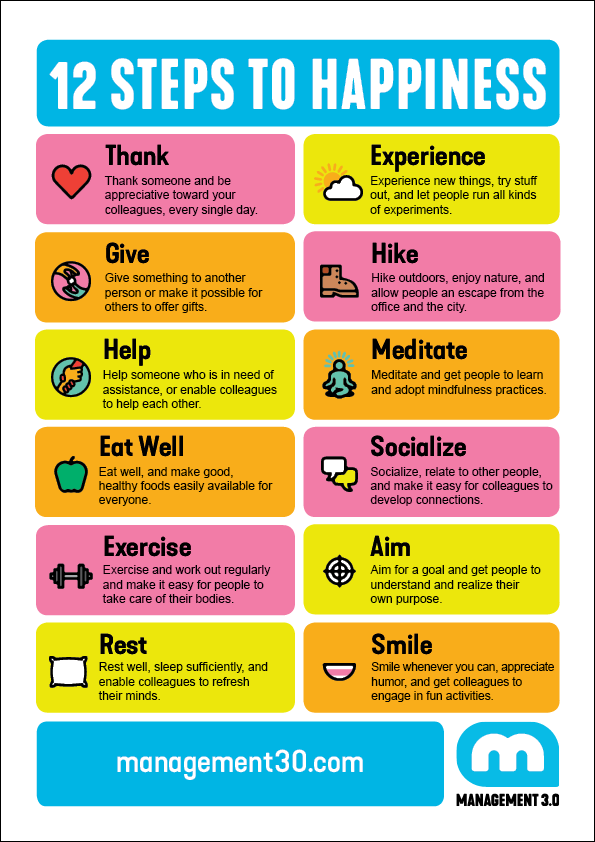
The 12 Steps to Happiness

12 Steps to Happiness
Click to download the 12 Steps to Happiness poster and display it in your office
Thank someone and be appreciative toward your colleagues, every single day.
Give something to another person or make it possible for others to offer gifts.
Help someone who is in need of assistance, or enable colleagues to help each other.
Eat well, and make good, healthy foods easily available for everyone.
Exercise and work out regularly and make it easy for people to take care of their bodies.
Rest well, sleep sufficiently, and enable colleagues to refresh their minds.
Experience new things, try stuff out, and let people run all kinds of experiments.
Hike outdoors, enjoy nature, and allow people an escape from the office and the city.
Meditate and get people to learn and adopt mindfulness practices.
Socialize, relate to other people, and make it easy for colleagues to develop connections.
Aim for a goal and get people to understand and realise their own purpose.
Smile whenever you can, appreciate humor, and get colleagues to engage in fun activities.