Showing posts with label Philosophy. Show all posts

Wednesday, May 31, 2023

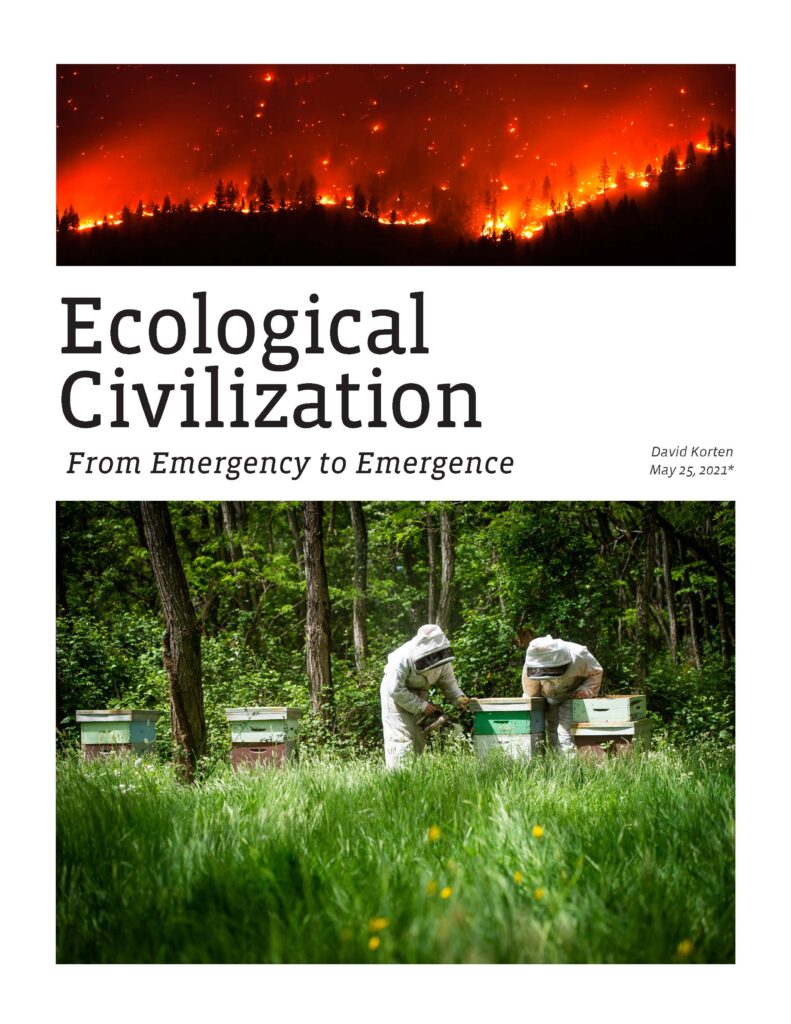
Ecological Civilization: From Emergency to Emergence (paper)

 Source: https://davidkorten.org/ecological-civilization-from-emergency-to-emergence/

Drawing on the work and insights of many colleagues and from ongoing conversations, this paper was written in an effort to connect the dots and engage a serious conversation about the causes of the existential crisis we face, while bringing a message of hope and possibility.

Click on the image below to read the paper and download the PDF. (For the best version to read via mobile devices, click HERE.) Feel free to use this paper and its content in any way you believe may be useful in your work, community, and personal life to draw attention and help move us forward on the path to an Ecological Civilization.
    – David Korten, May 25, 2021 (Updated with minor revisions on Nov 3, 2021.)

Read and download the PDF…
Read on mobile device… 
See Fritjof Capra’s Reflections on Ecological Civilization: From Emergency to Emergence (video)
Start an Ecological Civilization Discussion Group


Tuesday, October 1, 2019

A Curriculum for Generation Z

By Jenny Andersson

As I write millions of young people from around the world have taken to the streets in the 
Global Strike for Climate inspired by Greta Thunberg. From Melbourne to Manchester, Bangkok to Boston young people are rising up to demand governments take action on climate change.
These are Generation Z. Doesn’t quite trip off the tongue like ‘Millennials’ but they’re as potent a force. This is a generation of young people who are now profoundly concerned about having their future stolen from them. Who are following in Greta Thunberg’s footsteps and asking questions like “Why should I study for a future I can’t see?’ ‘Why don’t you adults act?”.
Whether governments and adults act or not, these young people will probably grow up into a profoundly different world to previous generations like mine. If I reflect back in time I know that I had deep underlying assumptions of security about the future, and an unacknowledged but accepted pattern of how my future could unfold. I would go to school, University (the first generation in my family to do so), I would build a career, probably marry and have children, I would accrue reasonable wealth and a pension, I would retire and probably set out to travel again as a pensioner as I did as a young backpacker.
In the last 15 years most of that has unravelled for me. Young people don’t even have that sense of security. If they are rebelling against their academic curriculum, what then might not only tempt them, but be the right kind of curriculum for their future and how can we adapt school and University experiences to reflect the need?
I’ve made an attempt at pulling out a few categories of learning I think might be both useful and important.

Cultural Anthropology

is the branch of anthropology that’s concerned with the study of human societies and their cultural development. In times of cultural disruption and change, it could be very valuable to develop a real undestanding of how cultures have formed and changed historically, in order to draw critical learning on what to do, and what not to do.
The kind of topics I would include here are the history and impact of colonialism; the history of indigenous peoples, their cultural repression and renaissance; the history of movements, activism and resistance; racial justice & privilege; a history of minority movements & culture, and the collapse of civilisations.
I will probably be roasted by academics but I would also put history of economic models from Descartes to Neoliberalism in here; the development of capitalism, and the history of innovation & technology. I would also include a study of the different kind of hidden economies that have more recently emerged such as the attention & information economy, the entertainment & distraction economy, the sharing and circular economies and post-truth digital communications strategies. And probably also the history of ownership, finance and the stock markets, plus a deep understanding of The Commons.

Empathetic Communication

People who can communicate and influence across the widest possible range of cultures, worldviews and environments have always been important. Yet historically great communications has been considered the domain of advertising professionals and political spindoctors. That’s not the kind of communications skills young people bent on delivering a regenerative future will need.
They will need deep listening, empathy, intercultural communication, facilitation and constructive feedback skills. They will need to know deep inquiry methods and models like Theory U, The Art of Hosting, and appreciative inquiry. They will also benefit from conflict awareness, resilience and resolution skills, and in particular non -violent communication patterns.
They will also need to know how to build collaborative effort. How to get past the cultural tendencies of individuals to want to protect what is theirs, their ownership of an idea, a region, a project, a name and build collaborative effort to solve complex problems. They will need to learn how to turn competition into collaborative advantage.

Personal Resilience Practice

To cope in times of uncertainty and complexity, a personal resilience practice becomes a vital prop. I would love to see subjects like meditation and martial arts introduced in schools and Universities, alongside body consciousness and somatic practices to reconnect individuals to a sense of self esteem, courage and confidence. Self-sovereignty practices such as knowing how to create healthy boundaries, and understanding self-care through good nutrition, fitness and health seem to be as important if not more important, than competitive sport.
Additionally studying the importance of Rites of Passage, incorporating reflection and journaling — athough this is becoming much more coming at under-graduate level in the UK — and incorporate specific programmes for climate resilience such as Joanna Macy’s The Work That Reconnects would be enormously beneficial in light of growing climate and future anxiety.

New Sciences

There is wide acknowledgement that humanity has designed a society that is largely disconnected from nature and the principles which create the conditions conducive to life. A foundational understanding of life’s principles through emergent scientific practices like biomimicry, ecology and evolutionary biology could be useful. An introduction to developmental psychology would help create a better understanding of how and why individuals young people meet operate from different models of thinking and have different value sets.

Philosophy

Having just spent a brilliant weekend at How The Light Gets In, I couldn’t leave the basics of philosophy off the agenda. Understanding the Stoics, the origins of philosophy, the use of power as a dynamic, a study of ethics and morality would give a brilliant grounding in thinking and behaviour in a complex world.

Systems & Patterns

Perhaps it goes without saying understanding patterns of thinking, and being able to apply those in the workplace is critical to the future curriculum. Subjects like systems thinking, pattern identification, complexity theory, creative & lateral thinking, and shifting from forecasting to scenario planning are even top of World Economic Forum’s listas being essential for future-fit businesses. I would probably add ecological design thinking to their list.
Although not everyone is a natural polymath, being able to see the inter-connectedness between multiple issues is essential to being able intervene successfully in the kind of complex systems we need to change.

Emotional & Spiritual Intelligence

Since Daniel Goldman first hit the headlines with Emotional Intelligene in 1996, we have seen a gradual shift towards organisations becoming more values centric. The leaders that are succeeding are those with deep emotional intelligence which allows them to communicate well and act in ways that model the kind of leadership that people will follow and emulate.
“We need leaders who are emotionally intelligent, and able to model and champion co-operative working. They’ll coach, rather than command; they’ll be driven by empathy, not ego. The digital revolution needs a different, more human kind of leadership”. Professor Klaus Schwab
There is also a resurgence in respect for spiritual intelligence. It may not yet meet the list of economic powerhouses like WEF but the ability to sense into the future, to activate intuition and imagination are getting much more respect. The ability to harness collective intelligence in the service of designing a regenerative future is a valuable way to overcome employment inertia and cultural entropy.

Innovation & The Future of Work

It’s probably not quite right to put these in one group, but to me they seem inter-related. Many of the most vibrant working models that underpin the ability to deliver creativity, autonomy and self-responsibility and reliance, are not old hierarchical business models. They include models like sociocracy, holacracy, and Laloux-inspired teal design. They may not be for every industry or organisation, but they are useful to study to understand how personal agency can be delivered in an oganisational model.
It’s also vital to understand the role of innovation in change. Are we designing innovations that deliver incremental change or transformational change? How do we know when different kinds of innovation are appropriate? Models such as Bill Sharpe’s Three Horizons would be a great addition to any learning programme.

The Role of Technology

I already mentioned technology in cultural anthropology. There are a million articles out there about technology skill sets that young people need to acquire. Many of them, they acquire naturally. It’s only old buffalos like me that need to actually ‘learn’ digital tech. Where I think we need to introduce critical thinking to the technological landscape however is around the rewards but also risk of artifical intelligence, exponential computing, biotechnology, bioengineering and genetic engineering. Personal data and privacy management are also important.

Regenerative Culture Design

Schools and universities could do worse than hand all students a copy of Daniel Christian Wahl’s Designing Regenerative Cultures to read!
But failing that, the kind of subject matter that should be on their minds should be permaculture design, regenerative agriculture systems, community design and building, immersive and experiential learning of indigenous culture, scale-linking salutogenic design, symbiosis for social innovation, green chemistry, biomimetic design, the circular economy, net-postive business models, collective living models, and panarchy.

Practical & Creative Skills

Less you think I’m without a practical bone in my body, I must also include a number of important practical skills. These include bringing back things into the curriculum like home economics, woodwork and gardening. They include creative skills like scribing and visual sense-making. They include project management and negotiation — because who is going to have a job for life in the next few decades? We’re going to become a cohort of social and environmental project-based designers for change.
and finally….

Leadership and Learning

Do we need more leadership development? Well, yes we probably do. But leadership of a different kind. Leadership that is focused on creating a future that is conducive to life for all. Collective leadership where groups and cohorts learn from each other in peer learning processes like emerging London-based She Leads Change and Rebel Wisdom. And people who are able to design their own learning programmes.
That’s perhaps the most important part of this ‘curriculum’. That it should be designed to allow self-directed learning, and encourage personal autonomy for any individual to respond to the needs they see in the world with a programme of learning that they personally design and direct.
In the last 5 years I have designed my own informal PhD. I couldn’t even name what I wanted to look at so had no opportunity to align with any University. It’s been a journey through exponential tech, biomimicry, developmental psychology, evolutionary biology — ah wait, it looks like everything I’ve just listed! It wasn’t a single course I could take, but maybe it could become a Baccalaurate for the Future. Who knows.
I am a creative strategist working with organisations who want to be part of a regenerative future for people and planet, and a trusted advisor for their CEOs and leadership teams. I use collective learning processes and change programmes to help organisations develop their sustainability strategies and strategic narratives, and activate them through co-creativel processes. I call on 30 years of experience advising global purpose-led brands and scale-ups to deliver world-class facilitated interventions which deliver results. I am a trained facilitator in Theory U, Art of Hosting, and more recently is training in biomimicry for social innovation. You can find me:-
Facebook
Twitter
LinkedIn
Websites: https://weactivatethefuture.com and https://jenandersson.com

Link: https://medium.com/activate-the-future/a-curriculum-for-generation-z-f8c501d7e187

Monday, July 8, 2019

Waldorf Education Philosophy

Source: https://www.onecommunityglobal.org/waldorf/

The Waldorf education philosophy is just one of the many systems we have researched to create the Education for Life Program. The Waldorf method distinguishes three broad stages in child development that each last approximately seven years. The first stage focuses on hands-on learning activities and through creative play; the second focuses on artistic expression, social development, and creative and analytic thinking; the third stage encourages critical understanding and morality. This page is meant to function as an ever-expanding archive of open source, free-shared, and duplicable Waldorf education philosophy inspired ideas that we organize into the primary components of the One Community Education Program: Curriculum for Life, Teaching Strategies for Life, Learning Tools and Toys for Life, and building The Ultimate Classroom. These components are designed to be combined to create endless “Lesson Plans for Life” purposed to grow and evolve what we feel will be the most comprehensive, effective, and diversely applicable free-education program and resource archive in the world. The One Community Foundations of Teaching, Leadership, and Communicating, combined with a collaborative Evaluation and Evolution Component (Portfolio Creation and Maintenance), help us to further grow and adapt both the program and as individuals.
RELATED PAGES
One Community school, One Community education, teaching strategies for life, curriculum for life, One Community, transformational education, open source education, free-shared education, eco-education, curriculum for life, strategies of leadership, the ultimate classroom, teaching tools for life, for the highest good of all, Waldorf, Study Technology, Study Tech, Montessori, Reggio, 8 Intelligences, Bloom's Taxonomy, Orff, our children are our future, the future of kids, One Community kids, One Community families, education for life, transformational livingOne Community school, One Community education, teaching strategies for life, curriculum for life, One Community, transformational education, open source education, free-shared education, eco-education, curriculum for life, strategies of leadership, education for life, transformational education, new paradigm learning, genius training, the ultimate classroom, teaching tools for life, for the highest good of all, Waldorf, Study Technology, Study Tech, Montessori, Reggio, 8 Intelligences, Bloom's Taxonomy, Orff, our children are our future, the future of kids, One Community kids, One Community families, education for life, transformational living, thinking out of the box, learning how to learn - not what to learn, learning to think, using your brain for a change, brainy builderOne Community school, One Community education, teaching strategies for life, curriculum for life, One Community, transformational education, open source education, free-shared education, eco-education, curriculum for life, strategies of leadership, the ultimate classroom, teaching tools for life, for the highest good of all, Waldorf, Montessori, Reggio, 8 intelligences, Bloom's Taxonomy, Orff, our children are our future, the future of kids, One Community kids, One Community families, education for life, transformational livingOne Community school, One Community education, teaching strategies for life, curriculum for life, One Community, transformational education, open source education, free-shared education, eco-education, curriculum for life, strategies of leadership, education for life, transformational education, new paradigm learning, genius training, the ultimate classroom, teaching tools for life, for the highest good of all, Waldorf, Study Technology, Study Tech, Montessori, Reggio, 8 Intelligences, Bloom's Taxonomy, Orff, our children are our future, the future of kids, One Community kids, One Community families, education for life, transformational living, thinking out of the box, learning how to learn - not what to learn, learning to think, using your brain for a change, brainy builderteaching tools, teaching toys, learning tools, learning toys, educational toys, educational tools, toys to learn with, toys to grow with, math toys, science toys, social sciences toys, classroom toys, classroom tools, english toys, art toys, music toys, health toys, writing toys, reading toys, reading toolslesson plans for life, educational lessons, learning for life, teaching for life, educational plans, math lesson plans, science lesson plans, english lesson plans, social sciences lesson plans, art lesson plans, vocational lesson plans, health lesson plans, education templates, education mindmaps, learning mindmaps, Education for Life program, One Community, open source education, Highest Good education, free-shared educationevaluation and evolution, learning for life, growing as individuals, evolving education, One Community school, One Community education, teaching strategies for life, curriculum for life, One Community, transformational education, open source education, free-shared education, eco-education, curriculum for life, strategies of leadership, the ultimate classroom, teaching tools for life, for the highest good of all, Waldorf, Study Technology, Study Tech, Montessori, Reggio, 8 Intelligences, Bloom's Taxonomy, Orff, our children are our future, the future of kids, One Community kids, One Community families, education for life, transformational living, Highest Good education, One Communitythe ultimate classroom, One Community Kids, enlightened children, children of the future, conscious kids, conscientious kids, kid leaders, leadership and children, children leading the world, sustainable education, Highest Good education, One Communityeducation licensing, classroom licensing, home school licensing, charter school licensing, pilot school licensing, private school licensing, open source education, educational licensingHighest Good society, education for life, Highest Good education, fulfilled living, enriched life, enriching life, living to live, how to live an enriched life, keeping it all running, sustainable living, social architecture, fulfilled living, thriving, thrivability, emotional sustainability, the good life, a new way to live
OTHER WAYS TO CONTRIBUTE TO EVOLVING THIS EDUCATION PROGRAM WITH US
WHAT IS THE WALDORF
EDUCATION PHILOSOPHY
If you have ideas stemming from Waldorf education, philosophy, and/or theory that you feel should be added to this developing resource guide, please use our Education for Life Collaborative Input Page. To create the upcoming page we have researched a diversity of the components of the Waldorf method and Waldorf schooling approach including: Waldorf education training, Waldorf education curriculum, Waldorf homeschooling, and more. Our goal is to list here what we feel are the best, simplest, and most usable tools with application and benefit for all ages?
Waldorf Foundations of Leadership, Teaching, and Communicating
● Self governing by consensus of a group of teachers: Provides creative autonomy as a foundational skeleton which enables children to learn by example
● Multiple intelligences: Children are measured as individuals (versus based upon universal criteria) to allow for multiple and differential intelligences
● Looping: Utilizing the same teacher over multiple years in order to build long-term relationships
● Greet: Shake each student’s hand, and make eye contact as each enters class. This strategy allows the teacher to check in on each student at the start of the day. Students will line up at the door, eager for a one-on-one moment with the teacher.
● Relate: Create a buddy system with students in an older grade. The cross-age pals at the John Morse Waldorf Methods School meet once a month to learn about building solid relationships with both younger and older students.
● Draw: Let students illustrate their own workbooks. Having students draw out math and reading lessons is a great way to integrate art into the curriculum. The students will take pride in their books, and learn in a new way.
● Plant: Get students outside through nature walks and gardening. Weekly nature walks in a local park or natural area will become science lessons as the teacher answers students questions about the natural world. A school garden can allow students to connect with nature and learn how plants grow.
● Play: Practice musical instruments during class transitions. Give each student a recorder, and have the whole class follow the teacher by playing a few notes at class breaks. The students will enjoy mixing short music lessons into everyday learning.
● Move: Allow kids to be active during lessons. Your whole class will enjoy getting out of their chairs to do physical activities such as stomping their feet and counting out numbers to begin learning multiplication.
● Ideas to add? Click here to make this page better!
Waldorf Curriculum Ideas
● Moral responsibility: An active practice teaching, “One should treat others as one would like others to treat oneself.”
● Social competence and personality development
● Eurythmy: Expressive movement art to poetry, music, plays. Learning moods combined with pitch, tone, rhythm, grammar
● Experiential Learning: Music, dance and theater, writing, literature, legends and myths are not simply subjects to be read about and tested, they are experienced
● Ideas to add? Click here to make this page better!
Waldorf Teaching Strategies
● Age 7-14: The approach emphasizes cultivating children’s emotional life and imagination. The core curriculum is introduced imaginatively through stories and creative presentations
● Age 14+: The curriculum is structured to foster pupils’ intellectual understanding, independent judgment, and ethical ideals such as social responsibility, aiming to meet the developing capacity for abstract thought and conceptual judgment. Secondary education is provided by specialist teachers for each subject. The education focuses much more strongly on academic subjects, though students normally continue to take courses in art, music, and crafts.
● Eurythmy: Expressive movement art to poetry, music, plays. Learning moods combined with pitch, tone, rhythm, grammar
● Reciting previous lesson: after each new lesson is taught, there is outdoor break, upon arrival back the previous lesson is recited and the child records findings in journal
● Each class normally remains together as a cohort throughout their years, developing as a quasi-familial social group whose members know each other quite deeply. In the elementary years, a core teacher teaches the primary academic subjects.
● Ideas to add? Click here to make this page better!
Waldorf Learning Tools and Toys
● Open Ended/Gender Neutral Toy: Squares of different colored silk
● Dress-up clothes/costumes near the mirror
● Natural objects as toys – stones, feathers, branches, earth, sand, leaves, pinecones, etc.
● Avoidance of toys and clothes with commercial fictional characters
● Recording book: Student has a ‘journal’ to record learnings after each lesson
● Waldorf Dolls are the type of doll used in Waldorf classrooms using traditional European doll-making techniques. They are usually handmade of natural fibers like cotton and wool that are comforting to hold and touch. The facial features of a Waldorf doll are left intentionally simple. Features usually consist of two eyes and a hint of a mouth. Some Waldorf dolls may have no features at all! This allows a child to use his or her imagination to imagine the doll’s expression.
● Ideas to add? Click here to make this page better!
Waldorf Classroom Design
● Natural containers and building materials – avoid plastic and other synthetics
● Natural toys without paint etc. so kids can use their imagination more
● Receives natural light
● Is designed with a quiet visual environment
● Uses warm colors on the walls and floor
● Has a large area of free space for building and diverse learning/play
● Has high-quality and purpose-designed furniture, fixtures and equipment
● Allows ease of movement
● Allows flexibility in learning varied activities
● Contains ergonomic tables and chairs
● Is modular, meaning the teacher can easily change the space configuration
● Waldorf classrooms commonly integrate the deliberate and consciously considered use of color. Although not every Waldorf school is exactly the same in its choice of colors there is often a general consistency based on a response to the stages of child development.
● Ideas to add? Click here to make this page better!
OTHER RESOURCES
OPEN SOURCE SUBJECT RESOURCES (click icons for complete pages)
OPEN SOURCE CURRICULUM OUTLINES (click image for summaries and links to complete pages)
CARE
teaching love, teaching connection, teaching empathy, teaching compassion, teaching values, One Community school, One Community education, teaching strategies for life, curriculum for life, One Community, transformational education, open source education, free-shared education, eco-education, curriculum for life, strategies of leadership, the ultimate classroom, teaching tools for life, for the highest good of all, Waldorf, Montessori, Reggio, 8 intelligences, Bloom's Taxonomy, Orff, our children are our future, the future of kids, One Community kids, One Community families, education for life, transformational livingteaching honesty, teaching integrity, teaching ethics, ethical teaching, honest teaching, One Community school, One Community education, teaching strategies for life, curriculum for life, One Community, transformational education, open source education, free-shared education, eco-education, curriculum for life, strategies of leadership, the ultimate classroom, teaching tools for life, for the highest good of all, Waldorf, Montessori, Reggio, 8 Intelligences, Bloom's Taxonomy, Orff, our children are our future, the future of kids, One Community kids, One Community families, education for life, transformational livingInterconnectedness, Sustainability Education, One Community school, One Community education, teaching strategies for life, curriculum for life, One Community, transformational education, open source education, free-shared education, eco-education, curriculum for life, strategies of leadership, the ultimate classroom, teaching tools for life, for the highest good of all, Waldorf, Montessori, Reggio, 8 intelligences, Bloom's Taxonomy, Orff, our children are our future, the future of kids, One Community kids, One Community families, education for life, transformational livingsocial equality and justice, celebrating diversity, diversity as a value, celebrating diversity
SHARE
teaching communication, teaching language skills, One Community school, One Community education, teaching strategies for life, curriculum for life, One Community, transformational education, open source education, free-shared education, eco-education, curriculum for life, strategies of leadership, the ultimate classroom, teaching tools for life, for the highest good of all, Waldorf, Montessori, Reggio, 8 Intelligences, Bloom's Taxonomy, Orff, our children are our future, the future of kids, One Community kids, One Community families, education for life, transformational livingteaching sharing, teaching giving, teaching receiving, sharing in education, open source, One Community school, One Community education, teaching strategies for life, curriculum for life, One Community, transformational education, open source education, free-shared education, eco-education, curriculum for life, strategies of leadership, the ultimate classroom, teaching tools for life, for the highest good of all, Waldorf, Montessori, Reggio, 8 Intelligences, Bloom's Taxonomy, Orff, our children are our future, the future of kids, One Community kids, One Community families, education for life, transformational livingcommunity contribution, a new way of living, time as your only currency, transforming life as we know itcooperating, living cooperatively, collaborative living, collaboration, working together, helping each other, global family, coming together, seeking agreement, team work
PLAY
a new way to life, living fulfilled, an enriching life, enriched life, fulfilled life, ascension, evolving consciousness, loving lifeTrue Community, how to build community, facilitating global community, community building, for The Highest Good of All, One Community, a new way to live, a new way of living, open source world, creating world change, One Community, 40+ tips for community making, One Communityteaching freedom, freedom in teaching, celebrating other perspectives, teaching other perspectives, One Community school, One Community education, teaching strategies for life, curriculum for life, One Community, transformational education, open source education, free-shared education, eco-education, curriculum for life, strategies of leadership, the ultimate classroom, teaching tools for life, for the highest good of all, Waldorf, Montessori, Reggio, 8 Intelligences, Bloom's Taxonomy, Orff, our children are our future, the future of kids, One Community kids, One Community families, education for life, transformational livingfoundations of greatness, knowledge is power, educating kids, smart kids, wisdom curriculum, knowledge curriculum, One Community school, One Community education, teaching strategies for life, curriculum for life, One Community, transformational education, open source education, free-shared education, eco-education, curriculum for life, strategies of leadership, the ultimate classroom, teaching tools for life, for the highest good of all, Waldorf, Montessori, Reggio, 8 Intelligences, Bloom's Taxonomy, Orff, our children are our future, the future of kids, One Community kids, One Community families, education for life, transformational living
OPEN SOURCE TEACHING METHODOLOGY SUMMARIES
INDEX OF ALL THE ONE COMMUNITY OPEN SOURCE LESSON PLANS
Lesson Plans for Life Image, One Community lesson plans
Click this image for the Lesson Plans for Life page with links to the rest of the lesson plans

THE WORLD'S LARGEST ONLINE FREE EDUCATION RESOURCE ARCHIVE RELATED CONTENT AND OTHER RELATED RESOURCES x
SUGGESTIONS     ●     CONSULTING     ●     MEMBERSHIP     ●     OTHER OPTIONS

Waldorf education, Waldorf schooling, Waldorf teaching methodology, Rudolph Steiner, Waldorf schooling, unschool
NOTE: One Community does not believe there is any one system that is the best. It is our Highest Good of All philosophy to look at all systems and all methodologies. Our goal is to learn and integrate everything we can to better inspire and create the Education for Life program as an open source and free-shared globally collaborative and accessible program available to positively contribute to the education of anyone who chooses to use it.
Here is our continually evolving list of Waldorf inspired ideas divided into the categories of the Education for Life program:

If you’d like to help us make this list better, please submit your Waldorf inspired suggestions so that we can integrate them here and into the Foundations of Teaching, Leadership, and Communicating component.
● Qualitative: Formative assessment helps teachers to monitor their students’ progress and to modify the instruction accordingly. It also helps students to monitor their own progress by incorporating feedback
Waldorf education training, Waldorf education curriculum, Waldorf homeschooling, rudolf steiner quote, steiner quote, waldorf quote, quoting steiner, steiner on education, Rudolph Steiner on education, Waldorf philosophy, Waldorf Method, One Community school, One Community education, teaching strategies for life, curriculum for life, One Community, transformational education, open source education, free-shared education, eco-education, curriculum for life, strategies of leadership, the ultimate classroom, teaching tools for life, for the highest good of all, Waldorf, Montessori, Reggio, 8 Intelligences, Bloom's Taxonomy, Orff, our children are our future, the future of kids, One Community kids, One Community families, education for life, transformational living

If you’d like to help us make this list better, please submit your Waldorf inspired suggestions so that we can integrate them here and into the Curriculum for Life component.
● Anthroposophy to incorporate inner development in areas such as intuition, inspiration, and imagination into natural science that could eventually be evaluated on the same basis
Waldorf education training, Waldorf education curriculum, Waldorf homeschooling, rudolf steiner quote, steiner quote, waldorf quote, quoting steiner, steiner on education, Rudolph Steiner on education, Waldorf philosophy, Waldorf Method, One Community school, One Community education, teaching strategies for life, curriculum for life, One Community, transformational education, open source education, free-shared education, eco-education, curriculum for life, strategies of leadership, the ultimate classroom, teaching tools for life, for the highest good of all, Waldorf, Montessori, Reggio, 8 Intelligences, Bloom's Taxonomy, Orff, our children are our future, the future of kids, One Community kids, One Community families, education for life, transformational living

If you’d like to help us make this list better, please submit your Waldorf inspired suggestions so that we can integrate them here and into the Teaching Strategies for Life component.
● Age 1-6/7: Learn best by being immersed in an environment where one can learn through unselfconscious imitation
Waldorf education training, Waldorf education curriculum, Waldorf homeschooling, rudolf steiner quote, steiner quote, waldorf quote, quoting steiner, steiner on education, Rudolph Steiner on education, Waldorf philosophy, Waldorf Method, One Community school, One Community education, teaching strategies for life, curriculum for life, One Community, transformational education, open source education, free-shared education, eco-education, curriculum for life, strategies of leadership, the ultimate classroom, teaching tools for life, for the highest good of all, Waldorf, Montessori, Reggio, 8 Intelligences, Bloom's Taxonomy, Orff, our children are our future, the future of kids, One Community kids, One Community families, education for life, transformational living

If you’d like to help us make this list better, please submit your Waldorf inspired suggestions so that we can integrate them here and into the Learning Tools and Toys for Life component.
● Open Ended/Gender Neutral Toy: Push Cart, Play Stand/Trestles, (submit ideas)
Waldorf education training, Waldorf education curriculum, Waldorf homeschooling, rudolf steiner quote, steiner quote, waldorf quote, quoting steiner, steiner on education, Rudolph Steiner on education, Waldorf philosophy, Waldorf Method, One Community school, One Community education, teaching strategies for life, curriculum for life, One Community, transformational education, open source education, free-shared education, eco-education, curriculum for life, strategies of leadership, the ultimate classroom, teaching tools for life, for the highest good of all, Waldorf, Montessori, Reggio, 8 Intelligences, Bloom's Taxonomy, Orff, our children are our future, the future of kids, One Community kids, One Community families, education for life, transformational living

If you’d like to help us make this list better, please submit your Waldorf inspired suggestions so that we can integrate them here and into the Ultimate Classroom component.
● Art station specifically for art, music, and dancing (by mirror and Montessori dress-up clothes?)
teaching arts, teaching trades, teaching life skills, teaching building, teaching communication, teaching painting, teaching exploration, teaching rhythm and tempo, teaching tactile skills, teaching learning strategies, teaching storytelling, teaching puppet theatre, teaching planting, teaching crafts, teaching woodworking, teaching metalworking, teaching pottery, teaching theatre, learning arts, learning trades, learning life skills, learning building, learning communication, learning painting, learning exploration, learning rhythm and tempo, learning tactile skills, learning learning strategies, learning storytelling, learning puppet theatre, learning planting, learning crats, learning woodworking, learning metalworking, learning poetry, learning theatre, the Education for Life Program, creative kids, artistic kids, art in the context of, music in the context of, One Community education, open source education, One Community school teaching english, teaching literature, teaching sociolinguistics, teaching communications, teaching linguistics, teaching speech etiquette, teaching listening, teaching pronounciation, teaching language, teaching reading, teaching writing, teaching parts of speech, teaching comprehension, teaching speaking, teaching stories, teaching poems, learning english, learning literature, learning sociolinguistics, learning communications, learning linguistics, learning speech etiquette, learning listening, learning pronounciation, learning language, learning reading, learning writing, learning parts of speech, learning comprehension, learning speaking, learning stories, learning poems, the Education for Life Program, creative kids, artistic kids, art in the context of, music in the context of, One Community education, open source education, One Community school teaching health, teaching emotional health, teaching mental health, teaching social health, teaching nutrition, teaching spiritual health, teaching physical health, teaching self respect, teaching self awareness, teaching flexibility, teaching fruit, teaching vegetables, teaching grains, teaching ego, teaching connection, teaching intuition, teaching motor skills, teaching fitness, teaching outdoors, learning health, learning emotional health, learning mental health, learning social health, learning nutrition, learning spiritual health, learning physical health, learning self respect, learning self awareness, learning flexibility, learning fruit, learning vegetables, learning grains, learning ego, learning connection, learning intuition, learning motor skills, learning fitness, learning outdoors, the Education for Life Program, creative kids, artistic kids, art in the context of, music in the context of, One Community education, open source education, One Community school teaching math, teaching arithmetic, teaching algebra, teaching calculous, teaching calculations, teaching geometry, teaching trigonometry, teaching architecture, teaching engineering, teaching addition, teaching subtraction, learning math, learning arithmetic, learning algebra, learning calculous, learning calculations, learning geometry, learning trigonometry, learning architecture, learning engineering, learning addition, learning subtraction, the Education for Life Program, creative kids, artistic kids, art in the context of, music in the context of, One Community education, open source education, One Community school
teaching earth sciences, teaching life sciences, teaching physical sciences, teaching astronomy, teaching states of matter, teaching motion, teaching investigation, teaching energy, teaching vibration, teaching magnetism, learning earth sciences, learning life sciences, learning physical sciences, learning astronomy, learning states of matter, learning motion, learning investigation, learning energy, learning vibration, learning magnetism, the Education for Life Program, creative kids, artistic kids, art in the context of, music in the context of, One Community education, open source education, One Community school teaching social sciences, teaching friendship, teaching family, teaching social skills, teaching language, teaching literature, teaching seasons, teaching fine arts, teaching emotions, teaching culture, teaching history, teaching sports, teaching relationships, learning social sciences, learning friendship, learning family, learning social skills, learning language, learning literature, learning seasons, learning fine arts, learning emotions, learning culture, learning history, learning sports, learning relationships, the Education for Life Program, creative kids, artistic kids, art in the context of, music in the context of, One Community education, open source education, One Community school teaching innovation, teaching awareness, teaching focus, teaching imagination, teaching strategy, teaching creativity, teaching visualization, teaching technology, teaching basic machines, teaching magnets, teaching gears, teaching coding, teaching app development, teaching design, teaching blueprints, learning innovation, learning awareness, learning focus, learning imagination, learning strategy, learning creativity, learning visualization, learning technology, learning basic machines, learning magnets, learning gears, learning coding, learning app development, learning design, learning blueprints, the Education for Life Program, creative kids, artistic kids, art in the context of, music in the context of, One Community education, open source education, One Community school teaching imagination, teaching communication, teaching care, teaching kindness, teaching hygiene, teaching sharing, teaching playfulness, teaching teamwork, learning imagination, learning communication, learning care, learning kindness, learning hygiene, learning sharing, learning playfulness, learning teamwork, the Education for Life Program, creative kids, artistic kids, art in the context of, music in the context of, One Community education, open source education, One Community school


We're building this resource section. Click here if you have a suggestion or resource for this page.