The Circle Way — Putting Equity and Justice in the Center The Circle Way unequivocally affirms the essential practice of turning to one another to uphold racial, ethnic, gender, disability, economic, and environmental justice. We can imagine a different way.
The Circle Way gathers people into a circular shape with participants at the rim and the purpose in the centre. Each person has a voice and everyone can see and hear one another. Social agreements and practices help facilitate respectful conversation. Circle supports a leader in every chair.
Support sustainability both personally and environmentally
Honor agreements and take ownership for outcomes
Guiding Materials
You are about to embark on a beautiful life-altering journey that will give you the tools to connect with your peers by sharing on a spiritual and practical level.
We hope you find this materials inspiring and useful!
If you use this materials we ask you to kindly give recognition to COE.
Purpose: Having a sustainability framework, such as the Sustainability Compass, allows individuals or teams to audit successes and challenges in an organization, personal or collective actions, or a project in relation to nature, economy, society, and wellbeing.
Student Impact Profile: Critically examine community needs to design ethical solutions
Enduring Understanding: Having a tool that critically assesses the sustainability of an organization, project, or personal action helps in identifying needs and potential impact projects that develop more sustainable attitudes, behaviors, actions, and policies.
Essential Questions:
Assess & Explain: How might using a Sustainability Compass support a greater understanding in the need for positive change in personal or community action?
Identify & Distinguish: In my sustainability assessment, how did I distinguish between identified community strengths and areas for improvement?
Reflect, Predict &Comment: How might a common understanding of sustainability unify a community?
(Extension) Transfer & Evaluate: How can I apply my experience with the Sustainability Compass in a school organizational assessment towards evaluating the sustainability a community project or the True Price of personal action?
Core Activities:
Pre-assess student background understanding of sustainability
Use the Sustainability Compass to help students enhance their understanding
Create a Sustainability Compass chart and audit the school campus and community.
Consolidate information for a bank of project ideas.
Flexible Steps:
Apply these ideas for context while scaffolding and differentiating for age, language proficiency, readiness, independence, learning needs, content connections, and so on.
Pre-assess student background understanding of sustainability then share the Sustainability Compass to help students to describe what they can synthesize. What is our new understanding of sustainability in relation to nature, economy, society, and wellbeing?
Create a Sustainability Compass chart. Have students survey the sustainability of the campus by walking around (20-30m), thoughtfully observing what they see in the campus and audit these strengths and areas for improvement.
Upon returning to class, have students reflect and share thinking and observations on their audits.
Consolidate information from the various teams in a community Sustainability Compass table or wall that highlights the most essential observations on successes and areas for improvement.
Keep these essential observations as an idea bank for innovative projects enhancing successes or problem solving for challenges.
Connect with Compass Education to access the School Sustainability Self-Assessment to help identify indicators for a campus sustainability audit which can spark inquiry or project ideation.
Use the Sustainability Compass to analyze the “True Price” of a campus service project (i.e. a bubble tea fundraiser) or in analyzing responsible consumption or production of goods and services (i.e. beef, t-shirts, iPhones, coffee)
Allow for embedded quality time to reflect on learning, understanding, or the essential questions through speaking, writing, or other creative reflection and formative assessment opportunities.
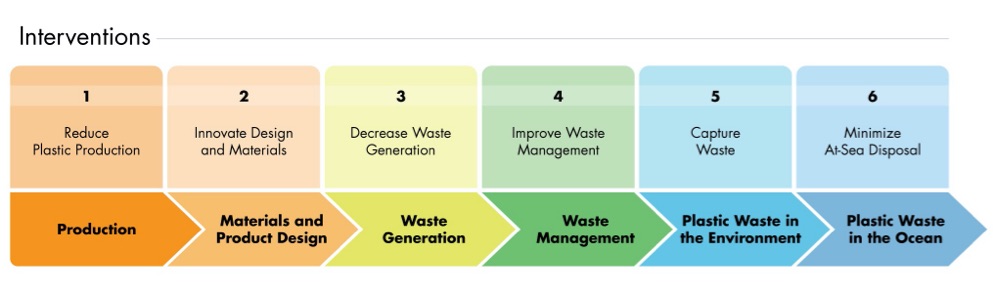
The United States should substantially reduce solid waste generation (absolute and per person) to reduce plastic in the environment and the environmental, economic, aesthetic, and health costs of managing waste and litter. There is no single solution to reducing the flow of plastic waste to the ocean. However, a suite of actions (or “interventions”) taken across all stages of the path from source to ocean could reduce ocean plastic waste and achieve parallel environmental and social benefits.
Decrease Waste Generation. Actions at this stage reduce unnecessary use of plastics such as some single use applications. Types of interventions can include product limits and targets for recycling and reuse.
Improve Waste Management (Prevent or Reduce Disposal/Discharge). Action within this stage improves solid and other waste infrastructure, collection, treatment and management, including leakage control and accounting.
Capture Waste (to Remove Plastic Waste from the Environment.) Improving waste capture from the environment before or after it enters the ocean is another intervention strategy. This can include re-capturing wastes from stormwater or directly from waters where it accumulates, such as during river or beach cleanups or using retention booms.
Minimize Ocean Disposal. This category reduces inputs of plastic waste into the ocean directly from vessels, point sources, or platforms and includes actions under specific laws and treaties relevant to ocean pollution.
Other Activities (to Support Above Interventions)
Flow diagram of available plastic waste interventions from plastic production to recapture of plastics in the ocean.
Alongside our 2021/22 Global Learning Wall Planner - 10 Ways to Reboot the Future - we’re releasing a series of monthly classroom resources.
Each of our class activity resources explores a different focus for creating a more sustainable and compassionate future, based on the 10 Big Shifts in Jonathon Porritt’s Rise Up to Reboot the Future.
The activities are adaptable for all age ranges and can be used as standalone activities for tutor group sessions or can slot into a lesson.
Rebooting International Cooperation
This month’s class activity explores December's theme of International Cooperation. Learners explore the concept of the Tragedy of the Commons through a game where resources are replenished as they are used up. Participants have to find a way to cooperate so that the resources don't run out.
New this year: monthly challenges
Every month we will be setting a series of challenges – complete one or more of the challenges as a whole class, or choose 2 or 3 pupils to complete one each month over the course of the year.
To win a bundle of books for your class – all linked to this month’s theme - simply post a photo of your class’s completed challenge on social media before the end of September 2021, and tag @globaldimension for the chance to win.