"Covid is shining the spotlight on the fragility of the linear systems that we have come to rely on.
In many countries, particularly in the US, the food system has been thrown into chaos. The industrial food system is inherently fragile. One missing link in the chain means the entire process grinds to a halt.
There are alternatives. 70% of the world's food is produced by smallholders (5 acres or less) and distributed to their local communities. Where I live in Central Victoria, we have created a thriving food network similar to the food systems that existed worldwide before industrialisation changed the way we eat. In our world, if one element of the network fails, there are many more to pick up the slack. A network like this can respond to change. It can adapt. It has humans at its source, so a bad year for one small farm provides an opportunity for the community to help out. In a system of people and not corporations you will never see millions of litres of milk thrown away or abattoir workers being forced to work when they're sick. You will not see the overt disregard for animal rights and the destruction of planet, climate and indigenous lands. You will never see millions on tonnes of food rotting in the fields while supermarket prices rise.
Creating resilient food networks is an exciting space, and many local councils, farmers and groups are bringing about positive and lasting change in this field. Check out what's going on in your area, find and meet your farmers, and plant food everywhere." - Brenna Quinlan
“Relation is the essence of everything that exists.” — Master Eckhart
When we look closer, we discover that Life is an explosion of relation, everywhere around and inside of us. From the biology of our bodies, to insects and plants, communication between trees through mycelium circuits... Relation is in the DNA of Life. Interaction and interdepedancy are part of our essence. We, humans, are in relation with ourselves, others and nature. All our senses, feelings and emotions are potential gateways to connect. These invisible and indivisible bounds relate us to Life at each moment.
In The Great Relation, we wish to share the beauty and mystery of this constant ocean of relation and bring light to creative ways in which Life experiences itself through human beings that are looking for more conscious and regenerative ways to relate to her.
A filmmaking project for a new culture
In these times of great transition, our aim is to communicate meaningful projects and stories that bring healing and regeneration to the individual, collective and environmental dimensions of our world.
We are exploring the potential of human beings to create a more conscious and regenerative way of living on this planet. These exploration goes from the design of resilient settlements, like intentional communities and ecovillages, and the discovery of practical ecological solutions, to spirituality and different approaches to relate more consciously with one another, heal our cultural wounds and traumas, and many other topics.
Our dream is to contribute to the flourishment of human consciousness through films that inspire to relate deeper with ourselves, others and nature.
“How do we change the world? Change the story.” — Charles Eisenstein
How do we navigate the intensity of emotions and reactions stirred up by climate change, or COVID-19 for that matter? How do we come to a place of peace, compassion, forgiveness and life-affirming action?
Both leading edge science and ancient wisdom traditions point us inwards for the answer.
In this documentary you will go with us on a journey to see how our inner climate relates to the topic of climate change. And how changing from within will create the change we need.
The INNER CLIMATE CHANGE documentary focuses on the very personal experiences, insights and responses to the climate crisis, of people who participated in the Climate Change and Consciousness conference (CCC19) held in 2019 at the Findhorn Ecovillage in the northeast of Scotland. Conference participants included 350 youngers and elders of multiple ethnicities and diverse genders from 45 countries.
How to work with your inner world?
The Findhorn Foundation Community has almost 60 years experience in working with the inner world. Use our resources on your own inner journey.
Transformational Leadership in the Time of Corona. Weekly online Zoom meeting for those of you who are looking for support to work through leadership challenges, to connect with other leaders, and to discover ways to move through the crisis gracefully and effectively.
Findhorn New Story Programmes: Our transformative suite of ‘Living the New Story’ online learning journeys are available live or on demand, in the spirit of the gift.
PATH - Planning and Architecture Towards Holistic development - is an architecture and planning studio in Auroville led by Lalit Kishor Bhati and Shailaja Sudhalkar Bhati that endeavours to create sustainable and harmonious designs in planning, architecture and interiors.
Beginning
PATH was formed in Auroville, in 2004 with the intention to manifest creative expressions stemming from the journey of self-discovery and an ever evolving understanding of life.
Being in Auroville, PATH has a wonderful opportunity of getting constantly inspired from the works of the pioneering architects of Auroville. The quality of the design, the detailing of the spaces, the element of inherent beauty and the joyful experimentation of materials in the precedents in Auroville constantly frames the brief of any project that PATH undertakes.
Approach "It is through Beauty that the Divine manifests in the Physical" - The Mother
Our work is centered on the belief that beauty and harmony in the built environment inspires corresponding harmony and wellbeing in life.
We strive to create spaces that respond to climate while exploring the various possibilities with materials and redefining elements to create forms that flow with the requirement and the essential spirit of the place. The built forms then become places one can be inspired in; the connection to the elements outside facilitating and mirroring the connection to the spaces within oneself.
While the built spaces communicate unobstructed with the nature and its elements, they provide appropriate protection from the same. The shading elements thus conceived form the basis of the visual language of our built works such as large overhangs on corbelled walls, spouts that bring down the rain water at points of easy collection, openings for cross ventilation and roofs that rise up to catch a piece of sky for every space enclosed.
Thus, our buildings are varied; follow no one particular style except that of honesty and creativity and the joyful celebration of the essence enclosed.
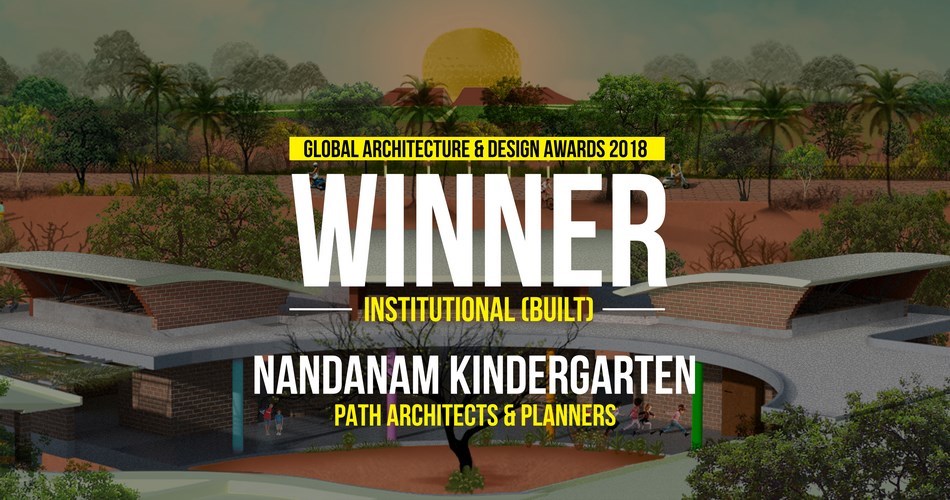
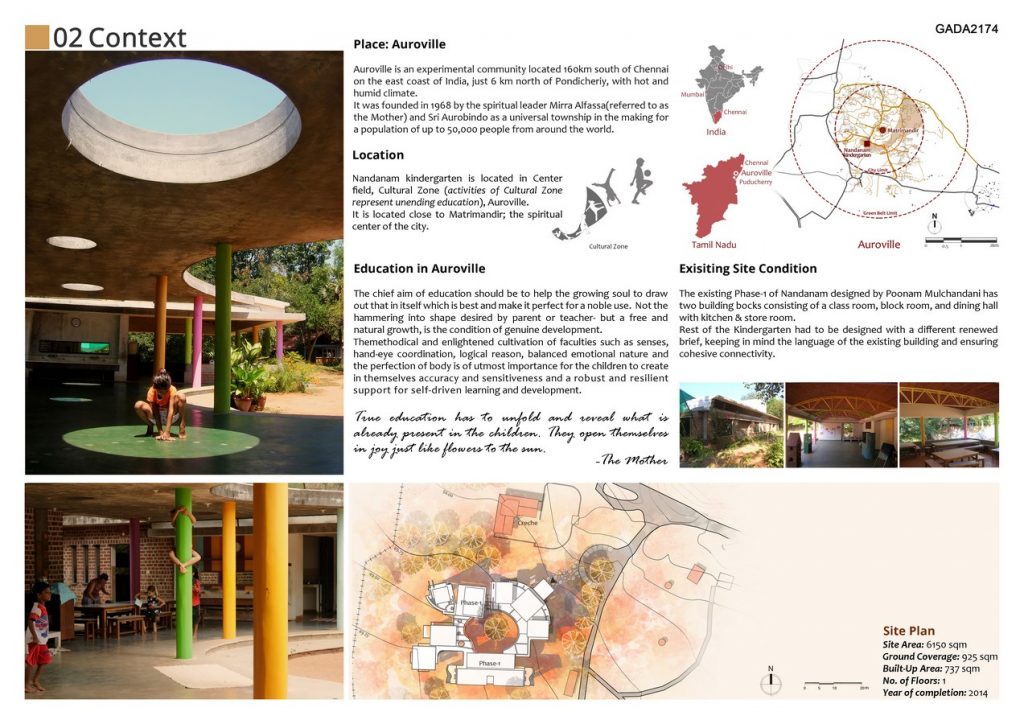
Nandanam Kindergarten is located in Cultural Zone, close to Matrimandir- the spiritual center of Auroville, Tamil Nadu, India. It was conceived when the children in Auroville outgrew the student intake capacity of the existing Kindergarten. The project was built in four phases starting from 2006 and was completed in 2014. Each phase took 9 months to complete and commenced as funds were available.
Global Architecture & Design Awards 2018 First Award | Category: Institutional (Built)
Architects: PATH Architects & Planners
Country: India
The Phase-1 was done by a different architect, and the rest of the Kindergarten is designed by our Studio with a renewed brief keeping in mind the design language of the existing building and ensuring cohesive connectivity.
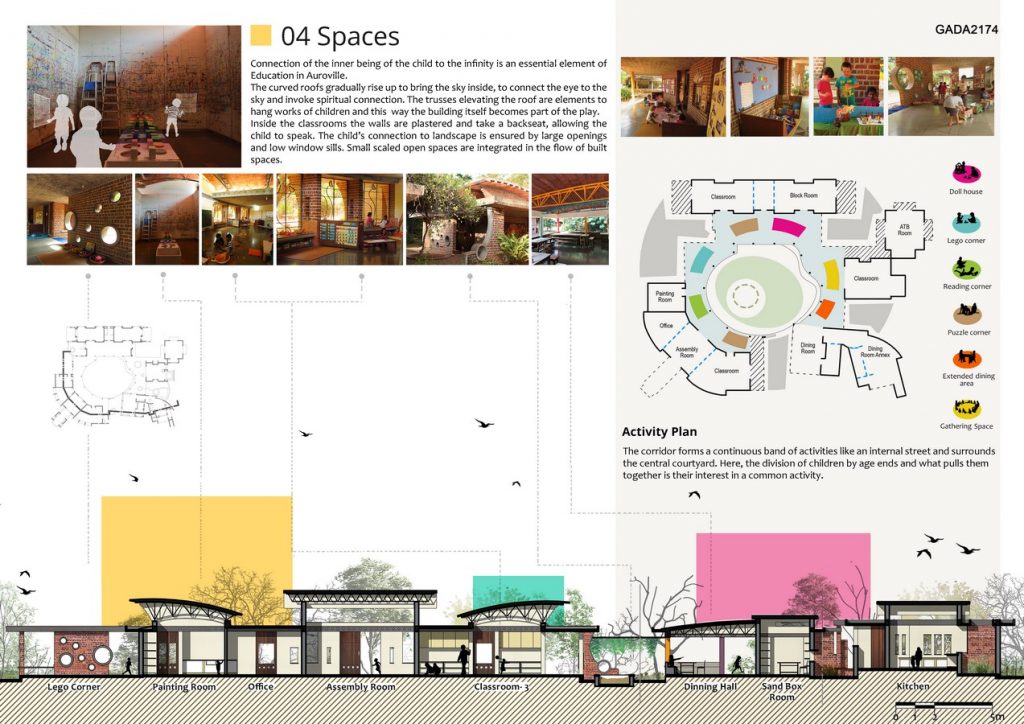
Inspiration: Nandanam endeavors to create through the medium of architecture, spaces that are responsive to the vast spirit of the child and facilitate natural curiosity, exploration and integral learning. The design is seen as the chance to break free from existing norms in education by creating an environment that nurtures and enhances inner wisdom and holistic development of each child.
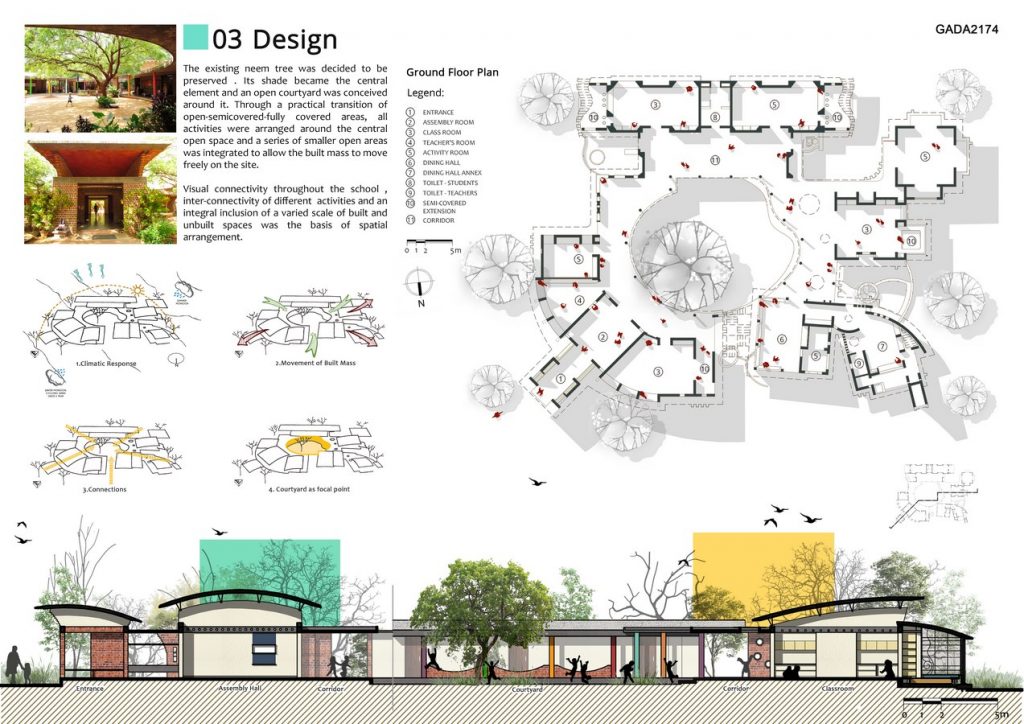
Design: The center of the entire plan and the main focal element – the open courtyard is the constant reference and shaded by existing Neem tree, it is indeed the calm anchor that holds the entire composition together. This is the heart of the school and is symbolic to the open minded approach as the core principal of education in Auroville. All the classrooms and activity rooms are arranged around this through common semi covered space which forms a continuous band of activities like an internal street. The classrooms have each been provided with a private play area and sand-pit to encourage physical education.
Unique features: The kindergarten is thought of as a garden for the young that facilitates visual drama with the use of bright colors, openings on the walls, skylights and plenty of landscape flowing through the building.
Design Challenges: The first challenge faced while designing this kindergarten was that the first phase out of 4 was already built by another architect. The existing building corresponded to a regular grid while the rest of the kindergarten called for a different approach. The second challenge faced was that the building had to be designed with flexibility in order to accommodate Auroville’s evolving and holistic system of education. The third challenge was to work on different designs with the teachers who were also the clients, who had multiple ideas and perspectives that often internally contradicted.
Specification:
Site Area: 6150sqm
Ground Coverage: 925sqm
Built Up Area: 737sqm
Number of Floors: 1
WHY REIMAGINING? The Fire of Evolution
In a world of accelerating technological evolution individuals and collectives are increasingly under pressure to evolve and adapt. Education is no more limited to children and youth but has become a lifelong process for everyone to remain relevant in a rapidly changing world. Such a learning, naturally, must be self-driven and this is possible only when the evolutionary fire within each individual is kindled. The present education system cast in the mould of industrial mass production methods ignores the true individual. Discovering the evolutionary fire within demands a radical re-imagination of the present education in its totality.
Learning Society
If education is to continue throughout life, then all activities and institutions of life must be consciously recognised and reorganised as contexts for learning. This demand us to reimagine the very notion of university if it is to embrace all contexts of human life from birth to death. It has to be a learning society that is at once a university as well as a city where the full complexity of human life is experimented upon in live-in laboratories. All social institutions and process, from science to technology, from arts to culture, from governance to economy, from families to workplaces, from birth to death, are to be reimagined into living laboratories to give birth to a new society, a new humanity.
Auroville
Auroville is a bold step in this direction, a prototype in the making, a live-in laboratory of transformational learning and research. According to the Auroville Charter: Auroville will be the place of an unending education, of constant progress, and a youth that never ages. Auroville will be a site of material and spiritual researches for a living embodiment of an actual human unity. Even after 50 years, children of Auroville are still going out after their schooling for higher education. At the same time, thousands of interns, volunteers & researchers who come to Auroville rarely touch the deeper dimension of Auroville. This brings into focus the need to organise higher education opportunities within Auroville.
How Does Learning Happen in Auroville?
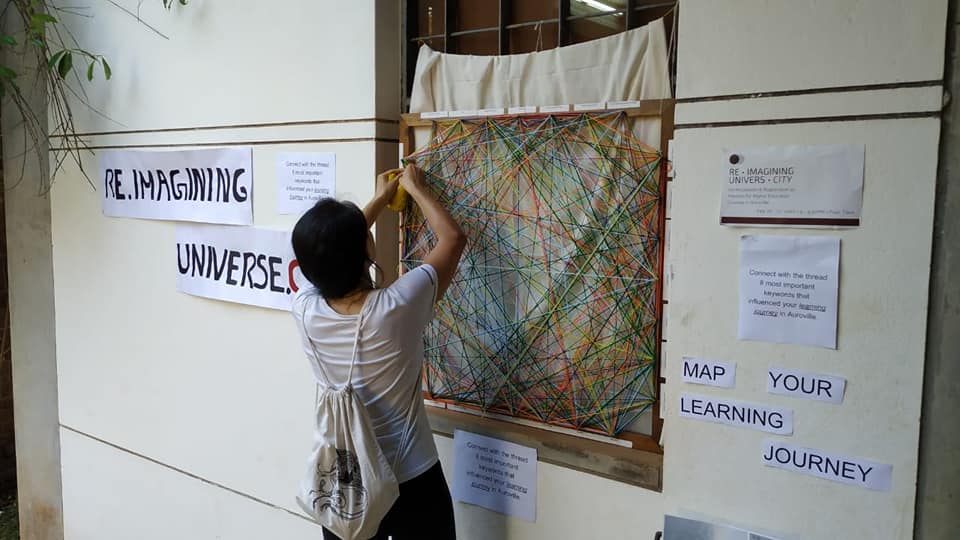
Auroville Campus Initiative, as a follow up to the Confluence (https://confluence.auroville.org) set-up a co-creative art installation on Re-imagining Auroville as a Univers-city. It was setup this year around Auroville's birthday outside Pour Tous, our collective cooperative. On the art installation, more than a 100 Aurovilians mapped their learning journeys through knitting threads that they used to connect the most unique aspects of their learning journey in Auroville. Each one chose 8 keywords out of 28 keywords to represent their learning journey.
The 28 keywords were derived from several community gatherings (including the Confluence & the Bridge), core documents of Auroville as well as semiotics research by Aiyana Gunjan on Auroville's culture.*
The installation was set-up in front of Pour Tous (PTDC) in Auroville on Feb 26 and Feb 27, 2020.The installation gave a glimpse of how learning happens in Auroville. It is often difficult to see how learning takes place for an outsider, since there are no degrees, titles and positions here! However, when we starting making the invisible factors visible, acknowledging them, verbalising them, it becomes apparent that the process of learning in Auroville is very real and it is indeed an educational Campus!
During the installation, we also took sign-ups from Aurovilians who said they would be interested in mentoring students interested in long-term serious study. Some said they would be interested in mentoring students about a specific skill or domain knowledge-base; others said they would be interested in mentoring about life in general; and yet a few more said they would be interested in mentoring in both areas - life in Auroville & a subject/domain.
If you are an Aurovilian interested in signing up to be a mentor, please take 30 seconds to fill the following form: https://forms.gle/9peDRhZLBj8AvMwg8
Please note that this is only an initial sign-up sheet. As a follow-up, we will be sharing a Google form over mail, that will allow Aurovilians to fill more details about - their profiles, their expectations from students, their availability etc. We may also have a follow-up in the form of a presentation/workshop to this.
Now, let us explore a little bit of our findings from the co-creative art installation! It was actually also a mini-research project, for it revealed the most significant contributors to our learning in Auroville as well as the least significant. The top three clusters of the most significant contributors to our learning in Auroville were found to be: 1. The Inner Work: Silence, Intuition, Aspiration, Self-discovery 2. The Outer Work Learning by Doing, Experimentation 3. The City: Nature, Beauty, Matrimandir
Perhaps it only reveals the areas where we intuitively already know. Cheers!
Appendix Here are 28 of the infinite aspects that enable learning in Auroville.
1. Cultural Diversity 2. Living your purpose 3. Free learning opportunities 4. Learning By Doing 5. Curiosity 6. Experimentation 7. Community Living 8. Silence 9. Self-Discovery 10. Meaningful work 11. Non hierarchical 12. collaboration 13. Peer to peer learning 14. Lifelong learning 15. Community Service 16. Nature 17. Beauty 18. Art 19. Matrimandir 20. Universal Culture 21. Global citizenship 22. Self expression 23. Sri Aurobindo & The Mother 24. The Dream 25. Aspiration 26. Brotherhood 27. Intuition 28. Addressing Global Challenges
+++ COVID 19 IS CHANGING OUR REALITY +++ IT IS ON US TO PROACTIVELY CHANGE OUR REALITY TOGETHER & BY OURSELVES
Be informed about new content
If you do not want to miss out on content and do not fully trust in the functioning of social media algorithms just subscribe here and we will send you the new content right into your mailbox.
Key design drivers
Before we get into the details and content of our COVID-19 Community Resilience & Permaculture Course, we want to share some of our values, beliefs and design drivers for this course. Our main design drivers are pretty solid and whatever we will change in terms of the structure and methods, our main purpose for this course will be consistent; we want to serve and increase resilience. By focusing on resilience and adding some more topics, techniques, and methods to the regular PDC curriculum we hope to
empower people in this time of isolation, uncertainty, and fear
build resilience on an individual, community, and global level
create the foundation and confidence to change our reality towards something new
Expectation managment
This entire project is work in progress. The content is and will be produced just in time and on top of our daily community structure and workload. At Gaia Ashram, we are fostering our food production at the moment with the aim to become more independent from outside food supply. To achieve this goal we are dedicating time and energy towards working with the land and the plants. This by itself is already a healing experience.
Nevertheless, we are trying our very best for every bit of content (video, text, graphic) we are about to share with you. We put our priority in terms of energy input towards the quality of the thematic content as this is key! But we know how important pleasing and well-created images and videos are; especially for you guys to absorbe as much as possible. Because of that, we try our very best and we hope to increse quality over time.
If you have time, skills, or any other resources that you would be willing to dedicate to this course we are happy for co-creation and co-ownership. This is about impact and not about ego. Please send us a email if you have any idea how to make it happen! We also love to listen to your constructive feedback so please share your thoughts, ideas, and recommondations with us.
Furthermore, this online course is not designed to replace a “real” Permaculture Design Course. Please understand it as a first step into the permaculture world and a great foundation to foster independence and increase resilience in your individual life. Our next “real life” PDC will most likely start on November 25, at Gaia Ashram in Thailand. If you’re curious, you can find all details here.
Thank you for becoming active and being part of this course! Let’s make it together and create a new reality full of love, peace, resilience, independence, and stewartship.
Structure of the course
The online course is following the daily sessions we are holding at Gaia Ashram at the moment to increase our own resilience and knowledge. We started with the community sessions pretty much 2 weeks ago. By now we feel ready to bring it out to you and share it with our global community.
Whenever we will upload a new session it will be automatically updated to this page and highlighted as new content. To keep yourself up to date you just have to visit this website from Monday to Friday for new content. If you want to get the newest content right into your mailbox, just write us a short email to info@flowful.org and we are happy to keep you on track.
We will start from patterns to detail and create an overall picture first before going into the details and the magic of the different permaculture tools and techniques. The content, tools and teqniques of permaculture are working under all climate conditions. In this course we will focus on temperate and tropical climates and will showcase examples from both climates.
Who can participate?
Everybody can participate! It doesn’t matter if you already have a some knowledge and experience or if you are just about to start to discover the permaculture world. The content is designed in a way that everybody will get the right thing out of it supporting your individual learning journey. The only requirement is to staying active and open-minded to new things and concepts.
Permaculture & Community Resilience Course Sessions
Let’s go to to the content and start our learning journey together. To get the most out of it you might want to follow the given strucutre and read and watch the content in the upcoming order.
BEFORE YOU START: BETTER TOGETHER AND MANAGE EXPECTATIONS
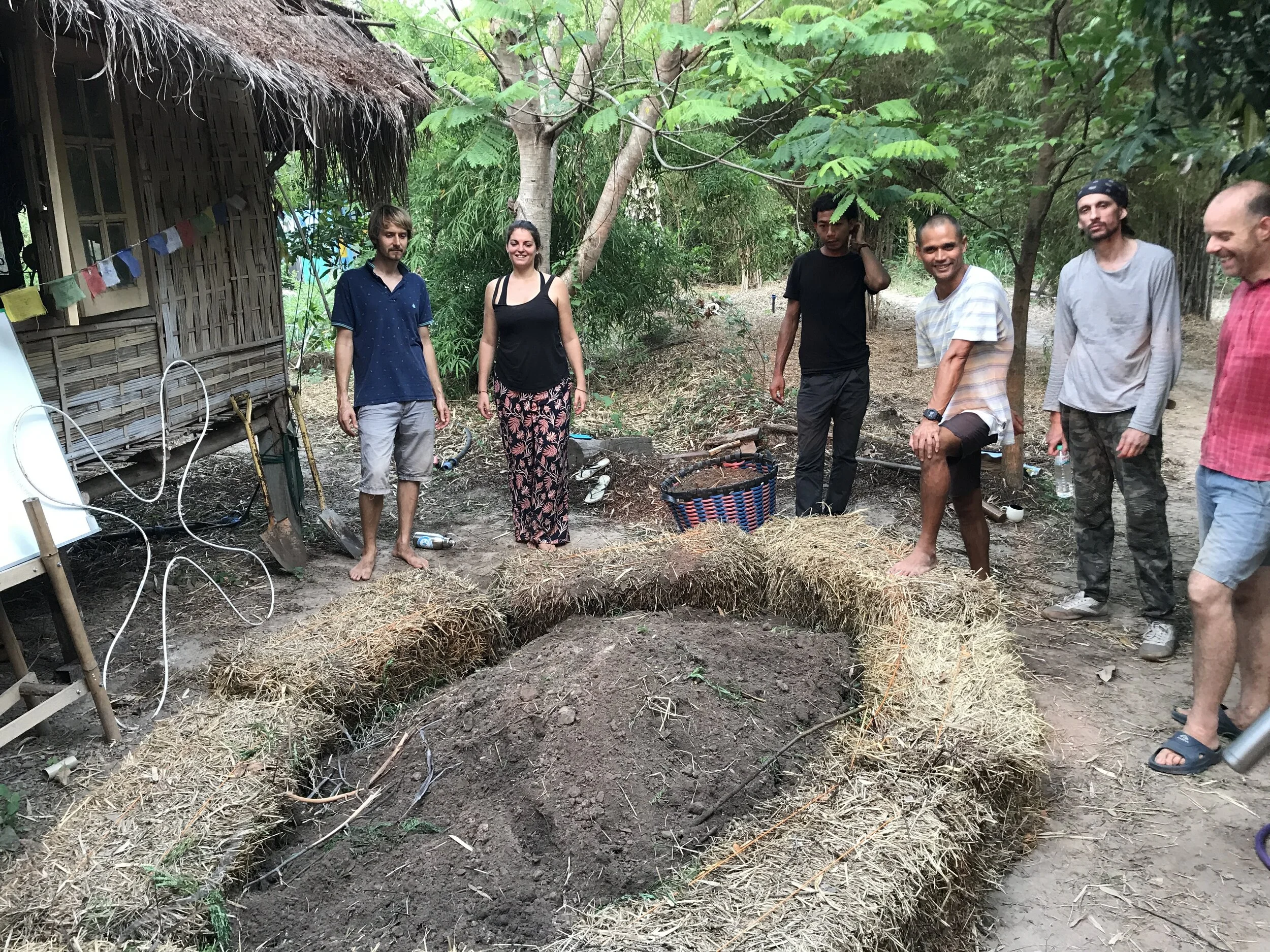
This session is dedicated to implementing Sepp Holzer’s famous Hugelkultur to create a new garden bed (horticulture). After this session you will:
Be introduce the concept of a Hugelkultur garden bed
Know the 5 steps to implement a Hugelkultur garden bed
Understand what one Element many functions is about
Be introduced into the benefits of Hugelkultur:
Session 5: Permaculture Overview (Online April 14)
Session 6: Basics of Soil (Online April 16)
Session 7: Permaculture Principles (Online April 20)
Session 8: tba
The team behind this course
This project is way more than a flowful project. It is a permaculture jam where our global friends contribute their expertise and compassion to make an incredible learning experience and (online) community happening for all of us. For now, the following people are mainly involved:
CONTENT
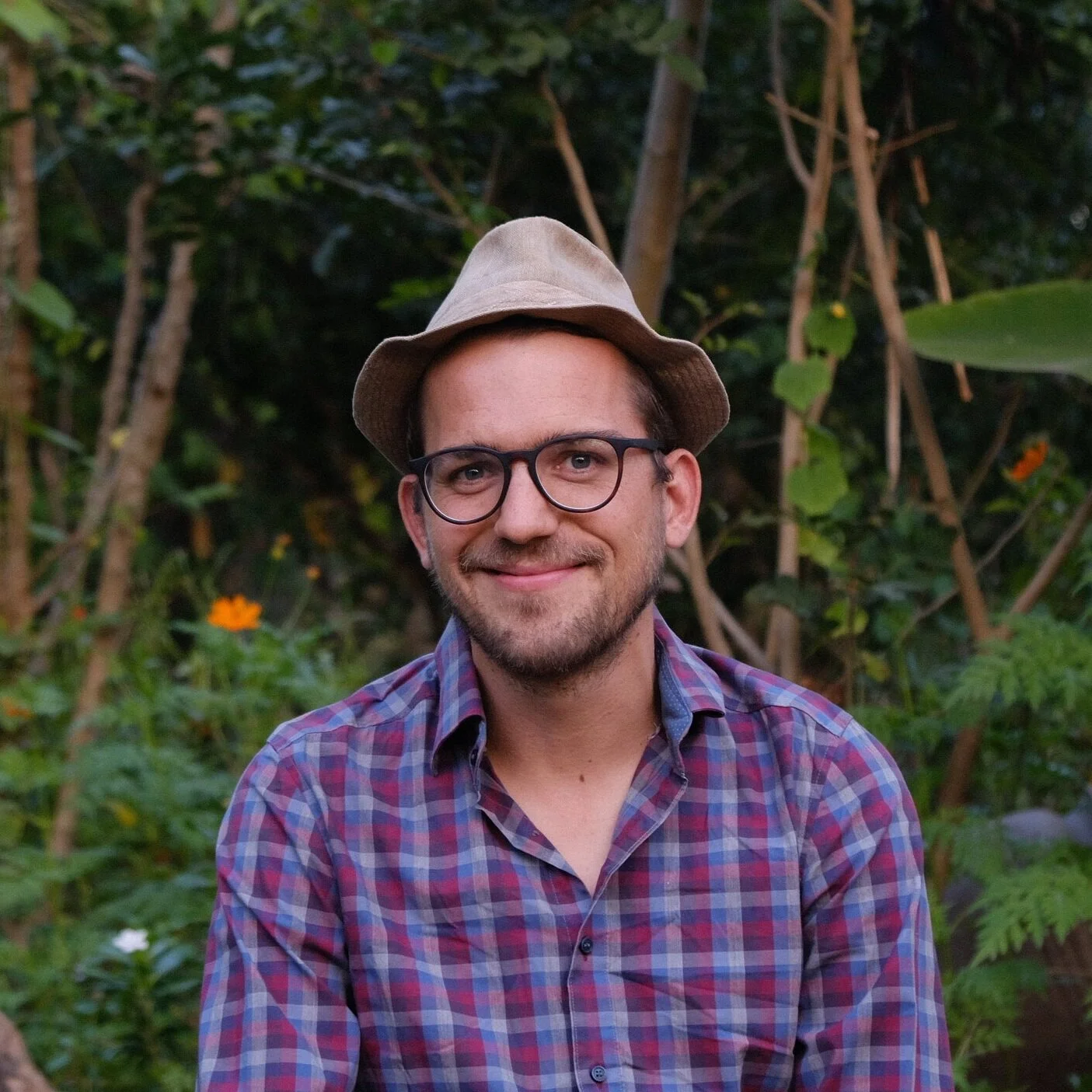
Karla Franielczyk is a permaculturist, yoga teacher, and natural builder. Always attracted by nature, she deepened her connection with Mother Earth through becoming vegan and finally did her Permaculture Design Course at the Panya Project, Thailand. Living at Gaia Ashram for almost 2 years, Karla has been practicing permaculture in her day to day life. She is passionate about soil, ecosystem restoration, holistic living, social permaculture, and natural building.
Lars Blume discovered his love for gardening in his early childhood and was introduced to the magic of plants by his grandparents. While supporting them to grow fruits and vegetables in the family garden, he gained a basic understanding and a natural way of interacting with soil and nature. He is passionate about increasing social, environmental, and animal justice with a focus on food democracy. Lars’ key learning and one of the reasons to co-found flowful is to keep on learning and stretching the personal comfort zone every single day.
VISUALISATION
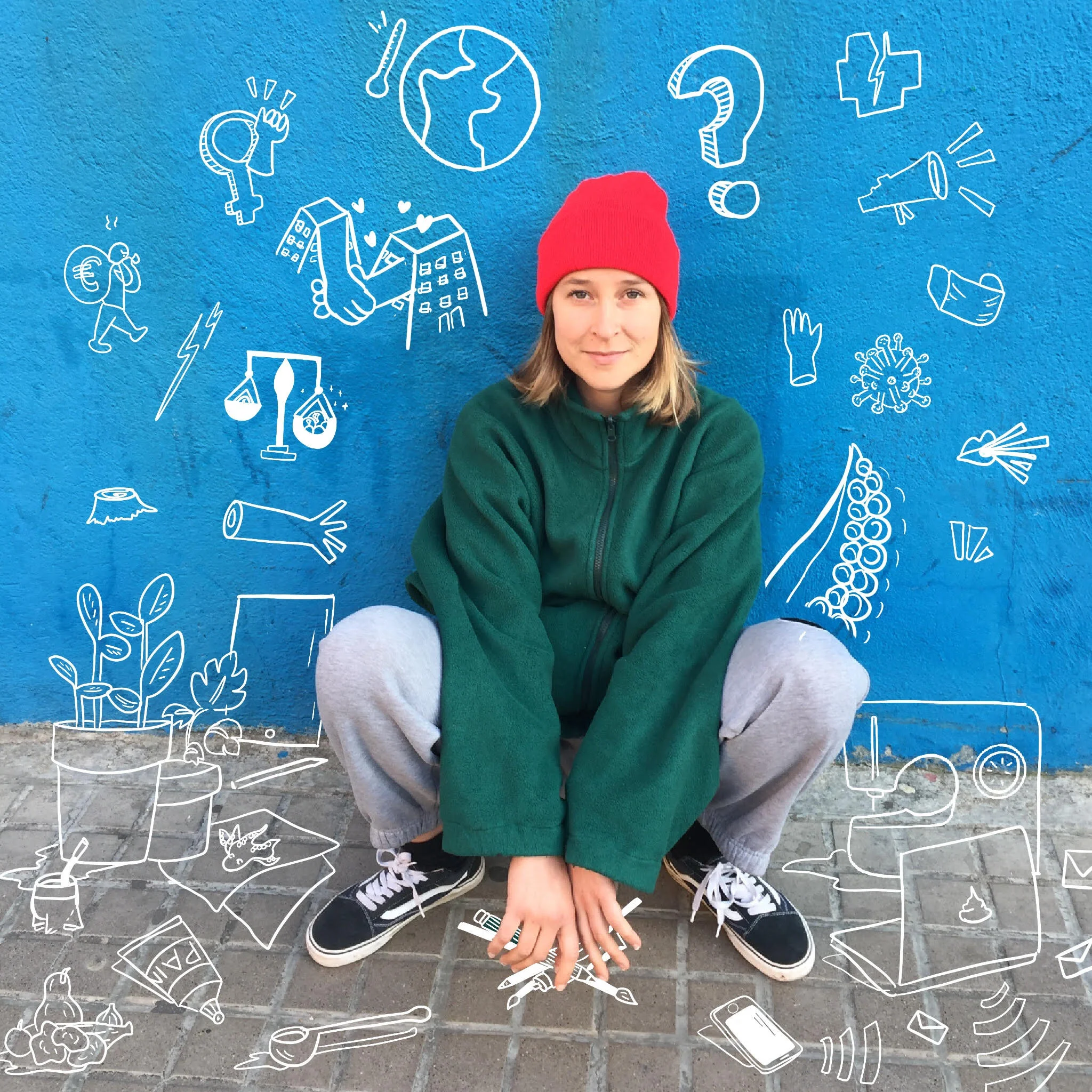
Fanny Didou is a graphic facilitator and graphic recorder. She founded sketching the move in order to support dialogue through a universal language: drawing. Fanny originally is from Britany in France and is currently living in Barcelona.
Sustainability is a key driver in the projects she is involved in. She is an illustrator and works with organisations involved in making an environmental and social change. She is also using creative methods in environmental education.