By Donella Meadows
The Dance
1. Get the beat.
2. Listen to the wisdom of the system.
3. Expose your mental models to the open air.
4. Stay humble. Stay a learner.
5. Honor and protect information.
6. Locate responsibility in the system.
7. Make feedback policies for feedback systems.
8. Pay attention to what is important, not just what is quantifiable.
9. Go for the good of the whole.
10. Expand time horizons.
11. Expand thought horizons.
12. Expand the boundary of caring.
13. Celebrate complexity.
14. Hold fast to the goal of goodness.
People who are raised in the industrial world and who get enthused about systems thinking are likely to make a terrible mistake. They are likely to assume that here, in systems analysis, in interconnection and complication, in the power of the computer, here at last, is the key to prediction and control. This mistake is likely because the mindset of the industrial world assumes that there is a key to prediction and control.
I assumed that at first too. We all assumed it, as eager systems students at the great institution called MIT. More or less innocently, enchanted by what we could see through our new lens, we did what many discoverers do. We exaggerated our own ability to change the world. We did so not with any intent to deceive others, but in the expression of our own expectations and hopes. Systems thinking for us was more than subtle, complicated mindplay. It was going to Make Systems Work.
But self-organizing, nonlinear, feedback systems are inherently unpredictable. They are not controllable. They are understandable only in the most general way. The goal of foreseeing the future exactly and preparing for it perfectly is unrealizable. The idea of making a complex system do just what you want it to do can be achieved only temporarily, at best. We can never fully understand our world, not in the way our reductionistic science has led us to expect. Our science itself, from quantum theory to the mathematics of chaos, leads us into irreducible uncertainty. For any objective other than the most trivial, we can’t optimize; we don’t even know what to optimize. We can’t keep track of everything. We can’t find a proper, sustainable relationship to nature, each other, or the institutions we create, if we try to do it from the role of omniscient conqueror.
For those who stake their identity on the role of omniscient conqueror, the uncertainty exposed by systems thinking is hard to take. If you can’t understand, predict, and control, what is there to do?
Systems thinking leads to another conclusion–however, waiting, shining, obvious as soon as we stop being blinded by the illusion of control. It says that there is plenty to do, of a different sort of “doing.” The future can’t be predicted, but it can be envisioned and brought lovingly into being. Systems can’t be controlled, but they can be designed and redesigned. We can’t surge forward with certainty into a world of no surprises, but we can expect surprises and learn from them and even profit from them. We can’t impose our will upon a system. We can listen to what the system tells us, and discover how its properties and our values can work together to bring forth something much better than could ever be produced by our will alone.
We can’t control systems or figure them out. But we can dance with them!
I already knew that, in a way before I began to study systems. I had learned about dancing with great powers from whitewater kayaking, from gardening, from playing music, from skiing. All those endeavors require one to stay wide-awake, pay close attention, participate flat out, and respond to feedback. It had never occurred to me that those same requirements might apply to intellectual work, to management, to government, to getting along with people.
But there it was, the message emerging from every computer model we made. Living successfully in a world of systems requires more of us than our ability to calculate. It requires our full humanity–our rationality, our ability to sort out truth from falsehood, our intuition, our compassion, our vision, and our morality.
I will summarize the most general “systems wisdom” I have absorbed from modeling complex systems and from hanging out with modelers. These are the take-home lessons, the concepts and practices that penetrate the discipline of systems so deeply that one begins, however imperfectly, to practice them not just in one’s profession, but in all of life.
The list probably isn’t complete, because I am still a student in the school of systems. And it isn’t unique to systems thinking. There are many ways to learn to dance. But here, as a start-off dancing lesson, are the practices I see my colleagues adopting, consciously or unconsciously, as they encounter systems.
1. Get the beat.
Before you disturb the system in any way, watch how it behaves. If it’s a piece of music or a whitewater rapid or a fluctuation in a commodity price, study its beat. If it’s a social system, watch it work. Learn its history. Ask people who’ve been around a long time to tell you what has happened. If possible, find or make a time graph of actual data from the system. Peoples’ memories are not always reliable when it comes to timing.
Starting with the behavior of the system forces you to focus on facts, not theories. It keeps you from falling too quickly into your own beliefs or misconceptions, or those of others. It’s amazing how many misconceptions there can be. People will swear that rainfall is decreasing, say, but when you look at the data, you find that what is really happening is that variability is increasing–the droughts are deeper, but the floods are greater too. I have been told with great authority that milk price was going up when it was going down, that real interest rates were falling when they were rising, that the deficit was a higher fraction of the GNP than ever before when it wasn’t.
Starting with the behavior of the system directs one’s thoughts to dynamic, not static analysis–not only to “what’s wrong?” but also to “how did we get there?” and “what behavior modes are possible?” and “if we don’t change direction, where are we going to end up?”
And finally, starting with history discourages the common and distracting tendency we all have to define a problem not by the system’s actual behavior, but by the lack of our favorite solution. (The problem is, we need to find more oil. The problem is, we need to ban abortion. The problem is, how can we attract more growth to this town?)
2. Listen to the wisdom of the system.
Aid and encourage the forces and structures that help the system run itself. Don’t be an unthinking intervener and destroy the system’s own self-maintenance capacities. Before you charge in to make things better, pay attention to the value of what’s already there.
A friend of mine, Nathan Gray, was once an aid worker in Guatemala. He told me of his frustration with agencies that would arrive with the intention of “creating jobs” and “increasing entrepreneurial abilities” and “attracting outside investors”. They would walk right past the thriving local market, where small-scale business people of all kinds, from basket-makers to vegetable growers to butchers to candy-sellers, were displaying their entrepreneurial abilities in jobs they had created for themselves. Nathan spent his time talking to the people in the market, asking about their lives and businesses, learning what was in the way of those businesses expanding and incomes rising. He concluded that what was needed was not outside investors, but inside ones. Small loans available at reasonable interest rates, and classes in literacy and accounting, would produce much more long-term good for the community than bringing in a factory or assembly plant from outside.
3. Expose your mental models to the open air.
Remember, always, that everything you know, and everything everyone knows, is only a model. Get your model out there where it can be shot at. Invite others to challenge your assumptions and add their own. Instead of becoming a champion for one possible explanation or hypothesis or model, collect as many as possible. Consider all of them plausible until you find some evidence that causes you to rule one out. That way you will be emotionally able to see the evidence that rules out an assumption with which you might have confused your own identity.
You don’t have to put forth your mental model with diagrams and equations, though that’s a good discipline. You can do it with words or lists or pictures or arrows showing what you think is connected to what. The more you do that, in any form, the clearer your thinking will become, the faster you will admit your uncertainties and correct your mistakes, and the more flexible you will learn to be. Mental flexibility–the willingness to redraw boundaries, to notice that a system has shifted into a new mode, to see how to redesign structure — is a necessity when you live in a world of flexible systems.
4. Stay humble. Stay a learner.
Systems thinking has taught me to trust my intuition more and my figuring-out rationality less, to lean on both as much as I can, but still to be prepared for surprises. Working with systems, on the computer, in nature, among people, in organizations, constantly reminds me of how incomplete my mental models are, how complex the world is, and how much I don’t know.
The thing to do, when you don’t know, is not to bluff and not to freeze, but to learn. The way you learn is by experiment–or, as Buckminster Fuller put it, by trial and error, error, error. In a world of complex systems it is not appropriate to charge forward with rigid, undeviating directives. “Stay the course” is only a good idea if you’re sure you’re on course. Pretending you’re in control even when you aren’t is a recipe not only for mistakes, but for not learning from mistakes. What’s appropriate when you’re learning is small steps, constant monitoring, and a willingness to change course as you find out more about where it’s leading.
That’s hard. It means making mistakes and, worse, admitting them. It means what psychologist Don Michael calls “error-embracing.” It takes a lot of courage to embrace your errors.
5. Honor and protect information.
A decision maker can’t respond to information he or she doesn’t have, can’t respond accurately to information that is inaccurate, can’t respond in a timely way to information that is late. I would guess that 99 percent of what goes wrong in systems goes wrong because of faulty or missing information.
If I could, I would add an Eleventh Commandment: Thou shalt not distort, delay, or sequester information. You can drive a system crazy by muddying its information streams. You can make a system work better with surprising ease if you can give it more timely, more accurate, more complete information.
For example, in 1986 new federal legislation required U.S. companies to report all chemical emissions from each of their plants. Through the Freedom of Information Act (from a systems point of view one of the most important laws in the nation), that information became a matter of public record. In July 1988 the first data on chemical emissions became available. The reported emissions were not illegal, but they didn’t look very good when they were published in local papers by enterprising reporters, who had a tendency to make lists of “the top ten local polluters.” That’s all that happened. There were no lawsuits, no required reductions, no fines, no penalties. But within two years chemical emissions nationwide (at least as reported, and presumably also in fact) had decreased by 40 percent. Some companies were launching policies to bring their emissions down by 90 percent, just because of the release of previously sequestered information.
6. Locate responsibility in the system.
Look for the ways the system creates its own behavior. Do pay attention to the triggering events, the outside influences that bring forth one kind of behavior from the system rather than another. Sometimes those outside events can be controlled (as in reducing the pathogens in drinking water to keep down incidences of infectious disease.) But sometimes they can’t. And sometimes blaming or trying to control the outside influence blinds one to the easier task of increasing responsibility within the system.
“Intrinsic responsibility” means that the system is designed to send feedback about the consequences of decision-making directly and quickly and compellingly to the decision-makers.
Dartmouth College reduced intrinsic responsibility when it took thermostats out of individual offices and classrooms and put temperature-control decisions under the guidance of a central computer. That was done as an energy-saving measure. My observation from a low level in the hierarchy is that the main consequence was greater oscillations in room temperature. When my office gets overheated now, instead of turning down the thermostat, I have to call an office across campus, which gets around to making corrections over a period of hours or days, and which often overcorrects, setting up the need for another phone call. One way of making that system more, rather than less responsible, might have been to let professors keep control of their own thermostats and charge them directly for the amount of energy they use. (Thereby privatizing a commons!).
Designing a system for intrinsic responsibility could mean, for example, requiring all towns or companies that emit wastewater into a stream to place their intake pipe downstream from their outflow pipe. It could mean that neither insurance companies nor public funds should pay for medical costs resulting from smoking or from accidents in which a motorcycle rider didn’t wear a helmet or a car rider didn’t fasten the seat belt. It could mean Congress would no longer be allowed to legislate rules from which it exempts itself.
7. Make feedback policies for feedback systems.
President Jimmy Carter had an unusual ability to think in feedback terms and to make feedback policies. Unfortunately he had a hard time explaining them to a press and public that didn’t understand feedback.
He suggested, at a time when oil imports were soaring, that there be a tax on gasoline proportional to the fraction of U.S. oil consumption that had to be imported. If imports continued to rise the tax would rise, until it suppressed demand and brought forth substitutes and reduced imports. If imports fell to zero, the tax would fall to zero.
The tax never got passed.
Carter was also trying to deal with a flood of illegal immigrants from Mexico. He suggested that nothing could be done about that immigration as long as there was a great gap in opportunity and living standards between the U.S. and Mexico. Rather than spending money on border guards and barriers, he said, we should spend money helping to build the Mexican economy, and we should continue to do so until the immigration stopped.
That never happened either.
You can imagine why a dynamic, self-adjusting system cannot be governed by a static, unbending policy. It’s easier, more effective, and usually much cheaper to design policies that change depending on the state of the system. Especially where there are great uncertainties, the best policies not only contain feedback loops, but meta-feedback loops–loops that alter, correct, and expand loops. These are policies that design learning into the management process.
8. Pay attention to what is important, not just what is quantifiable.
Our culture, obsessed with numbers, has given us the idea that what we can measure is more important than what we can’t measure. You can look around and make up your own mind about whether quantity or quality is the outstanding characteristic of the world in which you live.
If something is ugly, say so. If it is tacky, inappropriate, out of proportion, unsustainable, morally degrading, ecologically impoverishing, or humanly demeaning, don’t let it pass. Don’t be stopped by the “if you can’t define it and measure it, I don’t have to pay attention to it” ploy. No one can precisely define or measure justice, democracy, security, freedom, truth, or love. No one can precisely define or measure any value. But if no one speaks up for them, if systems aren’t designed to produce them, if we don’t speak about them and point toward their presence or absence, they will cease to exist.
9. Go for the good of the whole.
Don’t maximize parts of systems or subsystems while ignoring the whole. As Kenneth Boulding once said, Don’t go to great trouble to optimize something that never should be done at all. Aim to enhance total systems properties, such as creativity, stability, diversity, resilience, and sustainability–whether they are easily measured or not.
As you think about a system, spend part of your time from a vantage point that lets you see the whole system, not just the problem that may have drawn you to focus on the system to begin with. And realize, that, especially in the short term, changes for the good of the whole may sometimes seem to be counter to the interests of a part of the system. It helps to remember that the parts of a system cannot survive without the whole. The long term interests of your liver require the long term health of your body, and the long term interests of sawmills require the long-term health of forests.
10. Expand time horizons.
The official time horizon of industrial society doesn’t extend beyond what will happen after the next election or beyond the payback period of current investments. The time horizon of most families still extends farther than that–through the lifetimes of children or grandchildren. Many Native American cultures actively spoke of and considered in their decisions the effects upon the seventh generation to come. The longer the operant time horizon, the better the chances for survival.
In the strict systems sense there is no long-term/short-term distinction. Phenomena at different time-scales are nested within each other. Actions taken now have some immediate effects and some that radiate out for decades to come. We experience now the consequences of actions set in motion yesterday and decades ago and centuries ago.
When you’re walking along a tricky, curving, unknown, surprising, obstacle-strewn path, you’d be a fool to keep your head down and look just at the next step in front of you. You’d be equally a fool just to peer far ahead and never notice what’s immediately under your feet. You need to be watching both the short and the long term–the whole system.
11. Expand thought horizons.
Defy the disciplines. In spite of what you majored in, or what the textbooks say, or what you think you’re an expert at, follow a system wherever it leads. It will be sure to lead across traditional disciplinary lines. To understand that system, you will have to be able to learn from–while not being limited by–economists and chemists and psychologists and theologians. You will have to penetrate their jargons, integrate what they tell you, recognize what they can honestly see through their particular lenses, and discard the distortions that come from the narrowness and incompleteness of their lenses. They won’t make it easy for you.
Seeing systems whole requires more than being “interdisciplinary,” if that word means, as it usually does, putting together people from different disciplines and letting them talk past each other. Interdisciplinary communication works only if there is a real problem to be solved, and if the representatives from the various disciplines are more committed to solving the problem than to being academically correct. They will have to go into learning mode, to admit ignorance and be willing to be taught, by each other and by the system.
It can be done. It’s very exciting when it happens.
12. Expand the boundary of caring.
Living successfully in a world of complex systems means expanding not only time horizons and thought horizons; above all it means expanding the horizons of caring. There are moral reasons for doing that, of course. And if moral arguments are not sufficient, then systems thinking provides the practical reasons to back up the moral ones. The real system is interconnected. No part of the human race is separate either from other human beings or from the global ecosystem. It will not be possible in this integrated world for your heart to succeed if your lungs fail, or for your company to succeed if your workers fail, or for the rich in Los Angeles to succeed if the poor in Los Angeles fail, or for Europe to succeed if Africa fails, or for the global economy to succeed if the global environment fails.
As with everything else about systems, most people already know about the interconnections that make moral and practical rules turn out to be the same rules. They just have to bring themselves to believe that which they know.
13. Celebrate complexity.
Let’s face it, the universe is messy. It is nonlinear, turbulent and chaotic. It is dynamic. It spends its time in transient behavior on its way to somewhere else, not in mathematically neat equilibria. It self-organizes and evolves. It creates diversity, not uniformity. That’s what makes the world interesting, that’s what makes it beautiful, and that’s what makes it work.
There’s something within the human mind that is attracted to straight lines and not curves, to whole numbers and not fractions, to uniformity and not diversity, and to certainties and not mystery. But there is something else within us that has the opposite set of tendencies, since we ourselves evolved out of and are shaped by and structured as complex feedback systems. Only a part of us, a part that has emerged recently, designs buildings as boxes with uncompromising straight lines and flat surfaces. Another part of us recognizes instinctively that nature designs in fractals, with intriguing detail on every scale from the microscopic to the macroscopic. That part of us makes Gothic cathedrals and Persian carpets, symphonies and novels, Mardi Gras costumes and artificial intelligence programs, all with embellishments almost as complex as the ones we find in the world around us.
14. Hold fast to the goal of goodness.
Examples of bad human behavior are held up, magnified by the media, affirmed by the culture, as typical. Just what you would expect. After all, we’re only human. The far more numerous examples of human goodness are barely noticed. They are Not News. They are exceptions. Must have been a saint. Can’t expect everyone to behave like that.
And so expectations are lowered. The gap between desired behavior and actual behavior narrows. Fewer actions are taken to affirm and instill ideals. The public discourse is full of cynicism. Public leaders are visibly, unrepentantly, amoral or immoral and are not held to account. Idealism is ridiculed. Statements of moral belief are suspect. It is much easier to talk about hate in public than to talk about love.
We know what to do about eroding goals. Don’t weigh the bad news more heavily than the good. And keep standards absolute.
*****
This is quite a list. Systems thinking can only tell us to do these things. It can’t do them for us.
And so we are brought to the gap between understanding and implementation. Systems thinking by itself cannot bridge that gap. But it can lead us to the edge of what analysis can do and then point beyond–to what can and must be done by the human spirit.
Source: http://donellameadows.org/archives/dancing-with-systems
Saturday, February 9, 2019
Monday, January 14, 2019
Active learning approach


As the paradigm shifts towards learner-centered approaches to instruction, active learning has gained increased attention in higher education circles. You may have even seen images of classrooms that have undergone extensive renovation to become “active learning classrooms.” But what is active learning and how does it support student success?
Active learning, as the name suggests, is an instructional strategy where students take an active role their own learning, participating in activities and, reflecting on their learning.Students are fully engaged in the learning process rather than being passive participants. “Active Learning” is, in short, anything that students do in a classroom other than merely passively listening to an instructor’s lecture. This includes everything from listening practices which help the students to absorb what they hear, to short writing exercises in which students react to lecture material, to complex group exercises in which students apply course material to “real life” situations and/or to new problems. (Paulson and Faust)Active learning can take many forms but generally involves four basic elements which can take place individually, in pairs, or in small or collaborative groups. The inclusion of these four elements make active learning especially well suited to interdisciplinary studies. The four elements include:
- talking and listening
- writing
- reading
- and reflecting
Research indicates active learning works because it involves the active construction of knowledge by the learner. Additionally, learners are more likely to learn when they are with others rather than in isolation. There are a growing number of sites on the Internet with information on active learning strategies. However working in teams to solve a problem, or collaborating on a project, is not enough. What makes active learning more effective than traditional lecture-based instruction is not the activity alone, but how students engage in the task mentally. “Active learning is most effective when the experience supports students to interact with and reflect on the subject matter in substantive ways.”(Cerbin, 2009)
A popular misconception is that active learning can only occur in face-to-face learning environments. Active learning can also take place in large enrollment courses, hybrid courses, and with a little creativity, in online courses. The key takeaway is that in preparing instruction faculty should assess students’ prior knowledge and create learning tasks that engage students in the process of thinking. Read more about Active Learning here:
- Active Learning for the College Classroom
- Pedagogy and Space: Empirical Research on New Learning Environments
- When Students Learn (or don’t learn) from Active Learning Experiences
- Twilight of the Lecture


Global Platform
UNLEASHING POTENTIAL
We support youth networks, movements, organisations and individuals who promote the agenda of progressive youth-led change.
Global Platforms is a worldwide network of training hubs for youth empowerment and activism. We train and inspire young people to be the creators of social and political change.
NETWORK FOR
YOUTH-LED ACTIVISM
WE BUILD CAPACITIES, CONNECT PEOPLE AND CAUSES AND INSPIRE ACTION
Global Platforms is ActionAid’s network for youth-led activism. We support movements, youth networks, organisations and individuals who promote progressive social, political and economic change around the world.
Through capacity building and support to various youth-led initiatives, we seek to promote young people as drivers of change towards a more just, sustainable and democratic world.
Link: https://www.globalplatforms.org/
We support youth networks, movements, organisations and individuals who promote the agenda of progressive youth-led change.
Global Platforms is a worldwide network of training hubs for youth empowerment and activism. We train and inspire young people to be the creators of social and political change.
NETWORK FOR
YOUTH-LED ACTIVISM
WE BUILD CAPACITIES, CONNECT PEOPLE AND CAUSES AND INSPIRE ACTION
Global Platforms is ActionAid’s network for youth-led activism. We support movements, youth networks, organisations and individuals who promote progressive social, political and economic change around the world.
Through capacity building and support to various youth-led initiatives, we seek to promote young people as drivers of change towards a more just, sustainable and democratic world.
Link: https://www.globalplatforms.org/
Monday, December 17, 2018
Notes from Ms. Hai Yen
By Quach Thanh Thien
Thanks chi Hai Yen for inviting me and your awaking sharing sessons as well as our 2hrs deep talk in the bus. There are some Key Takeaway from today lesson:
The door of students have to be opened otherwise we can not go into them to teach, talk or change anything. To make it happens we have to have growth mindset, emotional approach and role model.
For different students with different learning style, we should figure out what works best for them or at least, try to diversify learning approaches in one lesson from media with the involement of 6 senses, movement, learn on context (storytelling, play a play,...) or ask to repeat...
Instead of focus too much on the weaknesses to change them, why dont we concentrate more on the strengths to develop it. Then somehow, the weaknesses will fade out and disappear.
Human behaviour is driven by emotions, so it is extremely important to understand and manage emotions.
Intrinsic motivation vs external motivation. Growth mindset vs Deficit mindset.
"We judge when we dont understand" You can not hate anyone after you know their whole story.
Our childhood and childhood trauma play crucial role on shaping who we are. Understand them help us understand our people more.
Monday, October 29, 2018
The Human Library
A WORLDWIDE MOVEMENT FOR SOCIAL CHANGE
DON’T JUDGE A BOOK BY ITS COVER
The Human Library™ is designed to build a positive framework for conversations that can challenge stereotypes and prejudices through dialogue.
The Human Library is a place where real people are on loan to readers.
A place where difficult questions are expected, appreciated and answered.
THE ORIGIN OF THE HUMAN LIBRARY
The Human Library or “Menneskebiblioteket” as it is called in Danish, was developed in Copenhagen in the spring of 2000 as a project for Roskilde Festival by Ronni Abergel and his brother Dany and colleagues Asma Mouna and Christoffer Erichsen.
The original event was open eight hours a day for four days straight and featured over fifty different titles. The broad selection of books provided readers with ample choice to challenge their stereotypes and so they did. More than a thousand readers took advantage leaving books, librarians, organisers and readers stunned at the impact of the Human Library.
THE EARLY YEARS – STOP THE VIOLENCE
Once upon a time in Copenhagen, Denmark. There was a young and idealistic youth organisation called “Stop The Violence”.
This non-governmental youth movement was self initiated by the youngsters Dany Abergel, Asma Mouna, Christoffer Erichsen and Ronni Abergel from Copenhagen after a mutual friend was stabbed in the nightlife (1993). The brutal attack on their friend, who luckily survived, made the group decide to try and do something about the problem. To raise awareness and use peer group education to mobilize danish youngsters against violence. In a few years time the organization had 30.000 members all over the country.
In 2000 Stop The Violence was encouraged by then festival director, Mr. Leif Skov, to develop some activities for Roskilde Festival. Events that would put focus on anti-violence, encourage dialogue and help to build positive relations among the festival visitors. The Human Library was born, as a challenge to the crowds of Northern Europes biggest summer festival.
THE REASONING BEHIND THE METHODOLOGY
One of the main concerns of the creators inventors was what would happen if people would not get the point? Or if the audience just simply did not want to be challenged on their prejudices? Well given that there was a total of 75 books available, the conclusion was that with so many different people together in a rather small space for a long time, then they are bound to start reading each other if no readers come. And so it was to become. Before the first reader could take out a book, the talks where already going on extensively and the feeling of something very special was in the air. The policeman sitting there speaking with the graffiti writer. The politician in discussions with the youth activist and the football fan in a deep chat with the feminist. It was a win-win situation and has been ever since.
CRUCIAL PARTNERS IN THE DEVELOPMENT
One of the creators, Ronni Abergel, realising the potential of the idea, decided after the first event, to begin to work to promote the idea to potential new organizers. Since then he has founded the Human Library Organization, produced a guide to new organizers with the Nordic Council of Ministers and the Council of Europe. Travelled to many countries to help train new local organizers, plan launch events and present the idea to interested organizations and public authorities. Today it is estimated that the Human Library has been presented in more than 7o countries around the world, most of them in partnership with local organizers.
COST EFFICIENT ACTIVITY
Further to having good partners to realize the project. The Human Library has another advantage to organizers around the world. Its not very expensive and can be organized no matter how big or small your budget is. The biggest ressource needed to facilitate a Human Library is time and idle hands to do the tasks. And due to this great quality it has been possible to stage events in a wide range of countries and with very little funding. This feature has made it possible to present Human Libraries in Romania, Iceland, Finland, Norway, Italy, Holland, Slovenia, Belgium, Portugal and Australia – to mention a few.
Link: http://humanlibrary.org/
Theory of Change
Setting up a Theory of Change is like making a roadmap that outlines the steps by which you plan to achieve your goal. It helps you define whether your work is contributing towards achieving the impact you envision, and if there is another way that you need to consider as well.
The Theory of Change tool not only helps to clearly articulate and connect your work to your bigger goal, it also allows you to spot potential risks in your plan by sharing the underlying assumptions in each step. In large organisations, when there may be several projects running simultaneously, the Theory of Change helps to map these different projects first and then consider how they link and relate to each other.
This tool can also aid in aligning team members to the larger end goal, and help them understand their role in achieving it.

Start by noting down the main problem you want to solve, and also your long term vision on the change you want to accomplish. Then complete the other boxes, such as your key audience and your entry point to reach that audience. Try to be as specific as possible because it will help you to come up with more effective actions that you can take.
Work outwards from your defining problem, and towards your long-term impact. Write down the people that are most affected by the issue that you’ve identified and who you hope to help with your work – this could be a small community group or a large organisation. Then think about where to start your work, you may need to find a place, a person or a thing that will be your first port of call. Try to think of some practical steps that you can take to make changes – like creating partnerships, or making tweaks to existing processes. Try to keep these as action-oriented as possible.
And finally, what would the immediate results or outcomes be? These could be tangible results that you can show to other people to clarify how your work is making a difference. List the key outcomes that your activity would lead to: these are the preconditions that you need to realise your vision.
As you fill each of the boxes in the worksheet, it is critical to also reflect on the key assumptions that underpin these steps in your work. This may help you to spot potential risks or connections between the different projects.
Link source: https://diytoolkit.org/tools/theory-of-change
Tuesday, October 9, 2018
15 Global Challenges and the Millenium Project

Actions to Address Global Challenge 1:
U.S.-China Apollo-Like Goal, with a NASA-Like R&D program to achieve it, that others can join; if U.S. falters, then an EU-China Goal should be pursued.
Produce meat, milk, leather, and other animal products directly from genetic materials without growing animals: Saves energy, land, water, health costs, and greenhouse gases.
Seawater/saltwater agriculture.
Increase vegetarian diets.
Retrofit older cities to Eco-smart Cities and build new additions as Eco-smart Cities.
Continue policies that reduce fertility rates in high population growth areas.
Reduce energy per unit of GDP.
Increase forest coverage.
Transition from fossil to renewable energy sources (see Global Challenge 13 for more detail and http://www.go100re.net/map for current global status).
Disinvest into fossil fuels
Introduce cap-and-trade systems.
Establish carbon taxes.
Engage arts/media/entertainment to foster work/lifestyle changes.
Train community resilience teams.
Make long-range coastal evacuation and migration plans.
Evaluate geo-engineering options.

Actions to Address Global Challenge 2:
Increase R&D for lower cost of desalination.
Invest in the development of wastewater products such as fertilizer, algae (for biofuel and feeding shrimp), and recovering nitrogen and phosphorus.
Implement WHO and UNESCO plans for universal water and sanitation access.
Manage all aspects of water resources to promote efficiency, equity, and sustainable development (integrated water management).
Create and promote smart phone apps to show water used to make products.
Produce animal products from genetic materials without growing animals.
Invest in seawater/saltwater agricultural development.
Promote Increased vegetarian diets.
Mass-produce electrochemical wastewater treatment solar power toilets.
Develop point-of-use water-purification technology.

Actions to Address Global Challenge 3:
Support policies to improve child survival, family planning, and girls’ education.
Improve methods that strengthen age differential intergenerational transfers to secure skills and employment for youth and care and services for the elderly.
Implement the UN Urban Agenda.
Integrate urban sensors, mesh networks, and intelligent software to create smarter cities that let citizens help in urban improvements.
Increase training in resilience, disaster forecasting, and management.
Teach urban systems ecology.
Increase R&D in saltwater agriculture (halophytes) on coastlines to produce food for humans and animals, biofuels, and pulp for the paper industry as well as to absorb CO2, which also reduces the drain on freshwater agriculture and increases employment.
Improve rain-fed agriculture and irrigation management.
Invest in precision agriculture and aquaculture.
Produce pure meat without growing animals (demonstrated in 2013).
Genetic engineering for higher-yielding and drought-tolerant crops.
Reduce food losses from farm to mouth (one-third or 1.3 billion tons of agricultural production is wasted each year).[1]
Plant sea grass to bring back wild fish populations along the coastlines.
Expand insect production for animal feed and human diets (insects have low environmental impact per nutrition, and 2 billion people already supplement their diet with insects today).
Encourage vegetarianism.
Build floating cities for ocean wind & solar energy, agriculture, and fish farms.
Accelerate R&D for safe nanotechnology to help reduce material use per unit of output while increasing quality.
See more at: http://www.millennium-project.org
Friday, August 31, 2018
Peace Revolution - Free Online Self Development Program
42-DAY GLOBAL FREE SDP
This is a full and free version available for all users in English. This is where you will learn many different lessons on meditation and personal development without any charge!
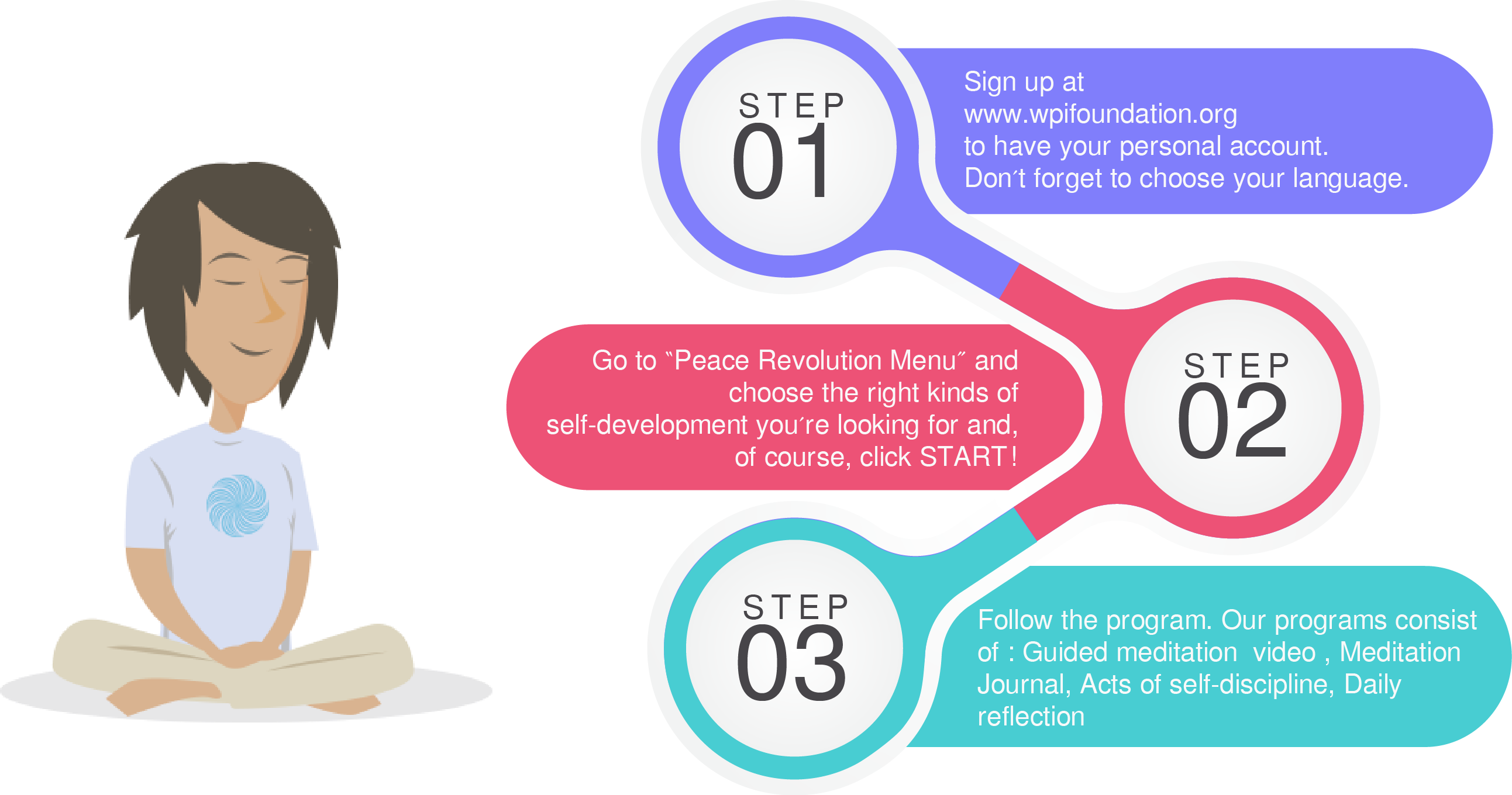
SDP is a rich pool of knowledge about the development of inner peace that you can learned through:
Guided meditation videos
Daily video provided for you to watch and follow the instruction on meditation step by step
Meditation Journal
A space to record your own meditation experience where you can consult your personal Peace Coach who will mentor you along your self-development journey.
Acts of Self-Discipline
Different lessons on how we can easily cut bad habits with little daily effort.
Daily Reflection
A feature for you to keep track of your own self-development.
Link MP3: http://www.peacerevolution.net/docs/en/mp3-to-go
Day 1:
Thursday, August 30, 2018

Sunday, August 26, 2018
21st Century Education - Systems Thinking
Tools for Systems Thinkers: The 6 Fundamental Concepts of Systems Thinking
By https://medium.com/disruptive-design
Tools for Systems Thinkers: Designing Circular Systems
Over the last five chapters in this series on tools for systems thinkers, I have looked at fundamental concepts, feedback loops, dominant archetypes and shared systems mapping tools.
I have worked on synthesizing the critical tools that assist with the
development of a more three-dimensional perspective of how the world
works. By no means have I covered it all, but I hope to have helped
ignite curiosity around the power of a systems-based perspective and the
opportunity that we all have in learning to love complex problems and
embrace challenges in more proactive ways.
In
the final chapter of this series, I cover some of the ways that
thinking in systems can transition us to a circular economy.
Specifically, I discuss how we can design circular systems that
facilitate sustainable and regenerative outcomes. For a more detailed
introduction to these concepts, take a look at the Circular Systems Design Activation Pack we created.
On Design
First
let me say that while I am a designer and advocate for professionals to
make intentional sustainability and systems based contributions through
their creative productions, when I say ‘design’ in this piece, I am
referring to design as the common practice of producing ‘things’. This
can be anything — artifacts, conversations, or policies, all of which
have impacts on the world. From supermarket designs, to government
regulations, to how we design our own lives, these are all the product
of design — the intent to direct or construct the world in a particular
way.
Design is a conscious and intuitive effort to impose meaningful order. Design is both the underlying matrix of order and the tool that creates it. — Victor Papanek
I
have written and spoken extensively on the role that design plays in
scripting out lives, influencing our minds and curating our experience
of the world (see here, here, here and here).
In
some cases ‘designs’ have massive impacts, and in others, only minor
roles. Nonetheless, everyday design is the act of creating something
new, so let’s dive into how we can design circular systems that build in
intentionally for positive impacts on people and the planet.
“You never change things by fighting the existing reality. To change something, build a new model that makes the existing model obsolete.” ― R. Buckminster Fuller
The Circular Economy
For many people the term ‘circular economy’
is still new, so allow me to briefly explain what this is all about.
Our current economy is based on a linear system of production where we
take raw materials and natural resources out of nature, process them
into usable goods to meet human needs, and then discard them back into
giant holes in the ground that, ironically, were often where we took the
raw materials from to begin with.
This
entire system is in opposition to the natural systems that sustain life
on Earth — which are circular and regenerative — and it’s
counterintuitive to the way we function as living organisms (for example
we all require nutrients to survive, which is part of the beautifully
designed system of nutrients cycling through bodies and back into the
ground to grow the next generation of food, this nutrient cycle is one
of the fundamental ecosystems that sustain life on Earth).
Basically
humans designed a broken system that creates waste and constantly loses
value through the economy. Our linear economy does not fit in a
circular world.
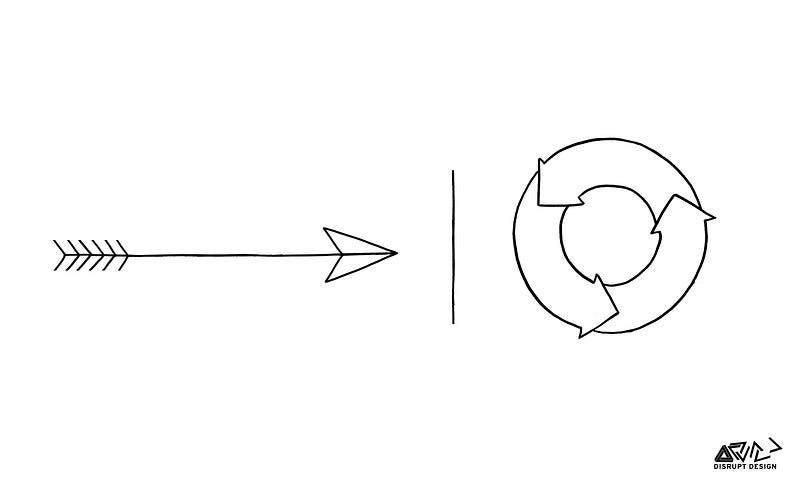
The
opposite to a linear system is a circular one. When you use the natural
world as a design reference, you quickly see that everything not only
plays a role, but also puts back in what it took out.
Most
organisms in nature, as well as the principles that nature plays by,
are regenerative; humans, however, design systems that are the exception
to this rule. Herein lies the problem that the circular economy
movement, and many other attempts (cleaner production, eco design, life
cycle assessment, industrial ecology etc.), that have come before, have
tried to address.
These
attempts have all worked hard to solve the complex puzzle of meeting
humanity’s growing needs while not screwing up the life support systems
that both nourish all living organisms (thank you food, air, and water)
but work effortlessly in amazingl complex ways to make life happen on
this magical ball of water and soil that we all share.
I
could go on and on about this missing link in our current economic and
social structures, the design mistakes that perpetuate it, how our
education system devalues circularity and prioritizes reductionism… But
right now I’m going to invest this time in the more interesting part,
where we figure out how to not make
a mess of this beautiful planet and instead, start to design out waste
and find unique ways of being a productive contributor to the planet (to
this end I am working on a project for a post disposable future, check it out here).
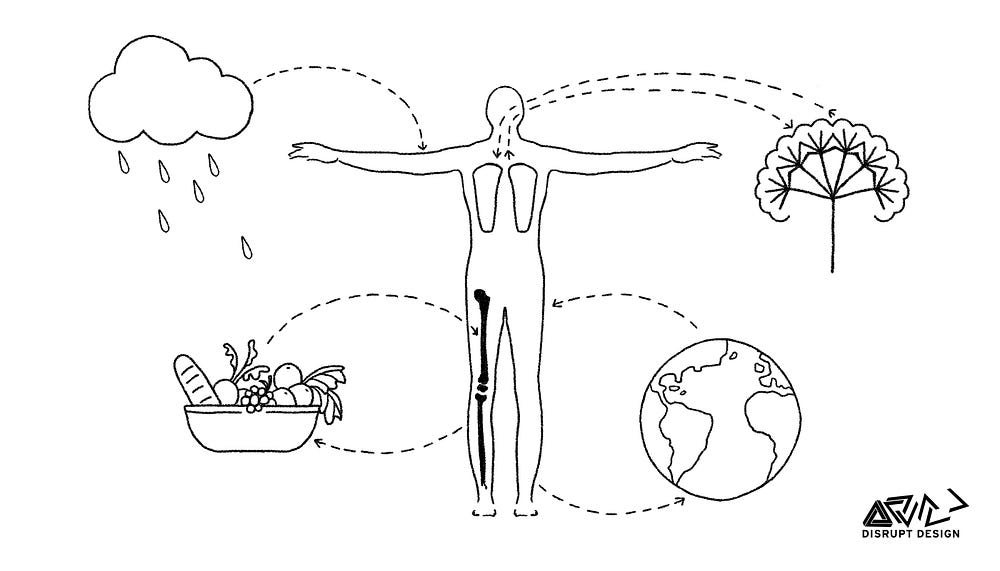
Everything is Interconnected
All
of this all boils down to the simple reality that we all have an
intuitive understanding of — everything is interconnected to everything
else in some way. Nothing living is in isolation, and we are require
other systems to survive—thus we are all in an interconnected,
interdependent relationship with everything else. I say this in a
non-hippy way, look at the design of a tree and you will see the same
fractile patterns in your lungs, your life is reinforced every few
seconds as you breath in oxygen that was produced free of charge by a
bunch of trees and phytoplankton.
We
live of a closed ecosystem that is perfectly calibrated for success.
Our bodies are small versions of this, and we benefit every second of
the day from the services that this giant ecosystem provides us.
Many
of the human-created systems that we have, such as cities, factories,
governments and industrial food production, are failed emulations of the
way nature designs things because they have not been designed as a
system that nests within other systems. They are isolated and siloed,
linear and reductive.
This
is where humans have really messed up: we have made things based on our
reductive one-dimensional perspective of the world, rather than taken
on the more detailed, systemic and creative perspective of what makes
everything work on Earth.

So
when we are seeking to solve and evolve some of the more complex
problems humanity faces, we must start first with a shift in mindset
from the one dimension of a linear plane to a three-dimensional
perspective of the interconnected and dynamic nature of systems at play
in the world around us.
This
requires not only developing systems thinking skills, but also
understanding sustainability sciences and developing reflexivity,
creativity and fostering more divergent neurological practices that
enhances creativity. These 3 things form the pillars of a practice in
creative systems change and can be applied by anyone who has invested
the energy in learning the practice tools.
We
are not born ignorant to the systems that sustain us (hang out with a
curious 5-year-old to learn all about how nature works), and we know creativity is a learned skill that
maximizes the hidden potential of the human brain. We have the building
blocks for designing a circular and regenerative future.
Circular Systems Design
Designing
for circular systems is about considering the full-picture perspective
of how the status quo of the natural, industrial, and social systems
play out, and then uncovering ways of shifting these to facilitate
circular and regenerative outcomes.
In
some cases this is extremely complicated (like how to circularize spent
nuclear rods, for example), and in others, it’s a no- brainer (like how
to change our collective addiction to disposable items like coffee
cups). But all of the systems changes we need to design have the same
basic elements: people, products, places, and processes. They can all be
redesigned to maximize benefits and minimize negative externalities.
Yes,
there is a level of complexity to this approach. But everything worth
doing requires work, and purpose-driven creatives in this world are at
the forefront of helping to activate this change from linear to circular
design. I will work on more content (additional to what I have already produced
for this new field) to help fuel this shift in the future, but for now I
encourage you to seek out resources that help you start to circularize
your thinking and doing in the world, from how you consume products
through to the decisions you make in your professional role.
There
are many narratives of the future being all f*$cked up, but I
personally refuse to believe in a dystopian future as nothing is
actually defined about what will happen next. We are all making up the
future based on our collective individual actions today.
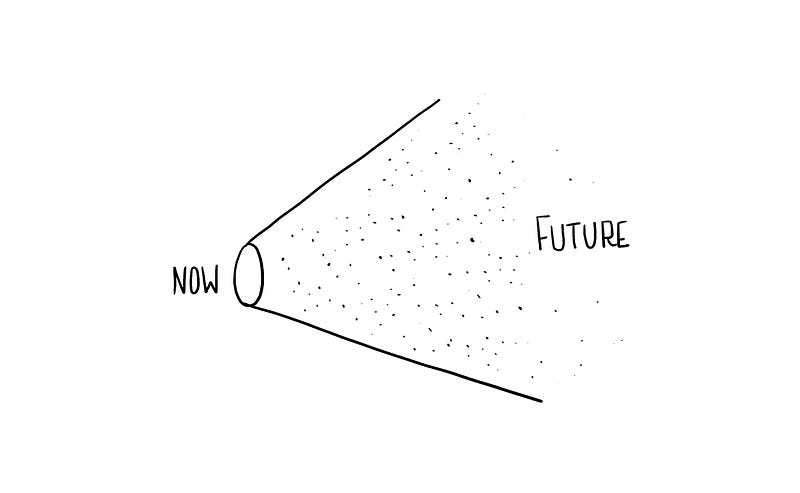
There
is no definite fact that robots will take over our jobs and that
presidents will push the big red button, just as there is no reason why
we can’t rapidly change the way we get the goods and services we desire
and need. I am completely confident in our capacity as a species to
figure out how to be a sustainable and regenerative contributor to the
magic that is life on Planet Earth.
— —
If this is your thing, check out my 4-week advanced training in circular systems design,
an online rapid learning journey and mentorship program for
professionals wanting to level up their skills in circular systems
design (starting in Jan 4. 2018). I offer one-on-one mentorship and
tailored content to help get you to a confident knowledge and leadership
position.
If you are not quite ready for advanced training, take my systems thinking class at the UnSchool online.
Beautiful illustrations by the talented Emma Segal
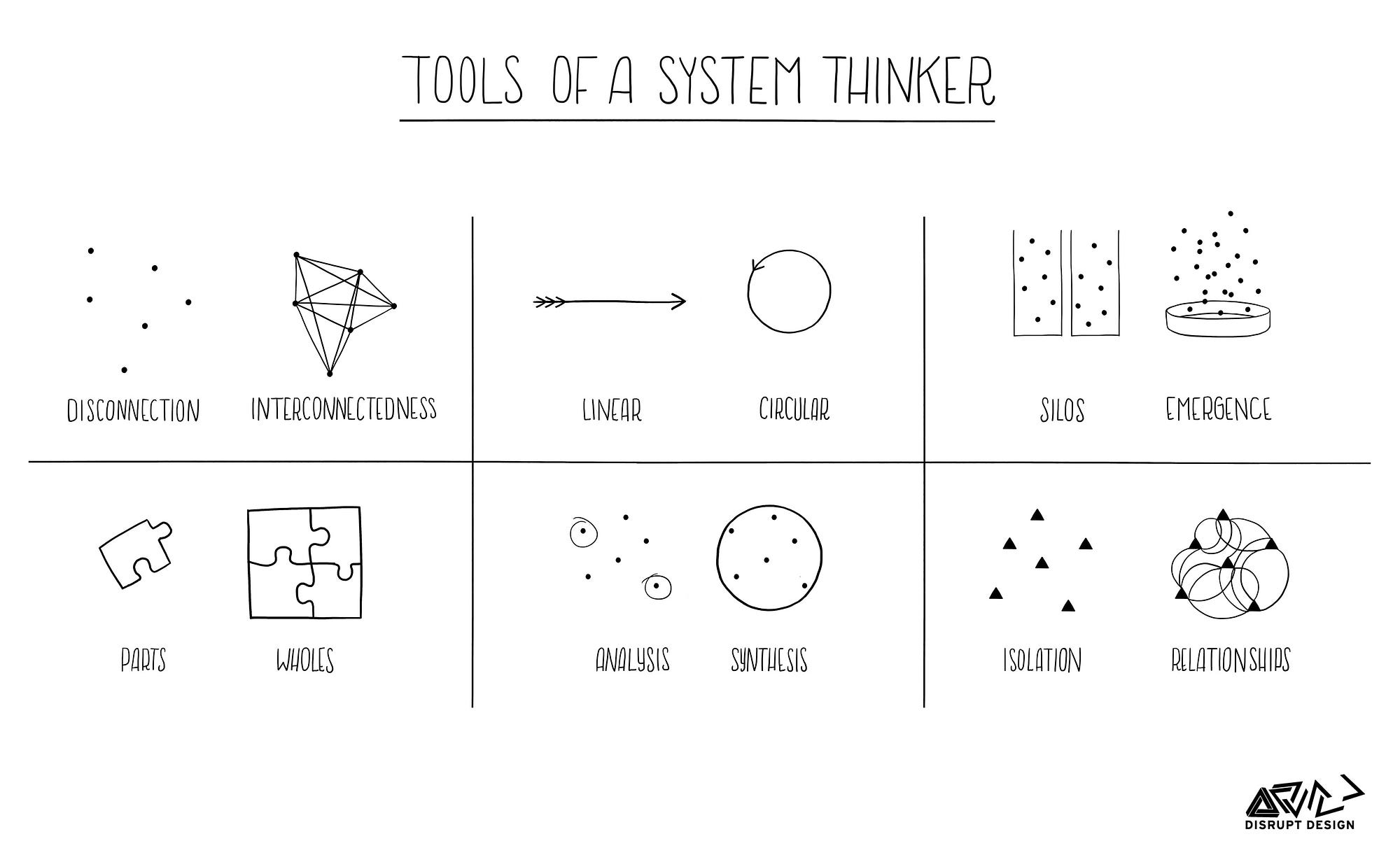
In this series on systems thinking, I share the key insights and tools needed to develop and advance a systems mindset for dealing with complex problem solving and transitioning to the Circular Economy.
I have taught thousands of hours of
workshops in systems, sustainability and design, and over the years
refined ways of rapidly engaging people with the three dimensional
mindset needed to think and work in circular systems. My motivation for
writing this online toolkit is to help expand the ability of
professionals to rapidly adopt to a systems mindset for positive impact.
Words
have power, and in systems thinking, we use some very specific words
that intentionally define a different set of actions to mainstream
thinking. Words like ‘synthesis,’ ‘emergence,’ ‘interconnectedness,’ and
‘feedback loops’ can be overwhelming for some people. Since they have
very specific meanings in relation to systems, allow me to start off
with the exploration of six* key themes.
*There are way more than six, but I picked the most important ones that you definitely need
to know, and as we progress through this systems thinking toolkit
series, I will expand on some of the other key terms that make up a
systems mindset.
1. Interconnectedness
Systems thinking requires a shift in mindset,
away from linear to circular. The fundamental principle of this shift
is that everything is interconnected. We talk about interconnectedness
not in a spiritual way, but in a biological sciences way.
Essentially,
everything is reliant upon something else for survival. Humans need
food, air, and water to sustain our bodies, and trees need carbon
dioxide and sunlight to thrive. Everything needs something else, often a
complex array of other things, to survive.
Inanimate
objects are also reliant on other things: a chair needs a tree to grow
to provide its wood, and a cell phone needs electricity distribution to
power it. So, when we say ‘everything is interconnected’ from a systems
thinking perspective, we are defining a fundamental principle of life.
From this, we can shift the way we see the world, from a linear,
structured “mechanical worldview’ to a dynamic, chaotic, interconnected
array of relationships and feedback loops.
A systems thinker uses this mindset to untangle and work within the complexity of life on Earth.
2. Synthesis
In
general, synthesis refers to the combining of two or more things to
create something new. When it comes to systems thinking, the goal is
synthesis, as opposed to analysis, which is the dissection of complexity
into manageable components. Analysis fits into the mechanical and
reductionist worldview, where the world is broken down into parts.
But
all systems are dynamic and often complex; thus, we need a more
holistic approach to understanding phenomena. Synthesis is about
understanding the whole and the parts at the same time, along with the
relationships and the connections that make up the dynamics of the
whole.
Essentially, synthesis is the ability to see interconnectedness.
3. Emergence
From
a systems perspective, we know that larger things emerge from smaller
parts: emergence is the natural outcome of things coming together. In
the most abstract sense, emergence describes the universal concept of
how life emerges from individual biological elements in diverse and
unique ways.
Emergence
is the outcome of the synergies of the parts; it is about non-linearity
and self-organization and we often use the term ‘emergence’ to describe
the outcome of things interacting together.
A
simple example of emergence is a snowflake. It forms out of
environmental factors and biological elements. When the temperature is
right, freezing water particles form in beautiful fractal patterns
around a single molecule of matter, such as a speck of pollution, a
spore, or even dead skin cells.
Conceptually,
people often find emergence a bit tricky to get their head around, but
when you get it, your brain starts to form emergent outcomes from the
disparate and often odd things you encounter in the world.
There is nothing in a caterpillar that tells you it will be a butterfly — R. Buckminster Fuller
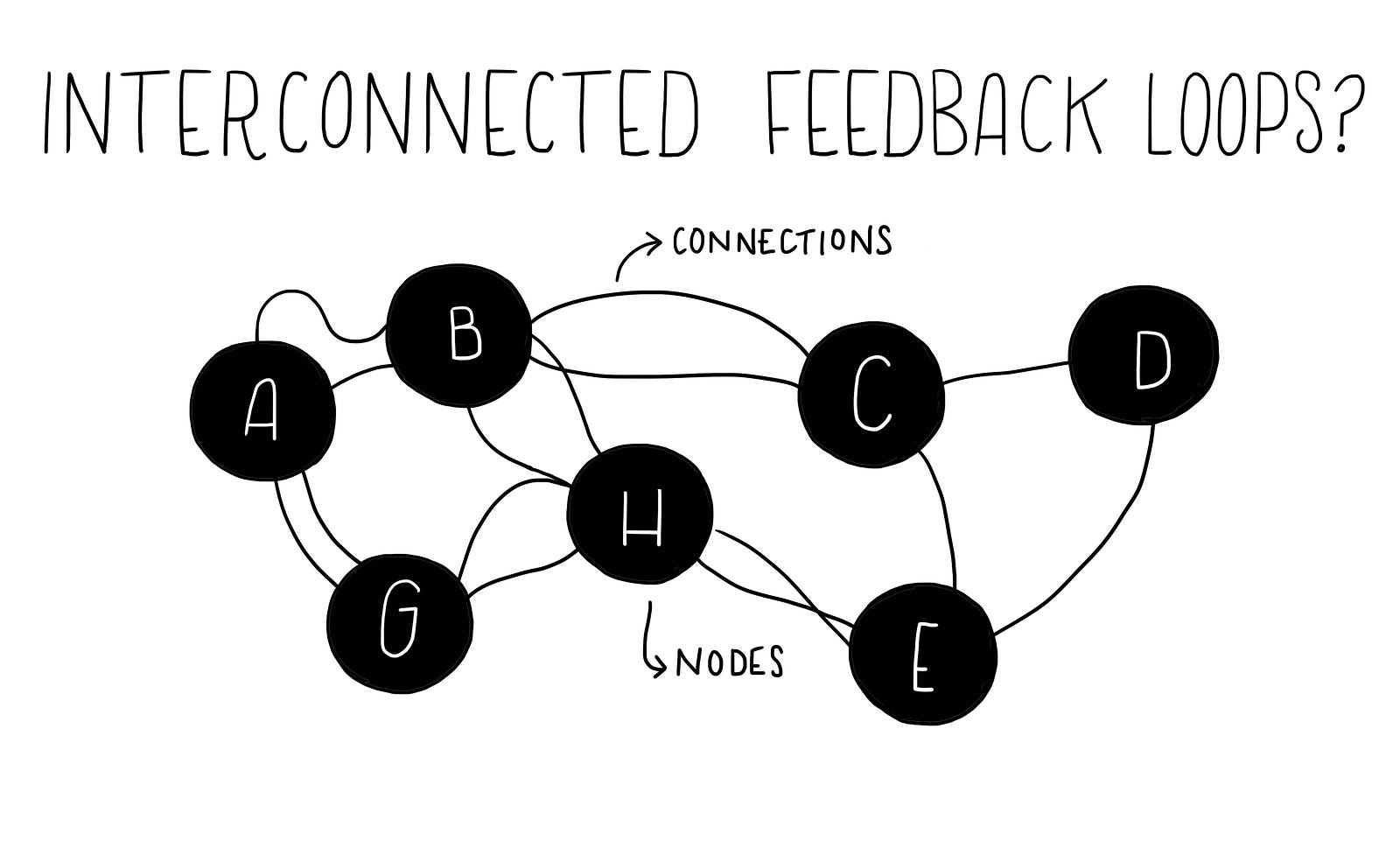
4. Feedback Loops
Since
everything is interconnected, there are constant feedback loops and
flows between elements of a system. We can observe, understand, and
intervene in feedback loops once we understand their type and dynamics.
The two main types of feedback loops are reinforcing and balancing. What can be confusing is a reinforcing feedback loop is not usually a good thing. This happens when elements in a system reinforce more of the same, such as population growth or algae growing exponentially in a pond. In reinforcing loops, an abundance of one element can continually refine itself, which often leads to it taking over.
A balancing feedback loop, however, is where elements within the system balance things
out. Nature basically got this down to a tee with the predator/prey
situation — but if you take out too much of one animal from an
ecosystem, the next thing you know, you have a population explosion of
another, which is the other type of feedback — reinforcing.

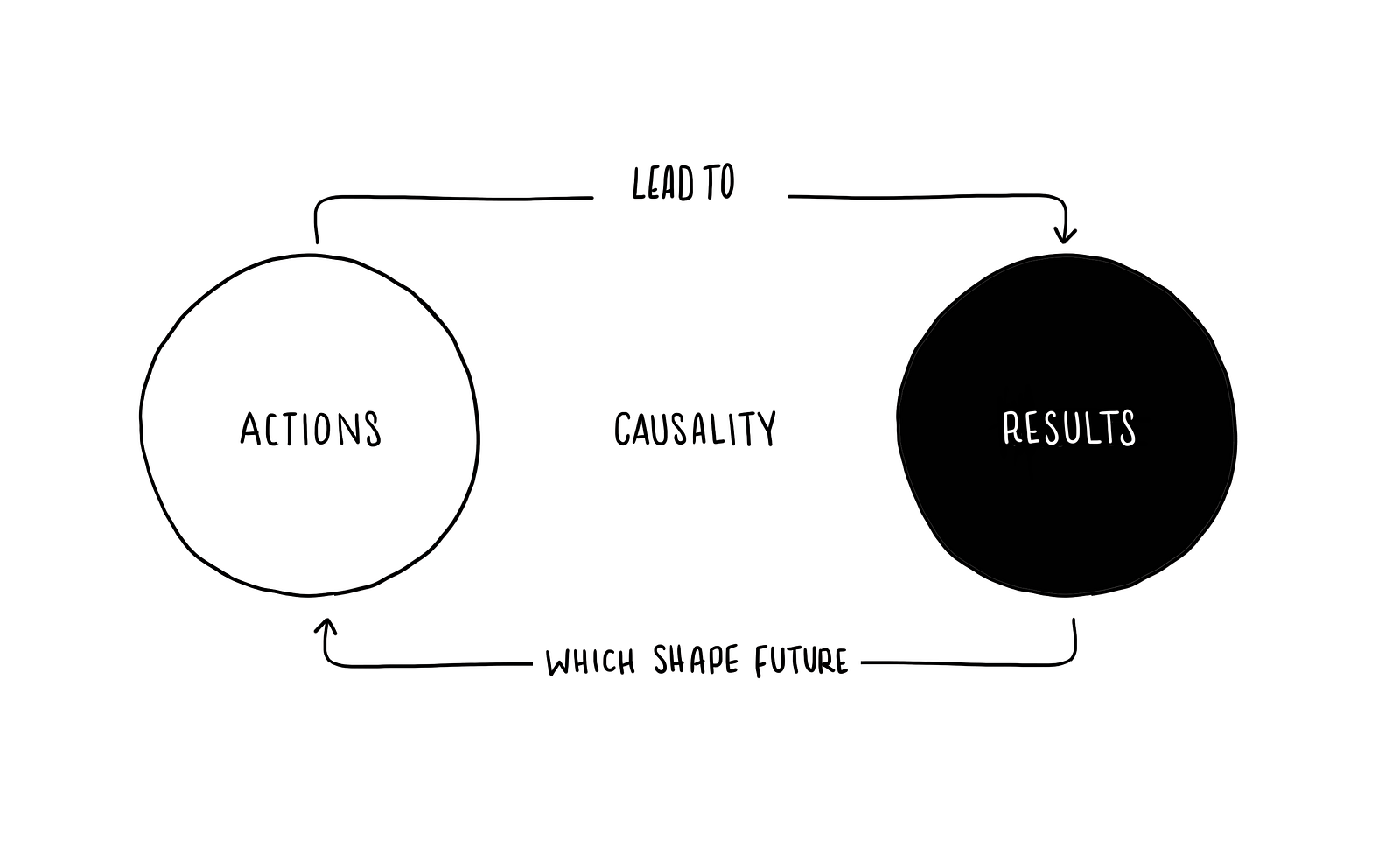
5. Causality
Understanding
feedback loops is about gaining perspective of causality: how one thing
results in another thing in a dynamic and constantly evolving system
(all systems are dynamic and constantly changing in some way; that is
the essence of life).
Cause
and effect are pretty common concepts in many professions and life in
general — parents try to teach this type of critical life lesson to
their young ones, and I’m sure you can remember a recent time you were
at the mercy of an impact from an unintentional action.
Causality
as a concept in systems thinking is really about being able to decipher
the way things influence each other in a system. Understanding
causality leads to a deeper perspective on agency, feedback loops,
connections and relationships, which are all fundamental parts of
systems mapping.
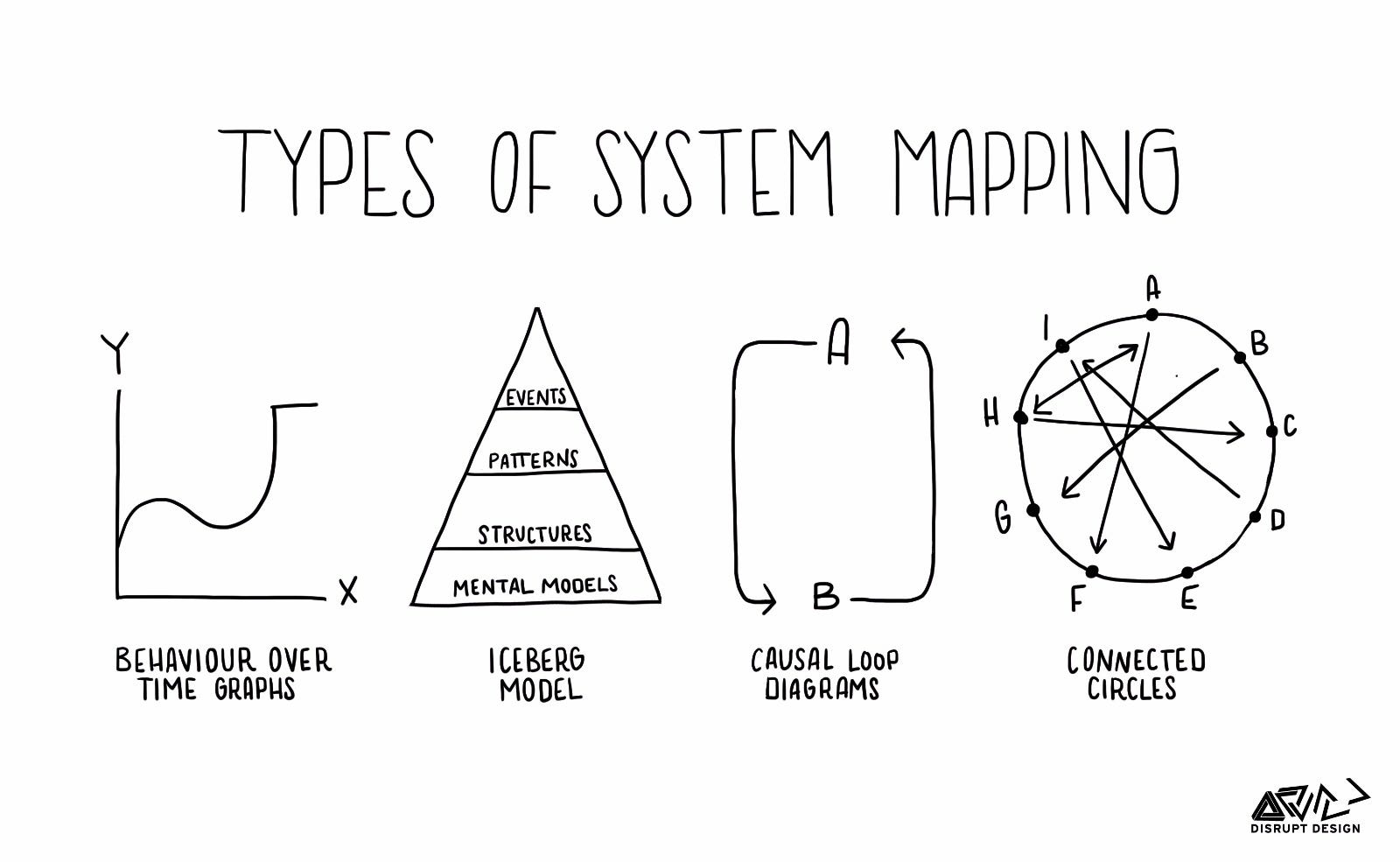
6. Systems Mapping
Systems
mapping is one of the key tools of the systems thinker. There are many
ways to map, from analog cluster mapping to complex digital feedback
analysis. However, the fundamental principles and practices of systems
mapping are universal. Identify and map the elements of ‘things’ within a
system to understand how they interconnect, relate and act in a complex
system, and from here, unique insights and discoveries can be used to
develop interventions, shifts, or policy decisions that will
dramatically change the system in the most effective way.
This
introduction to six key concepts are critical building blocks for
developing a detailed perspective of how the world works from a systems
perspective and will enhance your ability to think divergently and
creatively for a positive impact.
Working
and teaching systems thinking for years has led me to develop
additional new tools, as well as employ these time-honored concepts from
the pioneers.
What
stands out to me as critical in order to make a positive impact, is the
ability to develop your own individual agency and actions. To do that,
you first have to wrap your head around the core concepts. I have an
online class where I explain all of this here.
In the next chapter in this series, I will go into more detail on understanding systems dynamics, a core part of the practice. If you want to go even deeper, check out the full suite of programs I have created with my team at Disrupt Design and the UnSchool.
We designed them to help individuals and organizations level up their
change making abilities for a positive, regenerative, and circular
economy.
— — — — — -
All the beautiful illustrations are by Emma Segal and for the inspiration sources that helped develop these please see www.leylaacaroglu.com/credits
- Everything is interconnected: We live on a closed ecosystem called planet Earth where everything is connected to everything else. Otherwise, it ceases to survive and thrive.
- The easy way out often leads back in: If the solution were easy then it should have already been found.
- Today’s problems are yesterday's solutions: We need to make sure we don't accidentally create tomorrow problems through today's solutions.
- There is no blame in complex systems: Everything is interconnected. Thus, it's impossible to ever find one culprit for a problem. Systems have both the issue and the solution embedded within.
- Parts are elements of a complex whole: Everything is part of something else; there are no isolated elements in a complex system.
- There are no simple solutions to complex problems: We need to embrace complexity in order to truly address complex issues. Otherwise, we just deflect the problem to somewhere else in the system.
- Small, well-placed interventions can have big impacts: A well-designed, small intervention can result in significant and enduring systems change if it is in the right place – this is called a leverage point.
- Humans make linear systems – nature makes circular ones: We can learn to create regenerative products and services through understanding nature's design principles.
- Time changes complexity: Over time, things naturally get more complex. Simplicity and efficiency are very different things, yet we always think we can oversimplify complexity or reduce it down to the sum of its parts.
- ‘Failure’ is discovery in disguise: If there is no blame, then there is always an opportunity to discover through failure.
- Cause and effect are not related in time nor space: There is a mismatch and often a delay in the relationship between the cause of a problem in complex systems and the result (or symptom) appearing obvious.
Link: https://medium.com/disruptive-design/tools-for-systems-thinkers-the-6-fundamental-concepts-of-systems-thinking-379cdac3dc6a
https://www.disruptdesign.co/articles?category=Systems%20Thinking
Q Design Pack Systems Thinking | 21st CENTURY EDUCATION . http://educators.brainpop.com/wp-content/uploads/2014/07/IOP_QDesignPack_SystemsThinking_1.0.pdf
Subscribe to:
Posts (Atom)