Showing posts with label Design Thinking. Show all posts

Wednesday, July 4, 2018

Design thinking for Kids

Source: http://knowwithoutborders.org/design-thinking-for-kids/

By Karen Collias


“Often schools are teaching kids things they might never need to know again. We’re not teaching them how to be creative, or design, … or deal with unexpected situations. A lot of people are aware that we really need to change education, but they don’t know how. This is one method that could inspire people. It’s basically design thinking, adapted for children.” — Emer Beamer, Dutch design thinker
It’s nearly the middle of 2016.  As I read and watch reviews of educational issues and achievements in social media and traditional publications, I am struck by how the more things “change”, they the more they remain the same. Plus ça change, plus c’est la même chose! The same issues: ongoing inequality and student disengagement. The same “achievements”: new assessments, more assessments. What an overall lack of imagination! We certainly talk about the importance of creativity in 21st century life and work. So why do we continue to educate our kids as though we lived in the 19th century.
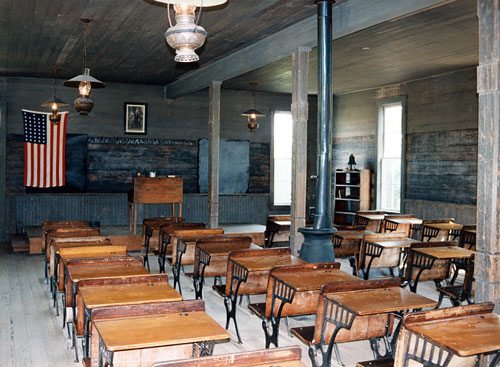
How different does this 19th century classroom setup look from your classroom?
Why don’t more educators adopt design thinking?
Design thinking is an educational approach that stresses creative problem solving for students with the added value of an entrepreneurial outlook. It’s an approach that could and should lead to more entrepreneurship — or at least, to a more entrepreneurial way of facing challenges in the future.
Design thinking has five “spaces.”
1. EmpathizeEmpathy is the centerpiece of human-centered design thinking. In order to create an innovative solution to a problem, it is essential to observe people–what they do, how they live, and their stories. Observing people builds an understanding of how they think and feel, what they value and how they see the world. Empathy almost always includes some sort of engagement with people. Engagement may be a conversation or a step-by-step explanation on how things are done.
To create meaningful innovations, you need to know your users and care about their lives.
2. Define: Defining a question or challenge based on empathy often changes the original problem you thought you understood how to solve. Defining a problem or challenge based on the needs of users provides focus, frames the issue, inspires and empowers, informs criteria for evaluating competing ideas and keeps the question in the realm of “actionable.”
3. IdeateCelebrate the power of possibility! Ideate is the space to imagine without judgment a variety of “wild, darling and practical” ideas.  Ideation discourages linear thinking and helps people step beyond obvious solutions.
A prototype can be a paper model, a poster, or a skit.
4. PrototypeOnce you have ideas, it is time to experiment with prototypes.  A prototype is a possible solution that allows time for feedback.  Prototypes are simple — storyboards, hand-made models, posters, or role-playing.  It is important to create something very quickly in order to see if the original question has been answered. Perhaps the question itself was wrong and it is time to go back to the drawing board. Better to fail quickly and cheaply before moving on to formal assessments.
Build to think and test to learn. — Hassno Plattner Design School at Stanford University, California, USA
5. TestTesting is the culmination of the empathize-define-ideate-prototype spaces of design thinking. Problems have been framed and reframed. Now it is time to engage in real-life, real-time testing in which the users are involved. It is only when we allow ourselves, our teams, our students to experience spaces of design thinking that we can implement authentic assessments.
Design thinking is active and inclusive. And kids are embracing design thinking with gusto. Schools around the world are embracing design thinking as a new way of learning and a way to increase student engagement.
A global “designathon” for kids took place in November 2014 in Berlin, Amsterdam, Rio Di Janeiro, Dublin and Nairobi.  Students came up with a myriad of ideas. One submission from students in Amsterdam was a robotic trash can that sorts out recyclable materials and alerts a garbage truck to pick up the recycles when the can is full. Perhaps this and other prototypes aren’t ready for primetime but design thinking gives kids the freedom to reframe questions, come up with new ideas, prototype and test.
Our brains need and search for context. Who likes to memorize large quantities of information with only a fuzzy context? Learning without context can be difficult for kids. Design thinking allows them to find all kinds of associations and possible connections among different pieces of information instead of memorizing them as separate segments. Flunking is okay when it is perceived as feedback that informs new ways of asking questions, coming up with ideas, and testing them.
Design thinking should be on the educational agenda. Sure it’s messier than pre-packaged standardized assessments. But design thinking offers kids golden opportunities for engagement and creativity — both prerequisites for real learning.

Karen Collias


Flipside Science

Source: https://www.calacademy.org/educators/flipside-science

A unique approach

This series is meant to create a transformational learning experience for students and their teachers by incorporating best practices for teaching environmental science and applying design thinking in the classroom. Flipside Science...

Inspires action with a positive, solution-oriented message. Flipside Science empowers students to make choices that positively impact their communities while teaching them about important environmental science concepts with engaging videos and design thinking challenges.

​Teaches critical thinking. Students learn how to define problems, evaluate evidence, and decide what they think about environmental issues. They are empowered and inspired to engineer their own solutions to complex problems.

Fosters collaboration. Flipside Science gives students the opportunity to learn from their peers and work with others to solve problems collaboratively.

Acknowledges the complexity of environmental issues. This series connects humans to their environment and helps students understand that there are no easy nor singular solutions—environmental problems are complex.

Highlights youth voice. Flipside Science is hosted by high school students from the Academy’s own Youth Programs. Middle schoolers can relate to teen narrators as near peers, versus adult narrators.

Is easy to implement in the classroom. Free and available online, the series currently features three fully-developed teaching units. Student worksheets that accompany each lesson in the food and water units are available in English, Spanish, and both Simplified and Traditional Chinese. The short modular videos also allow flexibility in the use of distinct Flipside Science materials. 


Flipside Science is a youth-powered series that tackles complex environmental topics and empowers viewers to make a difference.

Perfect for Teaching Human Impacts on Earth's Systems

Time: 30 minutes to several weeks
Grade: Designed for middle school, but applicable to high school
Focus: Food, water, and energy systems; ocean health; human impacts on Earth's systems (ESS3.C); engineering solutions (ETS1.A-C)
Flipside Science features media-rich units perfect for educators looking to engage their students in design thinking activities around environmental issues. This engaging and upbeat collection of videos, hosted by Academy youth, and associated lessons explores how local communities are addressing environmental problems with solutions ranging from vertical farming to greywater recycling. Check out the units on energy, food, water, and ocean health below:

Healthy Oceans

Ocean icon
The ocean affects everyone. It provides important resources and recreational enjoyment to people around the world and is home to some of the most diverse ecosystems on Earth: coral reefs. But the ocean's resources and biodiversity are under threat from human impacts. What are some local actions we can take to protect our global ocean?

Exploring Energy: Designing a Brighter Future

Energy icon
Energy is an important part of our everyday lives. We use energy to cook, get around, and send emails. In this unit, we'll explore the issues associated with fossil fuels and how people are coming up with innovative sustainable energy alternatives for a brighter future.

Our Hungry Planet: Food For a Growing Population

Food icon
To feed our growing world, we need innovative solutions. In this unit, we'll explore environmental issues related to the food we grow and eat. We'll review key issues like food waste, urban farming, and diet, and learn how simple choices we make can impact our planet.

Fresh Solutions: Water Use and Conservation

Water icon
Humans depend on water, and our need for this precious resource is growing alongside our population. How will we meet the needs of the future without harming the environment? In this unit, we'll explore key water issues, the water cycle, and some of the technology and techniques used to conserve water.

Build 21st Century Skills with Design Thinking

Source: http://creativeeducator.tech4learning.com/2012/articles/Interview-Dr_Maureen_Carroll

An interview with Dr. Maureen Carroll

Interview: Dr. Maureen Carroll
Dr. Maureen Carroll is the founder of Lime Design and Director of Stanford University’s Research in Education & Design Laboratory (REDlab) and adjunct faculty in the School of Education. She has been helping educators implement design thinking into their classrooms for the past five years. She recently co-authored with Melissa Pelochino, Lois Logan, and Richard Cox, designED: Integrating Design Thinking In Your K-12 Classroom.

What is design thinking?

Design thinking is both a process and a mindset. This human-centered innovation process finds solutions and solves problems in a user-centered context. Design thinking does not solve the mysteries of the universe; instead, a single problem is solved for a single user, with the hope that the resultant knowledge and empathetic understanding of that user’s needs will ultimately work for lots of other people. A familiar example is OXO kitchen tools. An engineer worked to make opening cans easier for his arthritic wife, and the resulting products work for many other people.

What does the design thinking process look like?

To begin, you Frame the problem so you can better empathize with your user. You conduct interviews and record observations. You use qualitative research techniques, working as an ethnographer to collect the story of the user to better identify exactly what they need. The mindset you attain during this part of the process is empathy.
The second part of the process is Imagine. This phase requires creative, generative brainstorms. Your goal is to develop a mindset that defers judgment, is open to different ideas, listens actively, and builds on the ideas of others. You are looking to push the boundaries and find a truly transformative innovation.
The third phase, Make, is about making the ideas tangible. This process involves iterative prototyping: developing a prototype, testing it, listening to feedback, making changes, and prototyping and testing again. Rather than creating an entirely new product, you quickly develop a “low resolution” version that you refine. The mindset is to learn from failure.
Ever tried. Ever failed. No matter. Try Again. Fail again. Fail better.
— Samuel Beckett
Teachers are natural prototypers. A lesson that may not be as polished as they’d like during first period is finely honed by fifth period.

Why is it important to be, or become, a design thinker?

In our quest to build thinkers for the 21st century, we have focused almost solely on analytical thinking. While analytical thinking is critically important, design thinking blends in equally powerful creative thinking.
It’s not that creative thinking is more important ... a blend of both types of thinking are more productive for finding truly unique and transformative innovation.
Design thinking requires students to be strategic and metacognitive about when to apply creative thinking and when to apply analytical thinking. Students must recognize where they are in the process and apply different ways of thinking to produce the best results. For example, when you are in the creating prototypes in the Make phase, it is essential to analyze whether you correctly understand your user’s needs.
“My contribution is to teach as many people as I can to use both sides of their brain, so that for every problem, every decision in their lives, they consider creative as well as analytical solutions.”
— David Kelley, founder Stanford’s Hasso Plattner Institute of Design

Why is important to teach design thinking in a K12 education context?

Design thinking builds two important mindsets: risk taking and resiliency. Design thinking requires you to take risks as a learner and push yourself. It is assumed that you will not succeed with your first prototype, so it is easier to put yourself out there.
A resilient 21st century learner works to find out what works and bounces back from failure. You must have a willingness to accept that a problem has multiple solutions and develop your ability to try again.Design thinkers learn from their mistakes so they can develop a better solution next time.

This sounds a bit like project- or problem-based learning. Is it?

Design thinking is different from project-based learning because the problem is not initially identified for the students. Design thinking requires that students identify the problem for themselves. Figuring out which questions to ask and what problems are worth solving gives students a different sense of agency.

Why did you write “designED: Integrating Design Thinking In Your K-12 Classroom?”

We were inspired by all the students and teachers we worked with and wanted to create a collection of design thinking activities. Our hope is that other educators will try these easy-to-implement ideas so they and their students can quickly and easily practice the mindsets necessary for successful design thinking.
Editor’s Note: I also spoke with Michelle Flores, a teacher at Aspire Capitol Heights Academy in Sacramento, California about her recent experience using some of the projects in designED with her 3rd graders.

Many people believe design thinking belongs the secondary classroom. Why did you try it with your 3rd graders?

For the past couple of weeks, I have been using activities from designED during my morning meeting. In fact, we worked on the “My Story is Your Story” activity for an entire week. During that time, students worked in pairs to share a personal story. The person listening to the story had to retell it in the first person, trying to express how the other person felt and convey the perspective of the original storyteller.
My students loved it, but it wasn't easy. They had to struggle to listen and put themselves in each other’s shoes. While this may not be easy for younger learners, the empathy skills they learned are crucial for future success. Seeing things from their classmates’ perspectives also helped build a strong sense of community in my classroom.
I am definitely looking forward to doing all of the activities with my students!

More resources to help you learn more about design thinking

Things We’ve Learned about Design Thinking, K-12 Education & 21st Century Learning
http://limedesignassociates.com/wordpress/archives/5
The Marshmallow Challenge TED Talk - the importance of learning from failure
http://marshmallowchallenge.com/TED_Talk.html
Melinda Kolk
 
by Melinda Kolk
Melinda Kolk (@melindak) is the Editor of Creative Educator and the author of Teaching with Clay Animation. She has been helping educators implement project-based learning and creative technologies like clay animation into classroom teaching and learning for the past 15 years.

Design Thinking in the Classroom

Source: http://creativeeducator.tech4learning.com/2013/articles/Design_Thinking_in_the_Classroom

http://creativeeducator.tech4learning.com/21st-century-classrooms

Design Thinking in the Classroom
As children move from kindergarten, through middle school, and to high school, instruction shifts from stories to facts, from speculation to specifics, and imagination fades from focus. Design Thinking provides an alternative model to traditional ways of learning academic content by challenging students to find answers to complex, nuanced problems with multiple solutions and by fostering students’ ability to act as change agents.
Design Thinking is all about building creative confidence — a sense that “I can change the world.” In the Bullies & Bystanders Design Challenge, the students discovered that changing themselves might be even more important.

The Bully and the Bystander

This challenge began with a short story and ended with tears and a new-found sense of empathy for both bullies and bystanders. As the school year was coming to an end, middle school literacy teacher Melissa Pelochino wanted to leave her students with something powerful. She succeeded.
Melissa had attended a Design Thinking workshop for teachers at Stanford’s d.school. The workshop focused on the six stages of the design process: understanding, observation, defining a point of view, ideating, prototyping, and testing. After completing their own design challenge, participants discussed how to bring this vibrant, human-centered, empathy-driven interactive process to their classrooms.
In the weeks following the workshop, Melissa began implementing design challenges in her classroom. Using short stories as springboards, she introduced her students to Design Thinking. “Everything changed when I began using the design process as a vehicle for instruction. Engagement in school increased as students became responsible for their own learning. The purpose for reading changed from “I am reading because my teacher told me to” to “I am reading because I need to solve this problem.”
For the final challenge of the school year, Melissa read The Other June to her students as the springboard for their design challenge. This young adult novel chronicles the experiences of a young girl who was teased and tormented by a classmate. This design challenge spoke to students’ real life experiences, as bullying thrived on their urban campus, where classrooms were housed in corrugated metal portables and conflicts colored the school day.
As they read the story, students focused on uncovering the needs of the bully and the bystanders. When Melissa asked the students to brainstorm what they knew about bullying, students shared comments like:
“A bully tries to make someone feel insecure about themself.”
“It doesn’t have to be people that are smaller than you—it can be people that are bigger.”
“If you don’t stand up to a bully they’re just gonna keep on doing it.”

Hidden Camera

As part of the observation and interviewing phase of the design process, seven students decided to conduct an experiment. They set up a hidden camera outside their classroom. As other students approached, they enacted a scene where one of them was being bullied. They circled the ‘victim’ with taunts like “Where did you get those pants—like the Goodwill [second hand] store?” and waited to see what would happen.
Students were astounded when only two people stopped to help and six others walked by. They followed the bystanders who walked by and questioned them. “Why didn’t you stop? Dude, you didn’t want to? You’re supposed to help the other person.”
They returned to their classroom after the experiment, discussed the results of their experiment, and imagined a bully-free world. “If people were more like Gina and Tim [the people who stopped to help] then there wouldn’t be bullying at all. There wouldn’t be a definition of a bully. There wouldn’t even be a word,” shared one student.

The Breakthrough

As they left class that day, Melissa gave each student a notepad and asked them to interview three people on bullying.
This observation experiment led most of the students to focus their interviews on the needs of bystanders. What did they need in order to help stop the bullying?
Students also used the task to reflect about their own actions. Eddie, who played the victim during the hidden camera experiment, interviewed someone he had bullied in the past. He shares, “I decided to interview Dwight, because to be honest, I bullied him sometimes and I wanted to see how he felt about bullies.” Dwight told Eddie it was “horrible.” After talking to him, Eddie said that he understood for the first time how it felt to be a victim of bullying.
Students on the playground
Juan returned to share how he felt when he listened to a boy talk about how much it hurt to be bullied. “I told him that I would back him up, that he could come to me if he was bullied.”
Each student shared a personal story of how they had been bullied, either at home and at school. Their pain was palpable and their tears seemed a comfort. They truly understood the devastating power of bullying.

Change Agents

The next phase of the process spoke to the most impactful part of Design Thinking. The students tackled the challenge of how to stop bullying in their school. Most importantly, they had acquired the creative confidence to act as change agents in their own environment.
Students decided to create a prototype for a movie that showed the effects of bullying. They then shared it with another class to get feedback they would use to iterate. Students who watched the film were asked to share what they thought in a brief survey.
When the filmmakers reflected on the survey results, they felt as though they had not been successful in stopping bullying. Melissa led a discussion about what they should do next. They talked about brainstorming and trying to better define the problem. One student, Denee, suggested modifying the movie by incorporating some of the footage from the hidden camera tape.
Then, students began to discuss the heart of the problem: “We have to give them empathy.”
Melissa pushed them to think about how they might proceed. Denee said it was different for different groups. Viola chimed in, “If you just stand up to them, bullying would stop.” Edgar said, “The problem is that there are no leaders at this school.” Discussions about peer pressure, following the crowd, and making choices ensued.
Class ended for the day. But for these students, the impact of the design challenge was just beginning.
Dr. Maureen Carroll
 
by Dr. Maureen Carroll
Dr. Maureen Carroll (@limedsgn) is the founder of Lime Design and Director of Stanford University's Research in Education & Design Laboratory (REDlab) and adjunct faculty in the School of Education. She has been helping educators implement design thinking into their classrooms for the past five years.

Our Hungry Planet: Design Thinking Challenge

Source: https://www.educationworld.com/our-hungry-planet

The following lesson, Our Hungry Planet, is brought to you by the California Academy of Sciences.

Subjects

Constructing Explanations, Earth & Space Science, Engineering & Technology, Flipside Science

Grades

6-12

Brief Description

Students will be asked to tackle a food system issue at home, at school, or in the community. This lesson will help you facilitate a structured design challenge in your classroom.

Objectives

The goal of this lesson is for students to
  • practice design thinking.
  • structure a design process.

Related Files

About This Lesson

Prep Time: 10 minutes
Activity Time: 60 minutes
This is the fifth and final activity in the Flipside Science: Our Hungry Planet unit designed for a middle school audience. In this lesson, students explore environmental issues related to the food we grow and eat with an emphasis on engineering and design thinking. Before implementing this design challenge in your classroom, it is recommended you start with the preceding activities in the unit:
  1. Food for Thought: Defining a Problem to Find a Solution
  2. Exploring the Impacts of Feeding the World
  3. Rapid Brainstorming: How Can We Improve Our Global Food System?
  4. Sustainable Food Solutions: Weighing the Pros and Cons
If you are using this design challenge independently of the unit, your students can become more familiar with issues surrounding our global food system and some proposed solutions by watching the Our Hungry Planet videos.

Using This Design Thinking Guide

‘Design thinking’ is a structured method that can be used to create a product, or to develop and implement solutions to a problem. Through the design thinking process, students can “learn to sharpen the focus of problems by precisely specifying criteria and constraints of successful solutions, taking into account not only what needs the problem is intended to meet, but also the larger context within which the problem is defined, including limits to possible solutions” (Engineering Design in the NGSS for Middle School).
The Design Challenge Levels outlined below are adapted from Design for Change’s design thinking toolkit. Each level can be printed off and given to students as a handout as they work through the challenge. Encourage students to keep track of their ideas and progress in a design notebook or on a blog.

How to Choose a Food Topic for Your Design Challenge

Encourage your students to brainstorm together food system issues that they would feel empowered to tackle either at home, at school, or in their broader community. You can make this a whole class discussion, small group brainstorm, or individual homework. Check out examples of design challenge food topics on the Food Topic Design Challenge Spectrumthat vary from one-day challenges to week-long challenges.
Students should work through the challenge in groups. Choosing a challenge that incorporates the whole class can not only help your students build teamwork skills, but can bring comradery to your classroom as your students empower not only each other, but youth outside of their own communities through the sharing of their designs.

Guide for Teachers

Print out the following design thinking levels worksheet for your students.
Design Challenge Level 1: What do your students want to change?
Think about the different groups that your students are a part of: their family, their school, their city, their extracurricular clubs or sports teams, etc. Think about the food system issues that might be present in one of these groups. How healthy are the snack options in the school vending machine? Is there a lot of uneaten food that gets thrown away after dinner at home? How many vegetarian options are there for lunch in the school cafeteria?
Have students discuss the following issues with their group, and keep track of their progress in their design notebooks or on their design challenge blog.
  • Have them choose an issue to focus on. Consider how much time they have to complete this design challenge.
  • Students will observe what’s going on and who is involved.
  • Have them reflect on what they notice and what concerns them.
  • Have them take note of what they already know about the issue. What do they need to find out more?
  • Have your students interview those affected by the issue. Students should ask them questions to better understand what inspires and motivates them, what they value, and what their constraints are.
Design Challenge Level 2: How can your students make a change?
In order to imagine change, your students need to brainstorm the possibilities. The possibilities multiply when they can brainstorm without constraints. Thinking outside of the box and sharing their ideas with each other can lead to highly successful and perhaps unforeseen solutions.
How do the students decide on a design? Have them discuss the following issues with their group, and keep track of their progress in their design notebooks or on their design challenge blog.
  • Set a time limit and have your students brainstorm as many ideas as they can. Have them set a goal -- 10, 20, 100 ideas? Let them really go for it! Students will make a list or draw pictures of anything that comes to mind, no matter how silly or impossible it might seem.
  • Have them share their ideas with others. Can any of their ideas be combined with someone else’s? Are there common themes or categories that their ideas can be organized into?
  • Each group will vote on a subset of solutions. Next, they will draw out the pros and cons of each solution.
  • Finally, they will vote on the best solution.
Design Challenge Level 3: Make the change!
Now it’s time for students to put their hard hats on! It’s time for them to get to work. Remind them why they have accepted this challenge! What is motivating to the students to design a solution? Who is going to benefit or be impacted by their solution? What do they need to take action? Discuss the following points with each group, and have them keep track of their progress in their design notebooks or on their design challenge blog.
  • Have students make a list of what resources they will need (supplies AND people) and where/how they will get them.
  • Have students draw up a plan for the steps that they will take to achieve their goal and divide up the work.
  • Next, they will draw up a timeline for their plan and set goals for completion.
  • Now it is time for them to make it happen and implement their plan.
  • Finally, have them reflect on what happened. What worked? What didn’t work? What could they change? What did they learn?
Design Challenge Level 4: Share their experience
Congratulations to your students on completing their design! They should be proud of their accomplishment and want to share it with others. They should think about a time when someone else’s inspiring story has motivated them to take action. They will inspire others to make changes and design solutions by sharing their own experience!
How will they empower others? Have the students discuss the following points with their group, and keep track of their progress in their design notebooks or on their design challenge blog.
  • They could share their story at a school assembly.
  • They could publish a blog that other youth can read.
  • They could create a Facebook page to showcase their project.
  • They might want to share their experience on Twitter. They could encourage others to use the same hashtag to share their stories.
  • Think about posting a short video onto YouTube about their solution.
  • Students could present their solution to the principal or at a local community meeting.
  • Students could send their findings to your local newspaper, or invite a journalist into the classroom.

Standards

NGSS Disciplinary Core Ideas (Grades 6-8)
  • MS-ESS3.C: Human Impacts on Earth System
NGSS Science and Engineering Practices (Grades 6-8)
  • Defining and Delimiting Engineering Problems
  • Developing Possible Solutions
  • Optimizing the Design Solution
For more standard alignments, resources, and references, visit Our Hungry Planet on the California Academy of Sciences educator website.

More Inspiration for Teachers

Watch stories of successful design thinking challenges in the classroom (from the Teaching Channel):
Or, read these stories:

Wednesday, June 27, 2018

A Design Thinking workshop for Educators


On 21 June 2018, School of Gumption was honored to partner the Director of Design For Change, Singapore to co-design and co-facilitate a one-day Design Thinking workshop for a primary school in the East. The aim of this workshop was to empower 30 innovation champions, including teachers, middle managers and school leaders to lead and build innovation culture in the school.

One of SoG’s underlying believes was that each of us hold a deep inner wisdom and an unlimited creative source within, when it comes to innovation for a purpose. As such, in designing the workshop, we focused a lot in facilitating the environment and conditions for our participants to access their intelligence of the heart, connecting back to the original purpose of why the participants have chosen education as their careers on the first day.

We selected role play on user interview to bring out the deepest empathy in the participants’ hearts. One participant from each group was requested to step into the being of their “user”, truly living the thought, feeling, behaviors and languages, while the others would assume the roles of interviewers and observers. These educators suddenly realized with the depth of their being how “difficult” pupils were struggling with the lack of parental care, the feeling these pupils had when being transferred to a new school. The role-play interview successfully opened the mind and the heart of all the participants with a radical insight “We thought we understand; now we realize we don’t”.

We also guided the participants through a mindful envisioning process, when we requested the participants to sit comfortably with their eyes closed, and visualize a desired future that they wish to create for their pupils. What do change look like? Do you see your pupils there? What are they doing? What are the looks on their faces? Do you feel what they feel? Connect to your feeling now when you see the looks on your pupils’ faces? How do you feel now? What if you can bring about that change for your pupils? Now, open your eyes and sketch a collective vision of what you visualized with your group. 

Silence across the room. Participants were so connected to their feeling. I have never felt such a sense of deep love vibrating through a room having 30 educators. All of us know, we are here to make changes for a purpose.

And indeed, a strong sense of purpose fueled the buzzing discussion and enthusiastic prototype building later on.

After the one-day workshop on Design Thinking with these passionate educators, I thought about innovation as very much the work of heart, hand and head together. In building the culture of innovation, we need to facilitate the environment when people are often connected to their heart’s purpose, for it is the pathway that opens the door for the head and the hands to build a better future for all.