Thursday, October 15, 2015

What makes an entrepreneurial ecosystem?

By Nicolas Colin


The Family is a strategic, minority, long-term shareholder. We grow a portfolio of investments in scalable companies, ideally from an early stage so as to create a privileged relationship with their founders. We identify the best of the best, finding Entrepreneurs through a process based on content and education. We then work with founders, providing them with resources (education, unfair advantages, and capital) and maximizing their chance of large-scale success. In other words, we operate our own proprietary ecosystem, designed to defeat toxic startup environments and to build scalable businesses.
TheFamily — building our own private ecosystem against a toxic environment
‘Ecosystem’: the problem is that the very term has become a bit of a cliché. Everyone uses it. For most people, its meaning has been lost along the way. It has become irritating to hear everyone talking about the damned ‘ecosystem’, all the more so because in reality it’s often not an ecosystem but a toxic environment for startups. And yet, if we follow Wikipedia, it seems that ‘ecosystem’ is a relevant word when it comes to describing the entrepreneurial environment. An ecosystem is
“A community of living organisms in conjunction with the nonliving components of their environment (things like air, water and mineral soil), interacting as a system.”
In short, an ecosystem designates entities living together in a habitat. It should be clear that those entities live better, longer, and happier lives if that habitat is healthy!
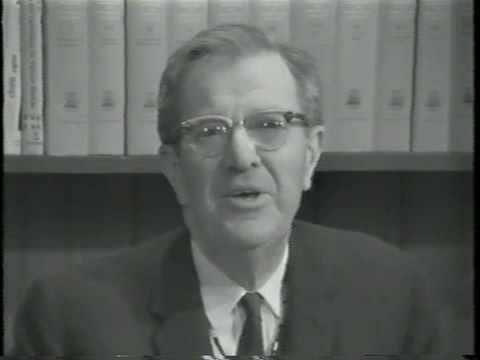
Frederick Terman, who played a crucial role in converting Stanford to entrepreneurship
Most discussions regarding the best habitat for Entrepreneurs focus on Silicon Valley. An abundant, mostly American, literature is dedicated to analyzing Silicon Valley’s success on the entrepreneurial front. Some explain why everything is so good in the Valley today, but don’t reveal how it all came together. Others go back to a distant past, but jump to premature conclusions: everything happened because of (you choose) Defense contracts / a mild climate in the Bay Area / Stanford University / technology clusters / the culture of rewarding failure / favorable tax and legal conditions. Finally, many sources help understand the critical role played by certain individuals: Frederick Terman, Georges Doriot (even though he was on the East Coast), Robert Noyce, Andy Grove, or Steve Jobs. It is worth noting, however, that most authors on the subject rightfully conclude that history never repeats itself and therefore that it’s not possible to emulate Silicon Valley’s story.
It’s high time we went beyond simplistic analyses. There’s not much time left: Silicon Valley is pulling way ahead and windows of opportunities are closing fast for other territories. But at the same time, there is a better understanding of how to grow a healthy entrepreneurial habitat: Steve Blank, Vivek Wadhwa (who recently joined TheFamily’s board), Paul Graham and Brad Feld are all getting a feel for what led to Silicon Valley’s dominance. Based on this understanding, it’s TheFamily’s mission to protect ambitious Entrepreneurs against toxic environments and to deploy our own proprietary ecosystem that maximizes their probability of success. For that reason, we constantly work on understanding what makes a great ecosystem and how it can be improved for the Entrepreneurs who inhabit it. We’ve read a lot, met hundreds of people, and worked on a model to make it easier to share our views on that matter.

Three ingredients

Our model is relatively simple, based on the idea that the entrepreneurial ecosystem has three characteristic ingredients. They are as follows:
  • capital—by definition, no new business can be launched without money and relevant infrastructures (which consist of capital tied up in tangible assets);
  • know-how—you need engineers, developers, designers, salespeople: all those whose skills are necessary for launching and growing innovative businesses;
  • rebellion—an entrepreneur always challenges the status quo. If they wanted to play by the book, they would innovate within big, established companies, where they would be better paid and would have access to more resources.
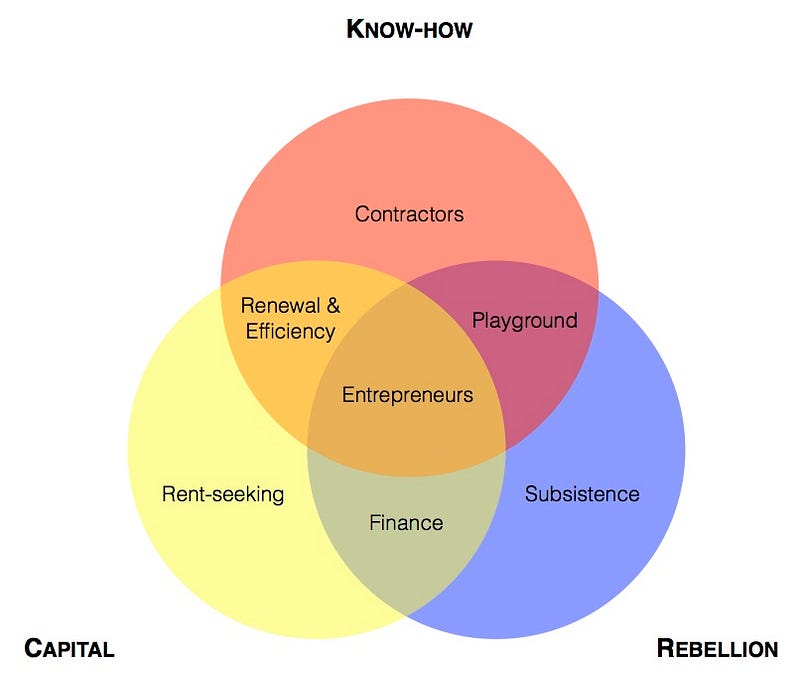
How an entrepreneurial ecosystem mixes the three ingredients together
All three ingredients are present, in variable proportions, in every country. But the most important thing is not simply their relative presence or absence in a certain place. Rather, it’s the degree to which they mix within the entrepreneurial part of the economy. That is to say, is there a place where all three ingredients come together, where capitalists, engineers, and rebels get to know one another and do great work together?

Seven combinations

The way the three ingredients are combined tells a great deal about a given country’s specific economy and sociology. There are seven possible combinations.
Oil-rich countries don’t need know-how or rebellion to conduct business
Capital only = rent-seeking economy. Oil-rich countries, such as those in the Persian Gulf, or those who own an essential, sought-after infrastructure (such as the Panama Canal or the pyramids in Egypt) are a good example of rent-seeking economies. Those are often dominated by real estate, natural resources, and utilities. In such economies, know-how is not rewarded (if it exists at all) and rebellion is repressed, sometimes through violence. Rent-seeking may also involve lots of lawyers: lobbying the government and suing innovative Entrepreneurs are simply two ways of seeking rent in democratic countries.
Capital + know-how = efficiency economy. When capital meets know-how in the absence of rebellion, innovation tends to be concentrated in established companies, which have only two goals: renew their products and improve the efficiency of their operations. As noted by Clayton Christensen, these kinds of innovation destroy jobs and free up capital (rather than empowering innovation which ties up capital and creates lots of jobs). Freed capital is then invested elsewhere, often sustaining the rent-seeking part of the economy. Above all, as noted by William Janeway, efficiency is the enemy of innovation: you can’t expect radical, Silicon Valley-style innovation from an economy without rebellion.
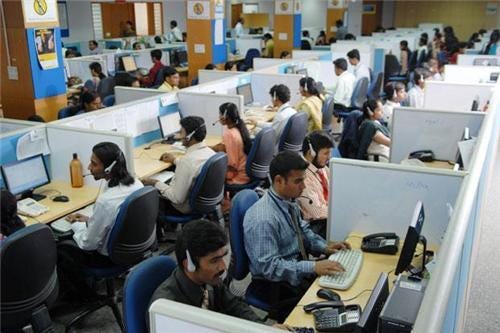
In Bangalore, center of the contractor economy — beware the thin margins
Know-how only = contractor economy. It’s quite simple: if there are lots of engineers, but no capital to invest and no taste for rebellion, then the best way to create value is to sell the engineers' know-how to foreign companies. This is what India does: selling IT engineering work to clients in developed countries. The contractor economy is characterized by narrow margins (revealed by cost-plus, non-scalable business models), thus it doesn’t contribute much to economic development.
Know-how + rebellion = playground economy. Why a playground? Because in such an economy, people may look like Entrepreneurs when in fact they’re more like children without the right (or the means) to grow. I have a specific example in mind. Every year or so, I go back to my old engineering school in Brittany. Every time I’m there, people tell me about lots of projects, whether in research, business, or both. But once I leave, none of those projects is ever heard from again. The following year, when I’m back on campus, they’ve left no trace. Ideas and small-scale experiments simply fall away into the ether. Why? Because when the economy lacks capital, local rebels are unable to go from fleshing out an idea to building an empire. The playground economy is a bit as if Larry Page and Sergey Brin had invented PageRank, published their famous article, tested the algorithm on the Stanford campus, then moved on to business as usual because the banker refused them the loan they needed to start a company. The playground economy exists where research is entrapped in the academic world, or startups are prevented from growing due to hostile regulations and a lack of capital. Playground innovation is mostly funded by the government, through research grants or SMB subsidies. It creates few jobs (except for those managing government subsidies) and doesn’t create value at a larger scale.

“The Wire”: a tale of the subsistence economy
Rebellion only = subsistence economy. When there’s neither capital nor know-how to start and grow companies, rebellion finds other ways: political movements, social activism, artistic creation, and crime. Marginal artists in Berlin, punks in England, and social activists in Porto Alegre are primary examples of what dominates a subsistence economy. It gives birth to great art, it drives social and political changes, it certainly stirs up anger, but it doesn’t help build great business empires. An economy fueled only by rebellion resembles many of the least developed countries: know-how is scarce due to the failure of the higher-education system or massive talent emigration; capital is spirited away by a fearful elite. Those who stay are the people in need who just try to make ends meet; charitable NGOs try to help them out; merchants make a business out of scarcity and extract the residual value out of a failed economy. Indeed, the only ones who create value in such economies are usually rent-seeking merchants and illegal organizations. As a result, there may be lots of capital, but since it’s been extracted by predators such as traffickers or monopolist traders, it can’t be invested into entrepreneurial ventures. As for genuine creators, they fall into two categories: artists and activists. The former find success abroad and are the local heroes; the latter ultimately trigger revolutions. It should be noticed that subsistence economies are not confined to developing nations: in every high income country, there are areas where there is nothing but rebellion. I’m sure you can picture them.
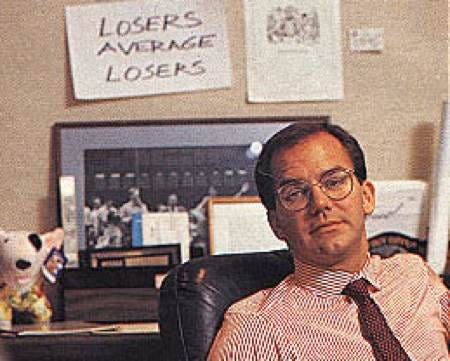
Rebels have been storming the financial sector for a while (here, Paul Tudor Jones)
Rebellion + capital = financial economy. Contrary to what people usually expect, finance is one of the most rebellious sectors out there. Decades of deregulation of financial markets have revealed how powerful finance is when it comes to forcing change upon companies or even whole societies. Without the know-how to start and grow a company, you can still make your mark (and earn a bundle) by exerting your sense of rebellion in the financial sector. In fact, many financiers are all the more rebellious as they come from humble backgrounds and desperately want to escape their direct, traumatic experience of the subsistence economy. A financial economy captures a great deal of value and creates a great deal of wealth. But the essence of the financial business does not lead to inclusive institutions: as it is concentrated in the hands of the few, it makes it complicated to ignite widespread economic development. A few rich traders won’t make a flourishing economy!

‘The Traitorous Eight’ committed their first act of rebellion when they left William Shockley to found Fairchild Semiconductor
Capital + know-how + rebellion = entrepreneurial economy. The Valley is the most obvious example. Capital initially came from the Department of Defense, then from early venture capital funds, and now from more traditional investors such as Goldman Sachs. Know-how was present from the late 1940s on, thanks to the attraction of engineers in the field of microwaves, then semiconductors. Finally, rebellion is a mindset that is typical in California. Many rebels have gathered there, from the first motorcycle clubs to artists, hippies, student leaders, LSD advocates, gay activists, Ronald Reagan, and of course computer scientists. The Valley is the byproduct of those three ingredients mixing together.
A quick step back, though. Is an entrepreneurial economy preferable? Is creating a healthy habitat for Entrepreneurs really that important? Aren’t we better off seeking rent or supporting the efficiency innovation efforts of established companies? These are tricky questions, but for us at TheFamily, the answers to them are clear: yes, yes, and no, we’re not!

Edmund Phelps (Nobel Prize in Economics) stresses the importance of “economic dynamism: the desire and the space to innovate”
In an economy in transition, an entrepreneurial economy creates far more value, more widely distributed, than any other economy: in Silicon Valley, you’ll find the headquarters of giant tech companies, ultra-rich Entrepreneurs, thousands of highly-paid engineers, designers, and managers, an adjacent economy that provides local services and amenities and creates lots of jobs for the less educated, and massive tax revenues to finance better public services. Silicon Valley is probably the closest to what Edmund Phelps (Nobel Prize in Economics) calls mass flourishing:
Flourishing is the successful exercise of creativity and talents. To flourish, people have to engage a world of challenges and opportunities. The economy’s dynamism and the resulting experience of business life are central to our well-being.
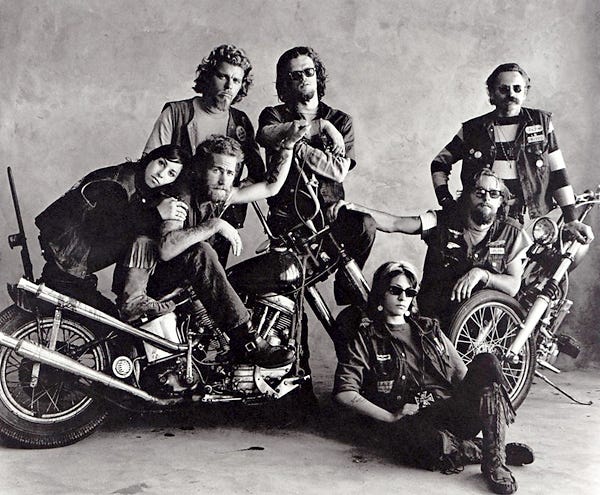
The most famous motorcycle club, the Hell’s Angels, was founded in 1948 in California
Yet Silicon Valley has its weaknesses as well, demonstrated by the tension in its real estate market and, like elsewhere in the U.S., its limited social safety net. These features should not be discounted as we look around at other geographic areas and other economies where entrepreneurship can thrive.

The entropy in the system

It is interesting to think about how a territory can drift from one economy to another. There’s actually a lot of entropy in the system: without successful Entrepreneurs, any entrepreneurial economy tends to decline into something else. After all, Paris used to be a fantastically entrepreneurial place at the dawn of the twentieth century. Hence the importance of immigration in sustaining an entrepreneurial ecosystem: once entrepreneurial institutions have been built by the first generation, it is vital that Entrepreneurs from outside flow in to sustain the ecosystem and help it grow.
Even when you only have two ingredients out of three, entropy is still at work and one of the two tends to be eradicated in time. Consider the three scenarios below.

The Soviet Union, the biggest playground of all time
A playground economy (know-how + rebellion) turning into a subsistence economy (rebellion only). If the know-how disappears, the playground is destroyed and there’s only rebellion left. That’s what happened when Soviet Russia (which was in itself a type of giant playground: lots of high technology, but no business empires whatsoever) transitioned to capitalist Russia, as most of the country’s know-how took off for Israel or the United States. From that point on, money was to be made only from natural resources (hence a rent-seeking economy dominated by oligarchs) until the prices went down (to a subsistence economy without much hope for anyone).
A playground economy (know-how + rebellion) turning into a contractor economy (know-how only). Even if they don’t leave the country, ultimately engineers get fed up with failed projects trapped in the playgrounds. For them, it takes only one step to become contractors. This is precisely the reason why every French startup aims at becoming the next Google and ends up becoming a small IT service business or Web agency. It’s OK, it pays the bills, but margins are thin and it doesn’t scale—at all. These startups-turned-Web-agencies don’t add up to an entrepreneurial economy, they contribute to developing a contractor economy with very little innovation.
A financial economy (capital + rebellion) turning into a subsistence economy (rebellion only). Watch out when capital flees from a country without know-how: Greece is a case in point. I suppose the United Kingdom also saw it coming in 2008. That is probably the reason why they decided to get serious about growing an entrepreneurial ecosystem in the wake of the crisis.
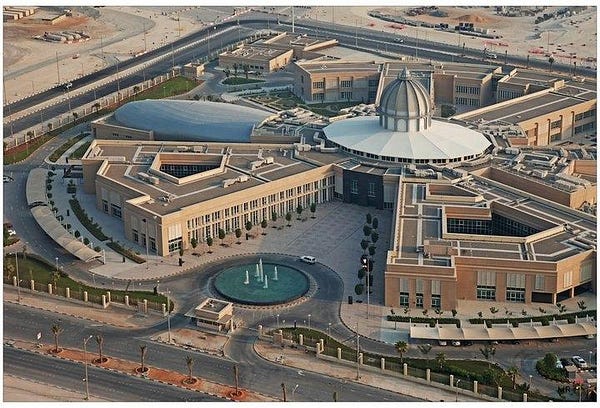
The Paris Sorbonne University in Abu Dhabi: will it inspire rebellion in the Emirates?
It isn’t enough to have two or even all of the key ingredients in one place. They tend to not mix together too easily. Even worse, in many cases they tend to evict one another, thus breaking the dynamics that could make a non-entrepreneurial economy more entrepreneurial. We all understand that it is much easier to seek rent, become a contractor or stay in the playground. You have to work hard to counter that trend and force the ingredients to mix together.
For instance, you can try to turn a rent-seeking economy (capital only) into a financial economy (capital + rebellion). Dubai or Abu Dhabi are attempting to do just that, because when the oil reserves dry out, rent-seeking will take a huge blow. Opening a Sorbonne subsidiary or using the Louvre brand is probably their attempt to inspire some rebellion and pave the way to the United Emirates becoming an entrepreneurial place in a distant future. We’ll see.

The key role of Entrepreneurs

So in order to counter that entropy, to mix all three ingredients and tie them together in the long term, it takes, well, an entrepreneurial ecosystem. And the only ones able to build it are—you guessed right—the Entrepreneurs themselves, those whom Babak Nivi defines as having “the ability to serve a customer at the highest level of quality and scale, simultaneously”. They initiate the best practices, overcome the obstacles and finally build the institutions that become the pillars of an entrepreneurial economy.
Consider the three cases that follow.
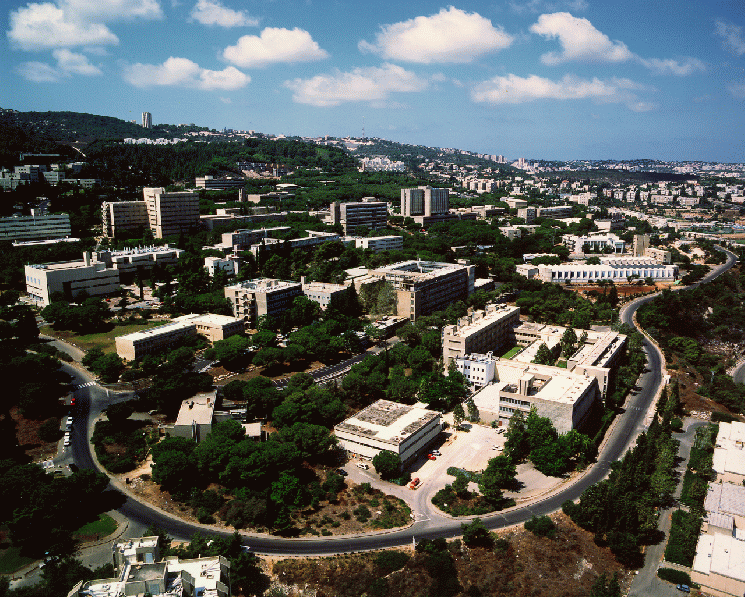
The Technion is the core of the Israeli high-tech sector
A playground economy turning into an entrepreneurial economy. It happened in Israel. The book Startup Nation tells us about those Israeli aspiring Entrepreneurs who, in the 1980s, built superb products but failed to market them to would-be customers. They weren’t short in know-how (even less so after the collapse of the Soviet Union, which brought many top-notch scientists to Israel), nor were they short in rebellion (what with the famous chutzpah and all). But there was no capital: Israel was a playground economy at that time. Then, working with the Entrepreneurs, the Israeli government designed the Yozma program to attract American venture capital and turn Israel into an entrepreneurial ecosystem. Everything changed from that point on.

The British have a taste for rebellion
A financial economy turning into an entrepreneurial economy. Here, we have London. The British government has a very simple reasoning: if London is the European capital of the financial sector, then it should become the European capital of innovation and technology in the financial sector. The first « FinTech » Entrepreneurs benefited from favorable conditions in the City (an economy already specialized in finance and with a great deal of capital), then attracted talent from all over the European Union, thanks to a very welcoming immigration policy towards citizens of other member states. London already had quite a high level of capital and rebellion (after all, England is home to the punk movement). The first Entrepreneurs, supported by the government, did what had to be done to overcome the deficit in know-how.

Robert Noyce, the first rebel and founding father of the Valley
An efficiency economy turning into an entrepreneurial economy. This happened at the dawn of the Silicon Valley. Did you know that Fairchild Semiconductor, the company that became both the matrix of the modern Silicon Valley and an inspiring precedent for all its Entrepreneurs, was a subsidiary of an established East Coast company called Fairchild Camera and Instrument? At one point, Robert Noyce and Gordon Moore couldn’t stand the constraints imposed by their corporate parent (which clearly favored efficiency above entrepreneurship) and decided to leave and start Intel. Their own personal touch of rebellion was enough to transform the local ecosystem and give birth to the fastest-growing entrepreneurial economy in the world.
In each case, a virtuous circle was initiated. In Israel, the combination of know-how and rebellion attracted foreign capital, with a little help from the government. In London, capital itself helped buy know-how thanks to the freedom of circulation in the European Union. What is probably more difficult to ignite is rebellion, which really depends on courageous, pioneering individuals who bear all the risks where entrepreneurial institutions are still lacking.
The idea that it takes Entrepreneurs to create an entrepreneurial ecosystem sounds like a tautology. Yet we must continue to hammer on this point. Many initiatives to create an entrepreneurial economy in the past came from the government or big established corporations. As Josh Lerner proved in a remarkable book, every one of those initiatives fell through (I insist: systematically, in every case, without exception, at a 100% rate, this led to a failure). In none of these cases did the government or established companies manage to create an entrepreneurial economy by using a methodical and planned approach. (In France, Sophia-Antipolis is a case in point, as are all the later efforts to artificially create such clusters.) This is the reason why you have to rely on the Entrepreneurs and stimulate their ambition at the highest level possible.
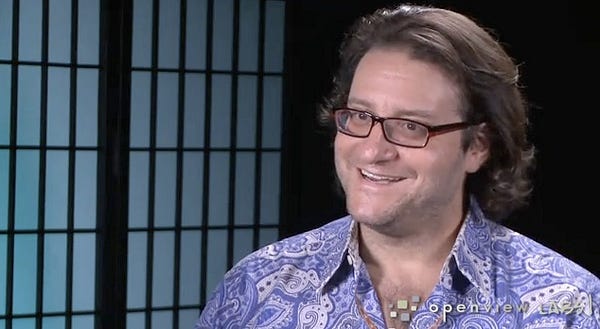
Brad Feld, investor and an astute author on the subject of entrepreneurial communities
There’s an empirical law here, one that Brad Feld formalized in his 'Boulder Thesis' and one that also inspired us to start TheFamily: only Entrepreneurs who combine long-term vision with short-term flexibility can inspire and grow an entrepreneurial economy. If you have the ingredients, let the Entrepreneurs cook them! That is precisely when heterogeneous elements can mash themselves into a system, built by Entrepreneurs for Entrepreneurs.
It should be noted that an entrepreneurial economy takes off more easily where other parts of the economy are not so strong. It’s difficult to be contrarian where a certain type of value creation is at its strongest. You can’t beat the financial economy in New York, but you can beat it in California, with government contracts covering the build-up. Even Michael Milken had to be in California to invent and implement high-yield bonds! London may be an exception here—providing radical financial innovation at the heart of the financial sector in Europe— but the success of the London FinTech sector has yet to be proven and what’s more, ensuring it takes the active support of the government because finance is a highly regulated sector (yes, it is).

Thanks to movies such as “The Social Network”, Entrepreneurs have become superstars
Also, make no mistake: everybody likes to be called an Entrepreneur, because there’s now a lot of prestige that comes with the title. But you’re no Entrepreneur if you lack ambition, abide by the status quo, or don’t want to build an empire. So it’s not enough to have people who call themselves ‘Entrepreneurs’. Docile engineers, however competent, make bad hackers. Complacent capitalists prefer to seek rent rather than to finance risky new ventures. What you need are those whom Marc Andreessen calls “imperial, will-to-power people who want to crush their competition.”
Walter White, the ultimate rebel, summed it up for us: he’s not in the meth business (= know-how), nor in the money business (= capital), but in the empire business (= all of the above + rebellion).

Benchmarking different countries

Another interesting perspective is found by looking at various countries and trying to understand why some perform better than others when it comes to growing a healthy entrepreneurial ecosystem.
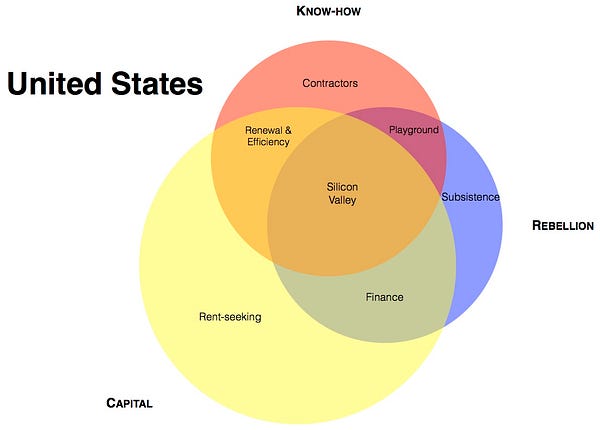
Let us begin with the United States. The ingredients are there: fantastic amounts of capital + lots of know-how + a great potential for rebellion (at least since 1776). The rent-seeking economy is obviously a huge part of the American economy, with oil, real estate, and utilities: wherever there is a lot of capital, people tend to seek rent. Fortunately, know-how is there as a counterbalance and is heavily represented within the entrepreneurial economy, especially in Silicon Valley. The financial economy is also huge (New York, Dallas, Chicago), but is receding as compared to Silicon Valley, which is attracting capital and even becoming a political power in the American democracy.
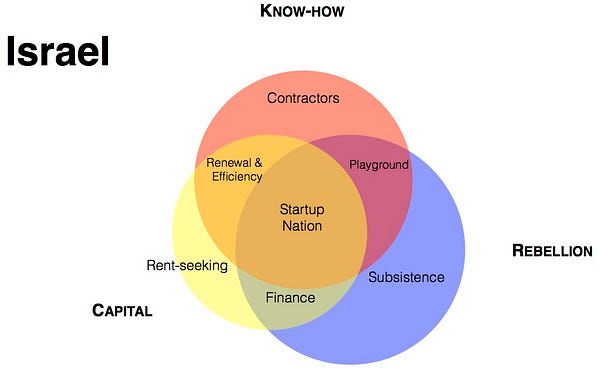
Israel is a very interesting case, as it used to have a serious gap: capital. The Yozma program helped launch a very dynamic local venture capital ecosystem, even though traditional small businesses still had difficulties accessing capital in the Israeli banking system. Hence in the Israeli economy, available capital has been primarily invested in entrepreneurial ventures, not traditional businesses. As a result, the Israeli entrepreneurial economy now attracts most of the know-how and diminishes the contractor part of the economy: contrary to their Indian (or French) counterparts, Israeli engineers work for Israeli startups (and the American tech companies that buy them) instead of working as contractors for foreign clients.
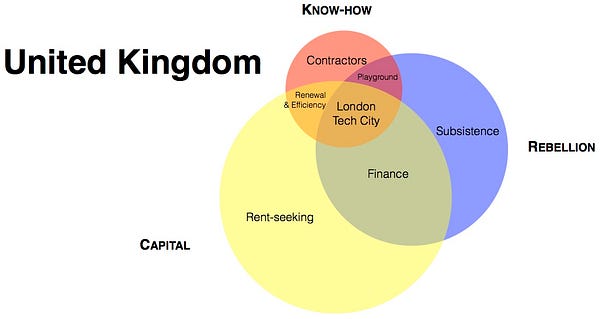
The United Kingdom is another very interesting example. In short, the British economy accounts for an enormous amount of capital, divided between a massive rent-seeking economy (notably in real estate) and a very dynamic financial economy. Lack of know-how explained why it was so difficult to create an entrepreneurial economy. But this has been overcome thanks to freedom of circulation in the European Union, the goal of making a FinTech capital out of London and aggressive support from both governmental and financial regulators. Contrary to most of their counterparts, the British government often sides with the rebels instead of siding with the rent-seekers.
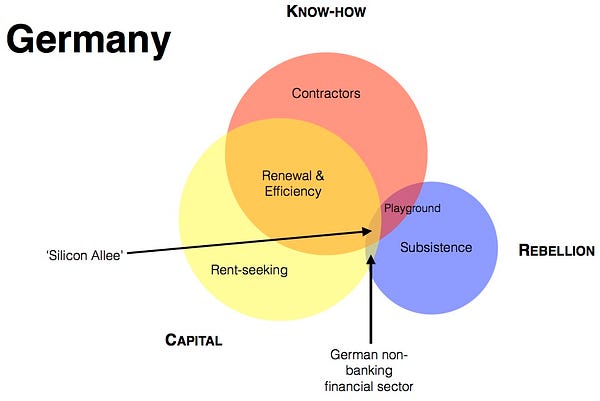
Germany is the land of efficiency. There is a lot of know-how in Germany, including that coming from neighboring Eastern European countries. But venture capital is small, probably due to the activism of German banks and their tradition of financing businesses. As a consequence, know-how is mostly “trapped” in established companies and allocated to efficiency innovation within big German corporations. Since they practice continuous innovation, those corporate powers tend to be ahead of their counterparts in other countries; but this does not amount to entrepreneurial innovation (I’ll spare you the VW jokes). Having worked in the German business world, I can tell you: there is no rebellion there. The entrepreneurial economy is thus confined in the marginal Berlin culture, and since capital and know-how are retained by established companies, the German entrepreneurial economy is far from thriving.
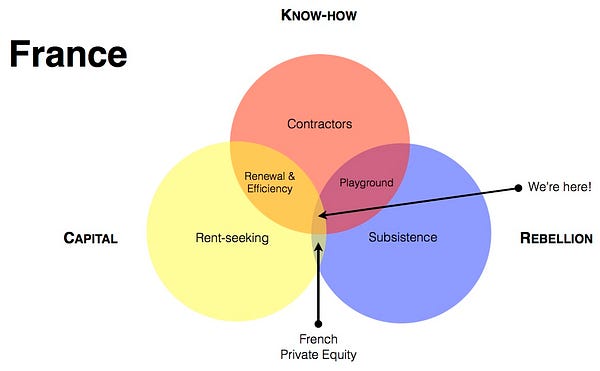
Let us conclude with the French case—also an interesting one, if only because it inspired us to start TheFamily. My partners and I often speak about the toxicity of the French environment for Entrepreneurs. We have founded TheFamily to try to battle this toxicity.
The model detailed above allows us to better understand where the French toxicity comes from. After all, France is an enigma: why do we have such a hard time building great entrepreneurial ventures when we have so much capital, know-how and rebellion? Every year, many people leave traditional companies to start their own venture. Know-how is abundant: our engineering schools are among the best in the world, as demonstrated by American companies that locate their R&D operations in France. Finally, there appears to be capital to finance launching and growing tech startups: venture capital key metrics are up; and they say all promising companies manage to raise capital in Paris.
And yet, it doesn’t work. Why? The short answer goes like this: in France, no one mixes up the three ingredients. Capitalists, engineers and rebels are there, but they don’t live in the same world and are often openly defiant towards one another.
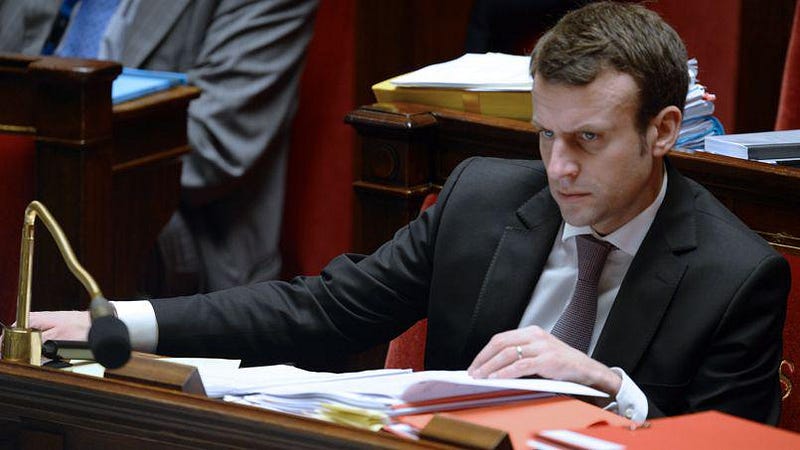
Emmanuel Macron learned it the hard way: France doesn’t like rebellion in business matters
The longer version follows three main arguments.
There’s a lot of capital in France, but the rent-seeking economy is so powerful (real estate, taxi companies, pharmacists, lawyers, doctors, craftsmen, farmers, solicitors and clerks of all sorts) that capitalists see no reason why they should risk anything by investing in startups. A lot of capital is also tied up in heavy infrastructures (transportation, energy, telecommunications, tourism), but that capital is also captured by special interests that seek rent (in tourism) or confine their innovation efforts to renewal and efficiency (telcos). The only rebels in French capitalism are those in the private equity sector, who frighten many stakeholders with aggressive leveraged buyouts. Even venture capitalists stay in line in France, as their funds are mostly financed by the Government through Bpifrance.
There’s a lot of know-how in France, but everything is done so that it is mostly allocated to efficiency or contractor work. France has good engineers, but there are two problems. 1) As Gwendal Simon explains here, French engineers are usually not interested in execution. They were the best students throughout their time in school, so they see themselves as corporate executives, not software developers. 2) Thanks to our research tax credit, a matter of national pride, engineers' salaries are subsidized by the government (yes: those engineers that every tech company is willing to pay good money for are subsidized in France). As a result, the engineering job market works like a cartel: every company, whether in the efficiency, playground or contractor economy, can afford to pay the same (relatively good) salary, whatever value they create. It is thus difficult for entrepreneurial ventures with no capital to match those salaries and to attract the best engineers.

Xavier Broseta, Air France’s corporate HR manager, tries to escape a furious employee mob
Finally, there’s a lot of rebellion in France, as demonstrated by frequent strikes and shirts being torn off corporate executives. But when that rebellion comes from Entrepreneurs trying to make their way out of the playground, it attracts nothing but problems: cease-and-desist orders, lawsuits, even nights in prison. It should be said again and again: in every country, Entrepreneurs usually don’t fit in the box. Only in some select countries, such as the U.S., rebellion allies itself with know-how and capital to overcome obstacles and beat corporatism. In France, on the other hand, rebellion is tolerated, even supported, but not in entrepreneurial matters. As a result, it thrives in other universes, such as activism or art creation. But Entrepreneurs are confined to the playground.

An economy specialized in tourism is prone to rent-seeking
My own perception, after many years spent in that ecosystem, is that France fails on the entrepreneurial front because entrepreneurship is suppressed by both rent-seeking (which ties up available capital), contracting (which captures know-how), and corporatism (which suppresses rebellion). It is not a caricature, but the inconvenient truth: we’re a mix of Tunisia (for tourism), London (for the real estate market), India (for IT services) and Greece (for the political system ready to explode).
Where is our entrepreneurial economy? For sure, there are a lot of Entrepreneurs in France, and they create hundreds of startups. A worrying sign, however, is that none of the currently dominant tech companies has grown out of France. This is why we’ve worked hard at TheFamily on finding ways to connect know-how, rebellion and capital enough to help promising ventures grow and scale.
France’s entrepreneurial economy is already proud of BlaBlaCar, en route to a dominant position on the global long-distance ride-sharing market: lots of know-how, lots of capital (thanks to foreign investors), and a good amount of rebellion.
But there are other promising jewels in the crown, notably future global players currently growing within TheFamily’s own ecosystem. Save, a company that rescues all your smartphones and tablets, was founded less than two years ago: it will have 700 employees and a €2M monthly revenue by the end of this year; in 2016, it will launch in the U.S. and China, adding to the 7 countries in which it is already operating. Algolia, another company in our portfolio, offers a Hosted Search API; it was also founded in 2013, raised $18M a few months ago and will soon have crossed the threshold of 250 billion API calls from customers all over the world. Out of 350 companies in our portfolio, we believe that we now have more than 50 such promising stars.
This is what we do as a long term, strategic, minority shareholder: operate our own ecosystem, empower Entrepreneurs, defeat toxic environments, and build new empires. So join up with us, and let’s get to work.
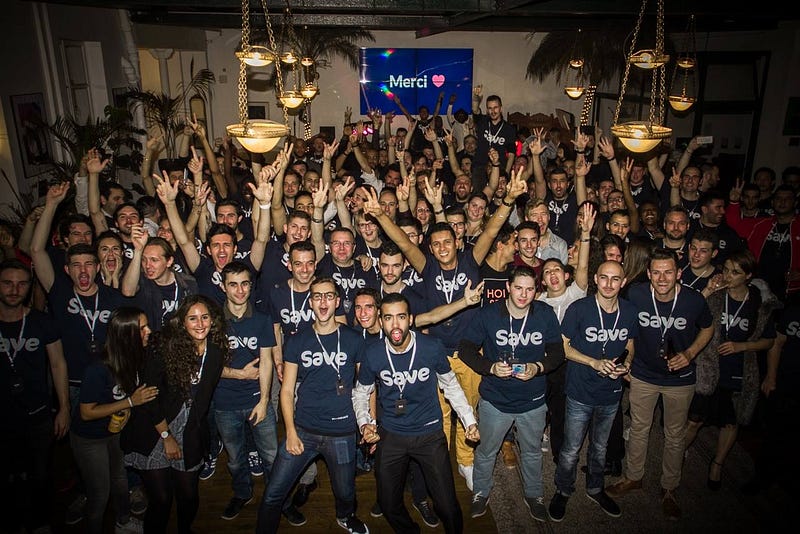
Save: amazing people, staggering performances
Here is a reading list I highly recommend for anyone willing to better understand entrepreneurial ecosystems:
A PBS program on Silicon Valley (you can watch it from the U.S. only).
For those willing to read more, a few excellent books by William Janeway, Josh Lerner, Enrico Moretti, Carlota Perez, AnnaLee Saxenian.


Source: https://medium.com/welcome-to-thefamily/what-makes-an-entrepreneurial-ecosystem-815f4e049804

Friday, October 9, 2015

Mindfulness-based Approach in the Classroom


By Phe Bach, Ed.D.


Good morning ladies and gentlemen,

         It is my honor to be here to share with you, dedicated and compassionate educators, some of the working strategies from my own classroom, personal and professional life. These strategies are also based upon my doctoral research; and together can be called a mindfulness-based approach.

Mindfulness is the energy of self-observation and awareness of what is going on around you and within you. Mindfulness brings you back to the present moment. The present moment is the only thing we truly have because, yesterday is history and tomorrow is mystery. Today is the gift--the here and now. Mindfulness enables us to focus, clear our mind, and enhance our loving-kindness. We all, including our students, know on some level that the future is dictated by what we are thinking, speaking, and acting at this moment. Everything we do has a consequence; and consequences can be positive or negative. Thus, if the students would like to have an A in the future, they must work hard at this very moment. At the beginning of the semester remind them that everyone is getting an A, but how to retain that A is another story. It is like love or being in a marriage: falling in love or getting married is an easy stage, but how you remain in love or stay married is an art and science in itself.

         A Mindfulness-based approach enables us to do just that--remain in love, stay married or keep the A. This is a life-skill that today’s students need. I often ask my students these questions, and I reflect often upon them as well. The questions are: "Are we part of the problem or part of the solution? and “What direction are we heading?” In terms of anything in our life: academics, finances, spiritual growth, our relationship to others-- including our siblings, friends, romantic partner, parents, and everyone else. If that “A” or that door, the gateway, to a better future is our aim, our goal, then are we heading in the right direction? Are we really moving toward that, with everything we do, say or think?

         Let's say, as an example to our students: Imagine you have 5 dollars for your allowance each day. In the morning you spend $3 on your Starbucks coffee and in the afternoon you spend another $3 for your Jamba Juice. You have $5 and spend $6--what direction are you going financially? You are going in a negative direction. You’re going to get a negative balance. In fact, you are going backwards just like Michael Jackson's moonwalk.  Thus, you need to be mindful, recognize your own actions, stop going backwards and move in a positive direction toward your set goals.  A philosopher once pointed out that it doesn't matter how slow or how fast we are going, as long as we are going forward in the right direction.

Through my own practice of mindfulness, I am able to recognize and be aware of how humans behave. As human beings, especially young ones, we are reactive. Whatever stimulus occurs, we tend to be reactive. For instance, students may talk back, using salty language or even displace physical behavior such as slamming the door. When using a mindfulness approach, whatever occurs, we are mindful--we pay attention to the moment, to what is happening inside oneself and outside in the situation.  Then you can respond to the situation. Not reactive, but rather responsive.  Know that we have many options, and choose the best one.


             In all situations, we can realize that we have a choice to settle on a win-win situation. Usually we react immediately when something happens; with the practice of mindfulness, whatever happens, we stay calm and practice mindfulness in that moment, and then respond to that stimulus.

The technique that I used often and asked students to use with me is called the P.E.A.C.E. practice, as put forth by Dr. Amy Saltzman in Still Quiet Place - Mindfulness for Teens (2010)

P - P is for Pause. When you realize that things are difficult, pause. Stop. Do not act. Do not do anything yet.

E - E is for Exhale. Take a deep breath (in via your nose and out via your mouth). I often do 3 times, but at first, students don't have that ability, so just once is all right.

A - A is for Acknowledge, Accept, and Allow. You must acknowledge your own emotions and the other’s emotion. If you are upset, mad or angry, it is ok to say that you are upset or mad. By recognizing your anger, you are already start to defusing it right then. I often say to my students, “I am not happy right now; what you did is a distraction to me and to the classroom. It also seems like you are not happy either. Thus, why don't you go outside the classroom and take a walk.”

C - is for Choose to respond with

Compassion: for yourself and others. In order for you to have compassion for others, you must have self-compassion first. Compassion is a concept central to Buddhism, and it can be defined as the ability to bring joy and happiness to others while reducing their frustration and suffering. We also need to turn this compassion inward towards our own selves. All transformation and happiness start from the within; we all transform and lead from the inside out. Compassion inward; compassion outward. (Like the egg if time permitted).

         C is also for Clarity: being clear about what you want, what your limits are, what you are responsible for. And finally, 

         C also stands for Courage: the courage to speak your truth, and to hear the truth of others.

         E - is for Engage Now we are ready to engage with the situation positively. We can create a win-win-win situation and "Begin with an open-end"--which means, to enter without attachment to a specific outcome.

          In the classroom, I use many mindfulness-based strategies to bring awareness to the present moment, such as inviting the bell --you call it “ringing the bell”, we call it “inviting the bell”-- to get students’ attention. We may do a quick breathing exercise, have quiet time or some other technique. I also share "Quotes of the Week" with my students to illustrate life lessons, with moral and ethical values. These quotes not only are to motivate my students, but also they help us build a strong interpersonal relationship. As you already know, once we have established a good relationship, teaching is much easier. I have even asked the students to do a “walking meditation” without letting them know they are doing that. If students ever use “salty language” or do some other misbehavior in my classroom, I ask them to go outside and not distract the classroom activities. However, instead of having them sit down and wait, which may result in anger building up, or at minimum, it’s boring and a wasted learning opportunity, I ask them to walk slowly and mindfully toward the next building. I tell them that they must touch this wall, to walk mindfully to that wall, touch it and go back and then go back and forth 5 times. By that time, they often have defused their frustration, sadness or anger and realized what they themselves did that needs correcting. When I asked "Do you know why I removed you from the class?", most of them say, ”Yes,” and “Sorry,” but if they don't, I ask them to walk 5 more times and this time, I guide them to focus their attention on a mark on the wall or a tree, and notice how their perception changes as they move closer or farther away from it. After the tenth time, they are more calm and ready to go back to the classroom and learn.

           Overall, research shows that mindfulness-based approach is working in the classroom both for teens and even for adults, at least for me. I am still using it. Here is an example to illustrate that: [play the audio].

         As you can see, it is hard for me as an educator, in this case a designated substitute Vice principal at Mira Loma High, to see a student get handcuffed and taken to jail. Somehow, I felt we failed as a whole system. This reminded me of something my Vietnamese Buddhist teacher once told me, “If the doctors or dentists makes a mistake, they can kill only one person, but educators like us, if we make mistakes we kill the whole generation." And I see it as not only one generation, but many generations.

          As educators of high school and middle school children, we deal with about 165 students in one single day, and our energy can run low each day. It is very important that we take a good care of ourselves. We can't give something we don't have. Please take care of yourselves physically, mentally, emotionally, spiritually and all the 'lys' that you can think of, so that we can give it forward. Have some quiet time for yourself each day to recharge your energy. Teachers matters. Keep Calm. Be Mindful. Teach On.

Breathe and Smile. Thank you for listening.
THANK YOU.


Phe Bach, Ed.D.
Mira Loma High School
San Juan Unified School District.


Sunday, September 27, 2015

Harvard psychologists have been studying what it takes to raise 'good' kids.

A lot of parents are tired of being told how technology is screwing up their kids.

Moms and dads of the digital age are well aware of the growing competition for their children's attention, and they're bombarded at each turn of the page or click of the mouse with both cutting-edge ideas and newfound worries for raising great kids.


But beneath the madness of modernity, the basics of raising a moral child haven't really changed.

Parents want their kids to achieve their goals and find happiness, but Harvard researchers believe that doesn't have to come at the expense of kindness and empathy. They say a few tried-and-true strategies remain the best ways to mold your kids into the morally upstanding and goals-oriented humans you want them to be. Here are six practical tips:

1) Hang out with your kids.


This is, like, the foundation of it all. Spend regular time with your kids, ask them open-ended questions about themselves, about the world and how they see it, and actively listen to their responses. Not only will you learn all sorts of things that make your child unique, you'll also be demonstrating to them how to show care and concern for another person.

2) If it matters, say it out loud.


According to the researchers, "Even though most parents and caretakers say that their children being caring is a top priority, often children aren't hearing that message." So be sure to say it with them. And so they know it's something they need to keep up with, check in with teachers, coaches, and others who work with your kids on how they're doing with teamwork, collaboration, and being a generally nice person.

3) Show your child how to "work it out."


Image by susieq3c/Flickr.
Walk them through decision-making processes that take into consideration people who could be affected. For example, if your child wants to quit a sport or other activity, encourage them to identify the source of the problem and consider their commitment to the team. Then help them figure out if quitting does, in fact, fix the problem.

4) Make helpfulness and gratitude routine.


Image by David D/Flickr.
The researchers write, "Studies show that people who engage in the habit of expressing gratitude are more likely to be helpful, generous, compassionate, and forgiving — and they're also more likely to be happy and healthy." So it's good for parents to hold the line on chores, asking kids to help their siblings, and giving thanks throughout the day. And when it comes to rewarding "good" behavior, the researchers recommend that parents "only praise uncommon acts of kindness."

5) Check your child's destructive emotions.


"The ability to care for others is overwhelmed by anger, shame, envy, or other negative feelings," say the researchers. Helping kids name and process those emotions, then guiding them toward safe conflict resolution, will go a long way toward keeping them focused on being a caring individual. It's also important to set clear and reasonable boundaries that they'll understand are out of love and concern for their safety.

6) Show your kids the bigger picture.


"Almost all children empathize with and care about a small circle of families and friends," say the researchers. The trick is getting them to care about people who are socially, culturally, and even geographically outside their circles. You can do this by coaching them to be good listeners, by encouraging them to put themselves in other people's shoes, and by practicing empathy using teachable moments in news and entertainment.

"Raising a caring, respectful, ethical child is and always has been hard work. But it's something all of us can do. And no work is more important or ultimately more rewarding."

Source: https://www.upworthy.com/harvard-psychologists-have-been-studying-what-it-takes-to-raise-good-kids-here-are-6-tips

Tuesday, September 22, 2015

10 ways the circular economy is changing the way businesses think

by Stephen Kennett

To mark the world’s premier circular awards program, The Circulars, opening up entries for 2016, we take a look at the impact that a circular economy approach is already having on businesses.
Two studies in recent weeks have put some hard figures to the economic benefits that a shift to the circular economy could bring.

First up was an independent report commissioned by resource management business Veolia and produced by Imperial College London. It found that a combination of closing the loop on resource use and moving to a service rather than product based economy has the potential to add £29 billion to UK Gross Domestic Product over the next decade.

Hot on the heels of this was the Growth Within report by the Ellen MacArthur Foundation. It claims a pan-European shift to a circular economy could create a net benefit of €1.8 trillion for European economies by 2030.

These are compelling and timely figures, as the European Commission considers its circular economy strategy with the promise of presenting a new, more ambitious plan by the end of the year. But there is already a huge up-swell in ground-level innovation in this field being driven by large corporations, and small and medium enterprises alike. Here’s a round-up of 10 ways the approach is impacting on what they are doing.

1. Encouraging collaboration to drive innovation

Closed-loop thinking and sustainable packaging are two targets that computer manufacturer Dell has committed to and it is using collaboration to drive innovation in both these areas. Dell has joined forces with bio-tech start-up, Newlight Technologies to pilot the use of carbon-negative product packaging and worked with original equipment manufacturer partner Wistron GreenTech to reuse plastic from its consumer and business-to-business recycling program and feed it back into its new IT products.

2. Thinking counter-intuitively

Clothing company Patagonia has made long-running efforts to counter over consumption and its Worn Wear California-to-Boston road show that took place earlier this year perfectly sums up this approach by building consumer knowledge about the value of fixing broken goods. GreenBiz author Lauren Hepler gives a first-hand account of Patagonia's vision for elevating the approach beyond the apparel sector.

3. Reverse logistics

Logistics giant Deutsche Post DHL is actively exploring new ways it can capitalise on reverse logistics, one of the most important enablers in the transition to a circular economy. With its global network reach, DHL is undoubtedly sensing an opportunity to develop new models that can push forward more circular flows of goods and materials.

4. Think users not consumers

Are we moving back to people behaving more like users rather than consumers? This is one of the trends emerging in the automobile and IT sectors. In this interview with Kirstie McIntyre, director of social and environmental responsibility at HP, explains how the company is seeing service models for users becoming more frequent and how that translates to product design.

5. Handing the creative process back to the consumer

Sustainable footwear is a hotbed of innovation for many apparel and lifestyle brands. But one enterprising start-up is looking to take this to the next level. Lyf Shoes is looking to capture a slice of the market by handing the creative process back to the consumer and is working up a customized 3D-printing service for shoemaking.

6. An incentive for transforming workplaces

The launch of the world’s first guide to creating an office using circular principles promises to minimize waste and maximize the life of all materials. The guide, which has been produced by a cross-industry collaboration of nine organizations, launched in July and the authors are now looking for a New Zealand office in need of refurbishment to become the world’s first Circular Economy Model Office. They claim it is the first step in revolutionising the office refurbishment industry.

7. Using it for brand building

Elvis and Kresse is an emerging brand in the luxury fashion market, selling belts, wallets, handbags and rugs. It uses 15 different wastes, including leather and old tea sacks to make its products and it’s an approach that underscores its entire brand ethos - what's more it’s got plans to build on this creativity.

8. Delivering social good

From a Mother to Another aims to extend the lifespan of baby and children clothing by redistributing high quality clothing that has been outgrown to vulnerable families in the UK. Research by Hubbub UK discovered that over £3,500 worth of children’s clothing goes to landfill per child growing up. From a Mother to Another aimed to create a new circular economy initiative based on such findings. The campaign is delivered by a partnership of the retailer JoJo Maman Bebe, the charity Barnardo’s and Hubbub UK.

9. A catalyst for disruptive innovation

In 2012 B&Q offered nine young people the opportunity to win a year’s placement on a Youth Board. Following a nationwide competition, the nine who secured a place were each appointed a B&Q Retail Board mentor and set a specific challenge — to apply circular economy and closed loop thinking to re-imagine B&Q’s future business model.

10. And finally… there’s more than one approach

Research by Accenture has identified five different business models companies are adopting – alone or in combination — when embracing the circular economy: circular suppliesresource recoveryproduct life extensionsharing platforms, and product as a service.
Source: 2degrees

Monday, September 21, 2015

Ananda Marga Gurukula - Global Education Network for People and Planet

Link: http://gurukul.edu/

Ánanda Márga Gurukula is an international educational network of schools and institutes engaged in teaching, research and service. It spans over fifty countries with over 1,000 kindergartens, primary schools, secondary schools, colleges and children’s homes that have been established over the past 50 years. It is based on the holistic philosophy of Neohumanism which stands for ”the practice of love for all creation including plants, animals and the inanimate world” as propounded by philosopher-seer Prabhat Ranjan Sarkar. The education imparted in Ánanda Márga Gurukula affiliated schools and institutions is known as Neohumanist Education.

The Sanskrit word “Gurukula”  has the following etymology: Gu: darkness; ru: dispeller; kula: an institution. Gurukula is an institution which helps students dispel the darkness of the mind and leads to total emancipation of the individual and society at large.

The Gurukula system of education is the oldest on our planet, tracing its roots back 10,000 years to the time of ancient civilisation and dedicated to the highest ideals of all-round human development: physical, mental and spiritual.

Today, Ánanda Márga Gurukula is a revival of that ancient tradition, offering a blending of occidental analytical approach and oriental synthetic knowledge. Gurukula is dedicated to innovative research and human resource development for the betterment of people and the planet.

At Gurukula affiliated schools and institutes, all aspects of one’s personality are developed utilising an integrated curriculum that empowers the student to know oneself and develop the confidence and empathy to utilise knowledge for serving the society. Intellectual cognitive abilities are extended to include the development of intuition, aesthetics and a futuristic and ecological perspective based on universal outlook.


For further reading:
Gurukula Education

Thursday, September 10, 2015

Steiner Education

A Serious Need for Free Play
A Creative Approach to Foreign Language for Waldorf Teachers
Alphabet letters, Waldorf style
Basic Elements of Daily Living with Children
Can We Play
Concepts and Practices of the Pikler Approach
Consciousness, child development and the misuse of words
Crying
Deeper relationship between Pikler and Steiner
Discover Waldorf education – Beyond Cognition
Drawing with hand, head and heart
Earth who gives to us…
Fever
Five reasons to stop sayings Good Job
From Beauty to Truth in Mathematics
From Playing to Thinking
Importance of Play
Laws of childhood
Learning through Imitation
Learning Through Play
Listening
On the seeing the child as cute
Parenting a young child
Self-directed play is disappering in kindergartens
The meaning of illness
The value of Grimm’s fairy tales
The Vital Role of Play in Childhood
Too much too early
Truth about sight reading
What is Child-led Play

Books

A Morden Art of Education
Adventures in Parenting
A Warm and Gentle Welcome – Nurturing Children from Birth to Three
Childhood under threat
Human values in education
Meeting the Needs of the Child today
Morality and Ethics in Education
No Fear – Growing up in a risk averse society
Overview of Waldorf Kindergarten
Painting in Waldorf Education
The Child’s changing Consciousness
The Education of the Child
The genius of language
The Roots of Education
The spiritual ground of education
Understanding young children
Working with anxious, nervous and depressed children

http://thotrangsteiner.edu.vn/tai-lieu-steiner/

Monday, August 17, 2015

The Future of Education


mtemrymyrm1111


If you had a chance to vote on what subjects of study our children would have in schools on the New Earth, what would they be? A balance of true galactic history, social interaction, math, and various artistic creative outlets seems to be a good mix. Whether you are a teacher, parent, or student, now is the time to decide how we will change the education of the indigos and crystals that have more strands of DNA activated than any other humans on the planet.


The current corrupt schooling agenda


Today’s public school system is built around programming our children to obey and to think outside of themselves. Schools have become businesses that are run by education boards that answer to the top domination and control group on the planet. Creativity and flexibility has been removed from the curriculum and teachers are frustrated and tired of holding children back from their amazing potential.


The history taught in schools is mostly a lie, created to cover up the real truth of The Vatican and Queen of England’s stronghold on the world. Although these forces seem like they are behind most of the illusion on this planet, the puppet strings are actually being pulled by the interbred Draconian families of the Rothchilds, Rockefellers, and other banking pioneers that control most of the wealth on the planet. The history taught in schools is mostly a lie, created to cover up the real truth of The Vatican and Queen of England’s stronghold on the world. Although these forces seem like they are behind most of the illusion on this planet, the puppet strings are actually being pulled by the interbred Draconian families of the Rothchilds, Rockefellers, and other banking pioneers that control most of the wealth on the planet.


Almost every book in our educational system in the subjects of history, math, English, social studies, and science can be thrown away because the basis of each is to teach cover up stories in every single way possible. The plan has intertwined politics, finance, and religion with education in order to keep people in the dark about the truth of who they are in order to keep them enslaved in a system of control. It has been part of a brilliant plan of control on this planet to brainwash humanity in the most formative years of their lives, but the game is over and the truth has been revealed.


Private Montessori schools are the closest thing we have in the United States to sensible education, however it is still a far cry from where we need to be. Many people have chosen home schooling over public schools which is a better choice but if a GED is desired, one must still follow a curriculum. 

Private Montessori schools are the closest thing we have in the United States to sensible education, however it is still a far cry from where we need to be. Many people have chosen home schooling over public schools which is a better choice but if a GED is desired, one must still follow a curriculum.


The system has been set up to where a high school diploma simply shows that you were programmed enough to follow orders, and therefore you would make a good employee. Paying for college in order to get a higher paying job has become a cruel trap for our young people. The price of a college education may take several years to pay off and many young adults took out student loans with high interest that can never be paid back.


The system will collapse, including education


The whole economic system supports institutionalism and when the system collapses, so will the educational system. Humanity has to be ready to create a whole new way of thinking around what kind of curriculum would benefit our children most, how long they should stay in school each day, and what kind of food they will be eating in order to stay healthy.


When Pluto entered Capricorn in 2008, we saw a collapse of the banking system, with the exception of the “Too big to Fail (Jail)” banks.


Pluto is known as the “Destroyer” and will tear down everything that is not in humanity’s best interests, which will allow us to rebuild them in a way that benefits humanity. Pluto stays in Capricorn until 2023. The last time Pluto was in Capricorn was in the 1700’s, during both the French and American Revolutions. Right now, revolutions are happening all around the world. This clearly shows us how astrology reflects the cycles of time and gives us an opportunity to learn from these lessons.


Right on schedule, we are seeing a collapse of money, government and religion as all three are used as forms of control in order to keep us subservient economic slaves to a failed system.


We are also entering the Age of Aquarius, which brings in a new energy that works in conjunction with Pluto in Capricorn. In other words, all systems of control will implode in order for the New Age to begin.


The first forms of education will involve many of our readers as you will be needed to help awaken those who have been asleep during this transition.


Ancient studies


To get an idea of what school was like before domination and control, we can turn to The book Urantia Chapter 7 “Adam and Eve”:


The children of Adam, except for four years’ attendance at the western schools, lived and worked in the “east of Eden.” They were trained intellectually until they were sixteen in accordance with the methods of the Jerusalem schools. From sixteen to twenty they were taught in the Urantia schools at the other end of the Garden, serving there also as teachers in the lower grades.


The entire purpose of the western school system of the Garden was socialization. The forenoon periods of recess were devoted to practical horticulture and agriculture, the afternoon periods to competitive play. The evenings were employed in social intercourse and the cultivation of personal friendships. Religious and sexual training were regarded as the province of the home, the duty of parents.


The teaching in these schools included instruction regarding:
  1. Health and the care of the body.
  2. The golden rule, the standard of social intercourse.
  3. The relation of individual rights to group rights and community obligations.
  4. History and culture of the various earth races.
  5. Methods of advancing and improving world trade.
  6. Co-ordination of conflicting duties and emotions.
  7. The cultivation of play, humor, and competitive substitutes for physical fight

Example of future studies


Although the subjects discussed in the Urantia book build a good basic foundation for education, higher learning classes would expand into subjects that will allow children will be excited about attending school. Examples of these kinds of subjects are:


Math– Geometry is the basic building block of all life. Math will take on a whole new meaning and new ways of arithmetic along with fun ways to calculate will be taught.


Cosmic Science– Identity and placement of Universes in our cosmos and the difference between free willed Universes and non free-willed Universes.


Universal Science– How planets, moons, and stars are sentient beings and how they all work together to form solar systems and galaxies.


Universal History– The history of the Universe including civilizations and placement in the Cosmos.


Creation and Unity Science– All We are One. Learn to be united worldwide and with one Creator, 

Celestial Hierarchy  and high realms. Study how we contribute to that creation.


Human History– DNA studies, human genetics, and the history of humanity from Lyra to today, including the social statistics, behaviors, and characteristics of all humans in our Universe.


Human Rights- Constitutional Law on freedom and the Golden Rule.


Sexual Relations– The responsibility behind merging energies with another human and teaching the ability to decide whether another human body is created.


Universal Language– Learning the language of light which is understood throughout the Universe.


Universal Law– Learning the importance of Universal Law and how it relates to all sentient beings.


Astrology – Learning how to read and fully understand your birthchart.


Astronomy – Understanding the importance of stars, planets and constellations. Learning how the stars can show us the cycles of time along with how they can be used for navigation.

Sixth Sense Studies– Developing all of your innate gifts.


Meditation– Guided classes on how to safely travel the Universe with your consciousness, learning new meditation techniques, developing new ones.


Exercise– Yoga, Tai Chi, etc.


Galactic Ambassador Training– How to become a galactic ambassador, spaceship flight training.


Healing– Methods for keeping the body clear of negativity (reiki, quantum touch, etc…), responsible thinking, service to others.


Gardening– How to grow organic food and hemp for cultivation, different forms of gardening such as hydroponics, permaculture, etc…


Technological and Industrial Sciences– How to make almost anything from hemp, 3d printing, free energy technology, encourage free thinking and non competitive invention


Environment– The true importance of being stewards of the earth by living on her without making footprints and healing the environment.


Recycling– Maximizing what has been created in the past into something sustainable.


Council of Elder training– With the elimination of government, a Council of Elders training program will be facilitated to ensure that future elders will always be working in humanity’s best interests.
Music– All forms of music including history, composition, symphonic band and concert, and voice.

UFO Research – Classes on the documentation of UFOs through night vision goggles, how to interact with them, sky mapping, UFOs in Art History, etc…


Creative arts– All forms of creativity including art, dance, drama, and writing.


Community– How to contribute economically to your community through barter, volunteering, and communal caregiving for all children. Creative culinary classes and decorating houses for energy flow could be subjects.


Life Path Development – Helping people find their life path, based on their astrological charts, personal interests and past life experiences.


Spiritual Psychology– Learning how the body, mind, soul and spirit interact. Dream analysis, dream journals, counseling methods, past life regression techniques are included in this genre.


Changing the way school is structured


Besides subject study, ample social time should be given between classes and play time (or nap opportunities) should be allowed in the morning and afternoon. A “free” class could be created where a child can expand on any topic they wish with other children, ie. let the children teach the children. The length of time for classes should be less than one hour for each class, schedules should be individualized, homework should be a rarity, and the children should not be overworked or stressed. Class credits should be given for the interaction in community of gardening, building infrastructure, and caregiving.


School should be fun and the children will want to add as many classes as they can. Curriculum should be an interactive choice between the student, parent, and a counselor based on the capability of the child, and graduation of primary and secondary schools could be done at any age.

Careers in education

Education will need to be continuously re-created as more strands of our DNA are activated and more information is available to humans through our higher selves and our Akashic records. One of Education will need to be continuously re-created as more strands of our DNA are activated and more information is available to humans through our higher selves and our Akashic records. One of the most sought after jobs will be teaching these brilliant children and it will be one of the most rewarding careers to have. Education administrators will be free thinkers, organizers, and mediators, and will enjoy their jobs just as much as teachers.the most sought after jobs will be teaching these brilliant children and it will be one of the most rewarding careers to have. Education administrators will be free thinkers, organizers, and mediators, and will enjoy their jobs just as much as teachers.

Does this article give you any ideas about the future of education and the co-creation of the New Earth? If so, now is the time to begin brainstorming and to form groups on Facebook and other social media sites dedicated to revamping our education system. Change will have to happen on the community level by example and then spread throughout the world due to the success of one particular curriculum over another. Information and awareness about the corruption of our current system and what we are going to do about it is the key to moving forward as free-willed humans.


What ideas do YOU have? 

Source: http://www.smartpla.net/uncategorized/the-future-of-education-new-schools-you-would-want-to-attend


Wednesday, July 15, 2015

13th Global Conference on Sustainable Manufacturing

13th Global Conference on Sustainable Manufacturing

to be held in Ho Chi Minh City / Binh Duong, Vietnam on 16th - 18th September, 2015.
Presented by


Technische Universität Berlin and Vietnamese-German University will jointly organize the 13th Global Conference on Sustainable Manufacturing (GCSM, www.gcsm.eu) near Ho Chi Minh City in Binh Duong New City. This conference is sponsored by the International Academy for Production Engineering (CIRP, www.cirp.net). The GCSM serves as a forum for academics, researchers, and practitioners from international universities, research institutes and industrial companies working on topics related to sustainable manufacturing. It offers keynote speeches, panel discussions and parallel session presentations.

You are cordially invited to submit a paper to the conference which is expected to attract representatives from academia and industry from all over the world. We are looking forward to welcoming you to Binh Duong New City for the 13th GCSM.

Best regards,
Holger Kohl, Jürgen Mallon and Günther Seliger


Global Conference Series on Sustainable Manufacturing


The rationally required sustainability in our global village shall be supported by innovative value creation in accordance with social, environmental and economic criteria exploiting the dynamics of market competition and cooperation. Sustainable manufacturing has emerged as the leading paradigm to address the dilemma of maintaining a progressive economic growth based on production of goods and services without continuing to damage our environment or future economic and social structures.
For almost 20 years the chairman of the Global Conference on Sustainable Manufacturing (GCSM) Prof. Dr.-Ing. Günther Seliger and other members of the International Academy for Production Science (CIRP, www.cirp.net) have been scientifically dealing with sustainable manufacturing. The GCSM is geared towards representatives of science and industry from all over the world. The conference serves as a forum for international research institutes and industrial companies related to the area of sustainable manufacturing. It aims at strengthening relations on sustainable manufacturing in the international network by both scientific/educational and industrial cooperation projects. In 2014, more than 140 participants from 30 countries contributed with 136 submissions.


For 2015 the conference organizations decided to host the conference in Vietnam. Chairman Professor Seliger emphasized the role of emerging countries for a sustainable development. Vietnam as one of the upcoming "factories of the world" has a special responsibility and should be enabled to a future industrial growth without having irresponsible resource consumption, environmental pollution and inadequate working conditions. High-tech solutions in innovative local product and process applications are essential drivers for local but also global sustainable development. The key for this development is qualification. Thus, local and foreign companies and universities should act as agents of change to boost sustainable manufacturing.


The GCSM is sponsored by the International Academy for Production Engineering (CIRP, www.cirp.net). 


Sunday, July 12, 2015

Climate Strike - One million students for the Climate on November 30th, 2015!


On November 30th, 2015, the first day of COP21 in Paris, our generation will write history. By organizing a first, global coordinated action with more than a million students participating and acting on climate. Learn more and join us here: http://climatestrike.net/

Climate Strike is on!

Monday, June 29, 2015

The Lie We Live