Sunday, December 19, 2021

Sustainability Compass - Inspire Citizens

 Source: https://inspirecitizens.org/

Audit institutions, community spaces, projects,
and personal habits for sustainability


Purpose:
Having a sustainability framework, such as the Sustainability Compass, allows individuals or teams to audit successes and challenges in an organization, personal or collective actions, or a project in relation to nature, economy, society, and wellbeing.

Student Impact Profile:
Critically examine community needs to design ethical solutions

Enduring Understanding:
Having a tool that critically assesses the sustainability of an organization, project, or personal action helps in identifying needs and potential impact projects that develop more sustainable attitudes, behaviors, actions, and policies.

Essential Questions:

  1. Assess & Explain: How might using a Sustainability Compass support a greater understanding in the need for positive change in personal or community action?

  2. Identify & Distinguish: In my sustainability assessment, how did I distinguish between identified community strengths and areas for improvement?

  3. Reflect, Predict & Comment: How might a common understanding of sustainability unify a community?

  4. (Extension) Transfer & Evaluate: How can I apply my experience with the Sustainability Compass in a school organizational assessment towards evaluating the sustainability a community project or the True Price of personal action?


Core Activities:

  1. Pre-assess student background understanding of sustainability

  2. Use the Sustainability Compass to help students enhance their understanding

  3. Create a Sustainability Compass chart and audit the school campus and community.

  4. Consolidate information for a bank of project ideas.


Flexible Steps: 

Apply these ideas for context while scaffolding and differentiating for age, language proficiency, readiness, independence, learning needs, content connections, and so on.

  1. Pre-assess student background understanding of sustainability then share the Sustainability Compass to help students to describe what they can synthesize. What is our new understanding of sustainability in relation to nature, economy, society, and wellbeing?

  2. Create a Sustainability Compass chart. Have students survey the sustainability of the campus by walking around (20-30m), thoughtfully observing what they see in the campus and audit these strengths and areas for improvement.

  3. Upon returning to class, have students reflect and share thinking and observations on their audits.

  4. Consolidate information from the various teams in a community Sustainability Compass table or wall that highlights the most essential observations on successes and areas for improvement.

  5. Keep these essential observations as an idea bank for innovative projects enhancing successes or problem solving for challenges.


Extension Possibilities:

  1. Connect with Compass Education to access the School Sustainability Self-Assessment to help identify indicators for a campus sustainability audit which can spark inquiry or project ideation.

  2. Use the Sustainability Compass to analyze the “True Price” of a campus service project (i.e. a bubble tea fundraiser) or in analyzing responsible consumption or production of goods and services (i.e. beef, t-shirts, iPhones, coffee)


Allow for embedded quality time to reflect on learning, understanding, or the essential questions through speaking, writing, or other creative reflection and formative assessment opportunities.

Thursday, December 2, 2021

Reduce Global Ocean Plastic Wastes

 Link: https://www.nap.edu/resource/other/dels/plastics-in-the-ocean/

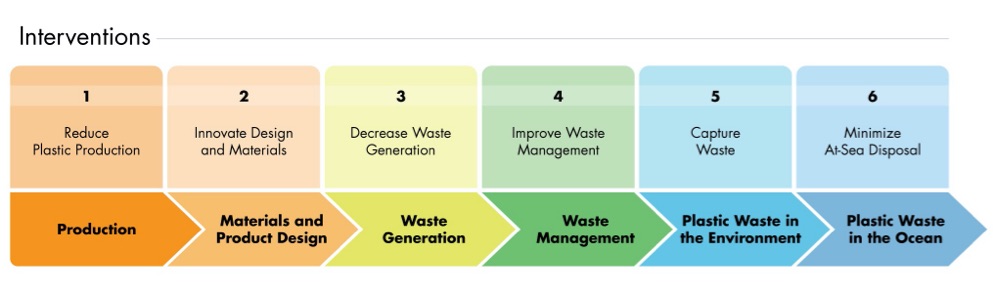
The United States should substantially reduce solid waste generation (absolute and per person) to reduce plastic in the environment and the environmental, economic, aesthetic, and health costs of managing waste and litter. There is no single solution to reducing the flow of plastic waste to the ocean. However, a suite of actions (or “interventions”) taken across all stages of the path from source to ocean could reduce ocean plastic waste and achieve parallel environmental and social benefits.


Decrease Waste Generation.
Actions at this stage reduce unnecessary use of plastics such as some single use applications.  Types of interventions can include product limits and targets for recycling and reuse.


Improve Waste Management (Prevent or Reduce Disposal/Discharge).
Action within this stage improves solid and other waste infrastructure, collection, treatment and management, including leakage control and accounting.


Capture Waste (to Remove Plastic Waste from the Environment.)
Improving waste capture from the environment before or after it enters the ocean is another intervention strategy.  This can include re-capturing wastes from stormwater or directly from waters where it accumulates, such as during river or beach cleanups or using retention booms.


Minimize Ocean Disposal.
This category reduces inputs of plastic waste into the ocean directly from vessels, point sources, or platforms and includes actions under specific laws and treaties relevant to ocean pollution. 

Other Activities (to Support Above Interventions)

Flow diagram of available plastic waste interventions from plastic production to recapture of plastics in the ocean. SOURCE: Modified from Jambeck et al. (2018).

Flow diagram of available plastic waste interventions from plastic production to recapture of plastics in the ocean.

SOURCE: Modified from Jambeck et al. (2018).

Tuesday, November 30, 2021

Rebooting International Cooperation

 Link: https://globaldimension.org.uk/resources/december-activity-rebooting-international-cooperation/

Alongside our 2021/22 Global Learning Wall Planner - 10 Ways to Reboot the Future - we’re releasing a series of monthly classroom resources. 

Each of our class activity resources explores a different focus for creating a more sustainable and compassionate future, based on the 10 Big Shifts in Jonathon Porritt’s Rise Up to Reboot the Future.

The activities are adaptable for all age ranges and can be used as standalone activities for tutor group sessions or can slot into a lesson.

Rebooting International Cooperation

This month’s class activity explores December's theme of International Cooperation. Learners explore the concept of the Tragedy of the Commons through a game where resources are replenished as they are used up. Participants have to find a way to cooperate so that the resources don't run out.

New this year: monthly challenges

Every month we will be setting a series of challenges – complete one or more of the challenges as a whole class, or choose 2 or 3 pupils to complete one each month over the course of the year.

To win a bundle of books for your class – all linked to this month’s theme - simply post a photo of your class’s completed challenge on social media before the end of September 2021, and tag @globaldimension for the chance to win.

Rise Up to Reboot the Future e-book

Ebook: https://globaldimension.org.uk/resources/campaign-book/

Rise Up to Reboot the Future - an e-book by Jonathon Porritt

Rise Up to Reboot the Future tells the story of the next five years, with a particular focus on the Climate Emergency, and how young people can play a role in transforming the world into a fairer and more sustainable place. 

Jonathon Porritt describes it as: “A just about plausible imagining of how the world finally gets to grips with the Climate Emergency by 2025 – largely thanks to the courage and creativity of young people”.

Companion Guide

The accompanying companion guide is designed to support groups reading Rise Up to Reboot the Future. It can also be a useful companion for solo readers who want to dive deeper into the topics and themes that emerge.


Part of the "How Will You Reboot the Future?" Campaign

This e-book and companion guide are designed to help teachers begin to introduce conversations about climate action into the classroom in a way that is positive, empowering, and adaptable to suit the needs of individual teachers and students as they navigate the transition back to school.

They sit alongside a series of 5 short films, each with an accompanying teaching guide. These resources flexibly slot into tutor group sessions or any gaps in the timetable, allowing teachers to spark conversations with their students and find space in the day to stop and consider how our actions now can make a real difference in the future. 

These materials are also suitable outside of classroom contexts, including youthwork, uniformed groups, Duke of Edinburgh, Youth Parliament meetings, Student council/ Pupil council meetings and more.

RESOURCE CONTENTS

TOPICS

Arts, Culture and Religion, Child Rights, Compassionate Values, Environment and Sustainability, Equality, Globalisation and Interdependence, Health and Well-being, Industry and Economy, Media, Internet and Technology, Peace, Conflict and Justice, Politics and Government, Production and Consumption, Social Justice

AGE RANGES

KS4: ages 14-16, KS5: ages 16+

SUBJECTS

Citizenship, Philosophy / P4C / Critical thinking, PSHE / PSE / PSED, Climate Campaign, Clubs and extra-curricular, Remote learning, Spiritual, moral, social, cultural (SMSC)

EcoGuide – Recipes to minimise your impact on the environment while saving costs

 EcoGuide – Recipes to minimise your impact on the environment while saving costs [EN, KM, MY, TH, VI]

EcoGuide – Recipes to minimise your impact on the environment while saving costs [EN, KM, MY, TH, VI]
55 tips and good practices to reduce Tourism’s impact on the environment

An Eco-Guide for Hospitality Businesses & Schools

“Recipes to minimize your impact on the environment while saving costs.”

55 tips and good practices to reduce Tourism’s impact on the environment

Reusable water bottles in hotel rooms, LEDs instead of incandescent light bulbs, composting restaurant leftovers… These are some examples of the 55 good practices gathered in the Eco-Guide for Hospitality Businesses & Schools. This “recipe book” is published by ASSET-H&C, a network of hospitality schools in Southeast Asia, and is geared towards restaurants, hotels and all tourism stakeholders willing to improve their environmental sustainability.


In this guide:

4 key focus: energy, water, waste & pollution, mitigation & adaptation to climate change

35 practical recommendations 

20 good practices already implemented by tourism actors

The COVID-19 crisis has been considered by many as a wake-up call for the industry. Time for deep social and environmental change has come, and the downtime in global tourism activities has offered a golden opportunity for such a change to happen. 

COVID-19 has made travelers more aware of their impact on the environment and local communities. 53% of global travelers will be seeking more sustainable tourism products and services in the future, according to the Future of Travel Report by Booking.com*. Such growing demand for environmentally responsible tourism is more than just a trend; it represents a shift in customers’ awareness and a call for action on this global emergency. As a result, tourism providers are surely adapting, and soon services and products that respond to the demand and contribute to making a positive impact will become predominant. 

To accompany them on this more sustainable pathway, ASSET-H&C provides accessible and easy guidance for tourism businesses to start taking action. As the Eco-Guide supports businesses in increasing their sustainability, it also helps them save costs and equips them with a distinctive advantage regarding consumer demand. It is accessible to everyone regardless of their technical background.


 Link download: https://assethc.org/publication/

To foster an inclusive approach to sustainability and make this Eco-Guide for Hospitality Businesses and Schools accessible to a wider audience, it has now been translated to Burmese, Khmer, Thai, and Vietnamese.

Friday, November 5, 2021

Climate Solutions 101 - Playlist of 6 Units


Source: https://www.youtube.com/playlist?list=PLwYnpej4pQF7UPnt0nkZEa8sxR9TmWR1B

Your climate solutions journey begins now. Filled with the latest need-to-know science and fascinating insights from global leaders in climate policy, research, investment, and beyond, this video series is a brain-shift toward a brighter climate reality.

Climate Solutions 101 is the world’s first major educational effort focused solely on solutions. Rather than rehashing well-known climate challenges, Project Drawdown centers game-changing climate action based on its own rigorous scientific research and analysis. This course, presented in video units and in-depth conversations, combines Project Drawdown’s trusted resources with the expertise of several inspiring voices from around the world. Climate solutions become attainable with increased access to free, science-based educational resources, elevated public discourse, and tangible examples of real-world action. Continue your climate solutions journey, today.

Learn more: www.drawdown.org/climate-solutions-101

#ClimateSolutions101


Building Resilient Cities

 Source: https://www.youtube.com/watch?v=wUEi5K6r2xs

Thursday, September 30, 2021

Global Citizenship Course

 Source: https://framerspace.com/courses

https://framerspace.com/course/global-citizenship

Modules

Module 1 ~ Getting Curious: Beginning to Question

When Isidore Isaac Rabi, winner of Nobel Prize in Physics was asked why he became a scientist, he replied, “My mother made me a scientist without ever knowing it. Every other child would come back from school and be asked, ‘What did you learn today?’ But my mother used to say, ‘Izzy, did you ask a good question today?’

In this module you will begin to inquire, ask questions and explore the power of inquiry.

Module 2 ~ Displacing homes: Movement and Separation

Albert Einstein once said, "Nothing happens, until something moves"

Shifting base, moving homes, separating from friends and loved ones can be hard, but it may be a precursor to a better life, a better promise!

In this module, you will inquire what movement is, what does it entail and how it may feel like.

Module 3 ~ Co-creating Governance: Active Citizens

"You must be the change you wish to see in the world." - Mahatma Gandhi

Everyone wants a better life and most see it through a better governance.

But, what is a better governance? Can we define it?

In this module, you will inquire for a near to perfect recipe for a successful governance.

Module 4 ~ Blurring Boundaries: Citizens of the World

"You have to take ownership of tomorrow. For that to be possible, you have to strengthen your capacity and widen your vision as a global citizen." Ban Ki-moon, 8th General Secretary of United Nations

In this module, you inquire what it is to be 'a global citizen' and the need for it. You look at stories from the world to broaden your horizon of the constraints that people encounter.

Module 5 ~ Discovering Myself: Who am I?

"Identity is the incredible, invisible force that controls your whole life. It's invisible, like gravity is invisible, but it controls your whole life." Tony Robins

Who are you? Why are you the way you are? Are you really who you are?

In this module, you will study human behaviour. You will understand what governs humans and inquire into who you are and what has shaped you.

Module 6 ~ De-rooting Violence

In this module, you will understand the essential elements of a violent act and identify them in different scenarios. We will explore the types of violence, nature of violence, causes of violence and triggers of violence.

Global Citizenship Education: Topics and learning objectives

 Source: https://en.unesco.org/news/global-citizenship-education-topics-and-learning-objectives

UNESCO has just launched its new publication on Global Citizenship Education (GCED) titled Global Citizenship Education: Topics and Learning Objectives. This is the first pedagogical guidance on GCED produced by UNESCO in an effort to help Member States integrate GCED in their education systems, formal and non-formal.

The guidance, presented during the World Education Forum 2015, suggests ways of translating GCED concepts into age-specific topics and learning objectives based on the three domains of learning – cognitive, socio-emotional and behavioural. It also presents examples of existing practices and implementation approaches in various countries. This pedagogical guidance can be adapted and implemented in an easy and flexible manner in any given context. It will be particularly useful for educators, curriculum developers, trainers as well as policy-makers but also other education stakeholders working in non-formal and informal settings.

The guidance was developed in consultation with experts on GCED from different parts of the world and it was field tested in selected Member States and various stakeholders including teachers, learners and ministry officials in all regions to ensure that the content is relevant and appropriate in various geographical and cultural contexts.  

This publication was produced with technical and financial support from the Asia-Pacific Centre of Education for International Understanding (APCEIU), a UNESCO Category 2 Centre. 

The publication in English is available here .

Global Citizenship Education Guides (Oxfam)

 Source: https://www.oxfam.org.uk/education/who-we-are/global-citizenship-guides/ 

These guides are the foundations of great global citizenship. They outline the key principles of taking a global approach to teaching and learning, as well as practical guidance for embedding it into your lessons.

Each guide has been created with teachers in mind and includes testimonies, teaching ideas and participatory activities to help you on your way. Whether you want to explore the world in the classroom or embed global citizenship across your whole school, we have a guide for you.

EDUCATION FOR GLOBAL CITIZENSHIP

Packed with creative ideas, advice and case studies to support the development of global citizenship in all curriculum areas.

A guide for schools

GLOBAL CITIZENSHIP IN THE CLASSROOM

A practical guide filled with tools and ideas to increase participation and develop a global perspective in the classroom.

A guide for teachers

TEACHING CONTROVERSIAL ISSUES

Young people frequently face making decisions about a wide range of issues on which there are many different views. This guide includes strategies, guidance and activities for teaching controversial issues.

Foster critical thinking

THE SUSTAINABLE DEVELOPMENT GOALS

The UN's Sustainable Development Goals present "a blueprint to achieve a better and more sustainable future for all by 2030."

Deepen your understanding of education about and for the Sustainable Development Goals (SDGs) and see how global citizenship education approaches and methodologies can underpin good practice.

A guide for teachers

MATHS AND GLOBAL CITIZENSHIP

Consider how real world contexts can enrich maths teaching and help unlock how it can be applied.

Make global connections

SCIENCE AND GLOBAL CITIZENSHIP

Deepen learners' understanding and discover practical ideas for adding a global lens to science.

Nurture young scientists

ENGLISH AND GLOBAL CITIZENSHIP

Ideas for learning about the world whilst improving speaking and listening, reading, writing and media literacy skills.

Capture learners' imaginations