"We've grown good at making many things in the modern world - but
strangely the art of making attractive cities has been lost. Here are
some key principles for how to make attractive cities once again."
Showing posts with label Place-making. Show all posts
Showing posts with label Place-making. Show all posts
Thursday, March 5, 2015
Friday, October 4, 2013
Building Cities that Think Like Planets

by Marina Alberti
Professor of Urban and Environmental Planning
University of Washington
Seattle, WA USA
Marina Alberti is professor of Urban and Environmental Planning in the Department of Urban Design and Planning in the University of Washington’s College of Built Environments. She directs the Urban Ecology Research Laboratory http://www.urbaneco.washington.edu/ and the UW Interdisciplinary Ph.D. Program in Urban Design and Planning http://depts.washington.edu/urbdpphd/. Her research focuses on Coupled Natural and Human Systems and Urban Resilience. She has led as a Principal Investigator a number large interdisciplinary research projects, the most recent studying the emergent properties of coupled human nature systems in two metro regions: Seattle, WA and Phoenix, AZ. Alberti’s work is grounded in complex system theory, system modeling and scenario planning. Dr. Alberti has authored or co-authored seven books and more than 50 peer-reviewed publications. Her most recent book Advances in Urban Ecology (Springer 2008) synthesizes the state of knowledge on the complex interactions between of urbanization and ecological function and articulates the challenges and opportunities for scholars of urban ecosystems.
This essay is adapted from Marina Alberti Cities as Hybrid Ecosystems (Forthcoming) and from Marina Alberti “Anthropocene City”, forthcoming in The Anthropocene Project by the Deutsche Museum Special Exhibit 2014-1015
Cities face an important challenge: they must rethink themselves in the context of planetary change. What role do cities play in the evolution of Earth? From a planetary perspective, the emergence and rapid expansion of cities across the globe may represent another turning point in the life of our planet. Earth’s atmosphere, on which we all depend, emerged from the metabolic process of vast numbers of single-celled algae and bacteria living in the seas 2.3 billion years ago. These organisms transformed the environment into a place where human life could develop. Adam Frank, an Astrophysicist at the University of Rochesters, reminds us that the evolution of life has completely changed big important characteristics of the planet (NPR 13.7: Cosmos & Culture, 2012). Can humans now change the course of Earth’s evolution? Can the way we build cities determine the probability of crossing thresholds that will trigger non-linear, abrupt change on a planetary scale (Rockström et al 2009)?
For most of its history, Earth has been relatively stable, and dominated primarily by negative feedbacks that have kept it from getting into extreme states (Lenton and Williams 2013). Rarely has the earth experienced planetary-scale tipping points or system shifts. But the recent increase in positive feedback (i.e., climate change), and the emergence of evolutionary innovations (i.e. novel metabolisms), could trigger transformations on the scale of the Great Oxidation (Lenton and Williams 2013). Will we drive Earth’s ecosystems to unintentional collapse? Or will we consciously steer the Earth towards a resilient new era?
In my forthcoming book, Cities as Hybrid Ecosystems, I propose a co-evolutionary paradigm for building a science of cities that “think like planets” (see the Note at the bottom)— a view that focuses both on unpredictable dynamics and experimental learning and innovation in urban ecosystems. In the book I elaborate on some concepts and principles of design and planning that can emerge from such a perspective: self-organization, heterogeneity, modularity, feedback, and transformation.
How can thinking on a planetary scale help us understand the place of humans in the evolution of Earth and guide us in building a human habitat of the “long now”?
Planetary Scales
Humans make decisions simultaneously at multiple time and spatial scales, depending on the perceived scale of a given problem and scale of influence of their decision. Yet it is unlikely that this scale extends beyond one generation or includes the entire globe. The human experience of space and time has profound implications for our understanding of world phenomena and for making long- and short-term decisions. In his book What time is this place, Kevin Lynch (1972) eloquently told us that time is embedded in the physical world that we inhabit and build. Cities reflect our experience of time, and the way we experience time affects the way we view and change the environment. Thus our experience of time plays a crucial role in whether we succeed in managing environmental change. If we are to think like a planet, the challenge will be to deal with scales and events far removed from everyday human experience. Earth is 4.6 billion years old. That’s a big number to conceptualize and account for in our individual and collective decisions.
Thinking like a planet implies expanding the time and spatial scales of city design and planning, but not simply from local to global and from a few decades to a few centuries. Instead, we will have to include the scales of the geological and biological processes on which our planet operates. Thinking on a planetary scale implies expanding the idea of change. Lynch (1972) reminds us that “the arguments of planning all come down to the management of change.” But what is change?
Human experience of change is often confined to fluctuations within a relatively stable domain. However Planet Earth has displayed rare but abrupt changes and regime shifts in the past. Human experience of abrupt change is limited to marked changes in regional system dynamics, such as altered fire regimes, and extinctions of species. Yet, since the Industrial Revolution, humans have been pushing the planet outside a stability domain. Will human activities trigger such a global event? We can’t answer that, as we don’t understand enough about how regime shifts propagate across scales, but emerging evidence does suggest that if we continue to disrupt ecosystems and climate we face an increasing risk of crossing those thresholds that keep the earth in a relatively stable domain. Until recently our individual behaviors and collective institutions have been shaped primarily by change that we can envision relatively easily on a human time scale. Our behaviors are not tuned to the slow and imperceptible but systematic changes that can drive dramatic shifts in Earth’s systems.
Planetary shifts can be rapid: the glaciation of the Younger Dryas (abrupt climatic change resulting in severe cold and drought) occurred roughly 11,500 years ago, apparently over only a few decades. Or, it can unfold slowly: the Himalayas took over a million years to form. Shifts can emerge as the results of extreme events like volcanic eruptions, or relatively slow processes, like the movement of tectonic plates. Though we still don’t completely understand the subtle relationship between local and global stability in complex systems, several scientists hypothesize that the increasing complexity and interdependence of socio-economic networks can produce ‘tipping cascades’ and ‘domino dynamics’ in the Earth’s system, leading to unexpected regime shifts (Helbing 2013, Hughes et al 2013).
Planetary Challenges and Opportunities
A planetary perspective for envisioning and building cities that we would like to live in—cities that are livable, resilient, and exciting—provides many challenges and opportunities. To begin, it requires that we expand the spectrum of imaginary archetypes. Current archetypes reflect skewed and often extreme simplifications of how the universe works, ranging from biological determinism to techno-scientific optimism. At best they represent accurate but incomplete accounts of how the world works. How can we reconcile the messages contained in the catastrophic versus optimistic views of the future of Earth? And, how can we hold divergent explanations and arguments as plausibly true? Can we imagine a place where humans have co-evolved with natural systems? What does that world look like? How can we create that place in the face of limited knowledge and uncertainty, holding all these possible futures as plausible options?
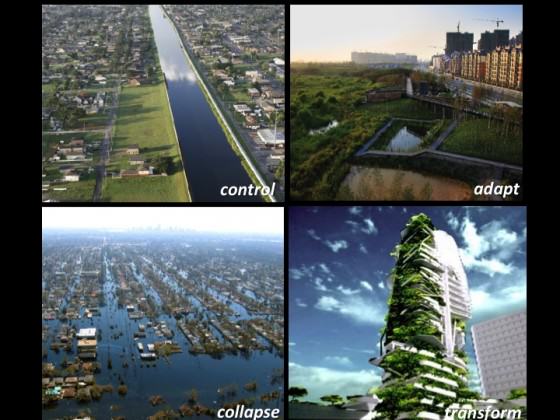
Futures Archetypes. Credits: Upper left: 17th street canal, David Grunfeld Landov Media; Upper right: Qunli National Urban Wetland, Turenscape; Lower left: Hurricane Katrina – NOAA; Lower right: EDITT tower, Hamzah & Yeang
The concept of “planetary boundaries” offers a framework for humanity to operate safely on a planetary scale. Rockström et al (2009) developed the concept of planetary boundaries to inform us about the levels of anthropogenic change that can be sustained so we can avoid potential planetary regime shifts that would dramatically affect human wellbeing. The concept does not imply, and neither rules out, planetary-scale tipping points associated with human drivers. Hughes et al (2013) do address some the misconception surrounding planetary-scale tipping points that confuses a system’s rate of change with the presence or absence of a tipping point. To avoid the potential consequences of unpredictable planetary-scale regime shifts we will have to shift our attention towards the drivers and feedbacks rather than focus exclusively on the detectable system responses. Rockström et al (2009) identify nine areas that are most in need of set planetary boundaries: climate change; biodiversity loss; input of nitrogen and phosphorus in soils and waters; stratospheric ozone depletion; ocean acidification; global consumption of freshwater; changes in land use for agriculture; air pollution; and chemical pollution.
A different emphasis is proposed by those scientists who have advanced the concept of planetary opportunities: solution-oriented research to provide realistic, context-specific pathways to a sustainable future (DeFries et al. 2012). The idea is to shift our attention to how human ingenuity can expand the ability to enhance human wellbeing (i.e. food security, human health), while minimizing and reversing environmental impacts. The concept is grounded in human innovation and the human capacity to develop alternative technologies, implement “green” infrastructure, and reconfigure institutional frameworks. The potential opportunities to explore solution-oriented research and policy strategies are amplified in an urbanizing planet, where such solutions can be replicated and can transform the way we build and inhabit the Earth.
Imagining a Resilient Urban Planet
While these different images of the future are both plausible and informative, they speak about the present more than the future. They all represent an extension of the current trajectory as if the future would unfold along the path of our current way of asking questions, and our way of understanding and solving problems. Yes, these perspectives do account for uncertainty but it is defined by the confidence intervals around this trajectory. Both stories are grounded in the inevitable dichotomies of humans and nature, and technology vs. ecology. These views are at best an incomplete account of what is possible: they reflect a limited ability to imagine the future beyond such archetypes. Why can we imagine smart technologies and not smart behaviors, smart institutions, and smart societies? Why think only of technology and not of humans and their societies that co-evolve with Earth?
Understanding the co-evolution of human and natural systems is key to build a resilient society and transform our habitat. One of the greatest questions in biology today is whether natural selection is the only process driving evolution and what the other potential forces might be. To understand how evolution constructs the mechanisms of life, molecular biologists would argue that we also need to understand the self-organization of genes governing the evolution of cellular processes and influencing evolutionary change (Johnson and Kwan Lam 2010).
To function, life on Earth depends on the close cooperation of multiple elements. Biologists are curious about the properties of complex networks that supply resources, process waste, and regulate the system’s functioning at various scales of biological organization. West et al. (2005) propose that natural selection solved this problem by evolving hierarchical fractal-like branching. Other characteristics of evolvable systems are flexibility (i.e. phenotypic plasticity), and novelty. This capacity for innovation is an essential precondition for any system to function. Gunderson and Holling (2002) have noted that if systems lack the capacity for innovation and novelty, they may become over-connected and dynamically locked, unable to adapt. To be resilient and evolve, they must create new structures and undergo dynamic change. Differentiation, modularity, and cross-scale interactions of organizational structures have been described as key characteristics of systems that are capable of simultaneously adapting and innovating (Allen and Holling 2010).
To understand coevolution of human-natural systems will require advancement in the evolution and social theories that explain how complex societies and cooperation have evolved. What role does human ingenuity play? In Cities as Hybrid Ecosystems I propose that coupled human-natural systems are not governed only by either natural selection or human ingenuity alone, but by hybrid processes and mechanisms. It is their hybrid nature that makes them unstable and at the same time able to innovate. This novelty of hybrid systems is key to reorganization and renewal. Urbanization modifies the spatial and temporal variability of resources, creates new disturbances, and generates novel competitive interactions among species. This is particularly important because the distribution of ecological functions within and across scales is key to the system being able to regenerate and renew itself (Peterson et al. 1998).
The city that thinks like a planet: What does it look like?
In this blog article I have ventured to pose this question, but I will not venture to provide an answer. In fact no single individual can do that. The answer resides in the collective imagination and evolving behaviors of people of diverse cultures who inhabit a diversity of places on the planet. Humanity has the capacity to think in the long term. Indeed, throughout history, people in societies faced with the prospect of deforestation, or other environmental changes, have successfully engaged in long-term thinking, as Jared Diamond (2005) reminds us: consider Tokugawa shoguns, Inca emperors, New Guinea highlanders, or 16th-century German landowners. Or, more recently, the Chinese. Many countries in Europe, and the United States, have dramatically reduced their air pollution and meanwhile increased their use of energy and combustion of fossil fuels. Humans have the intellectual and moral capacity to do even more when tuned into challenging problems and engaged in solving them.
A city that thinks like a planet is not built on already set design solutions or planning strategies. Nor can we assume that the best solution would work equally well across the world regardless of place and time. Instead, such a city will be built on principles that expand its drawing board and collaborative action to include planetary processes and scales, to position humanity in the evolution of Earth. Such a view acknowledges the history of the planet in every element or building block of the urban fabric, from the building to the sidewalk, from the back yard to the park, from the residential street to the highway. It is a view that is curious about understanding who we are and about taking advantage of the novel patterns, processes, and feedbacks that emerge from human and natural interactions. It is a city grounded in the here and the now and simultaneously in the different time and spatial scales of human and natural processes that govern the Earth. A city that thinks like a planet is simultaneously resilient and able to change.
How can such a perspective guide decisions in practice? Urban planners and decision makers, making strategic decisions and investments in public infrastructure, want to know whether certain generic properties or qualities of a city’s architecture and governance could predict its capacity to adapt and transform itself. Can such a shift in perspective provide a new lens, a new way to interpret the evolution of human settlements, and to support humans in successfully adapting to change? Evidence emerging from the study of complex systems points to their key properties that expand adaptation capacity while enabling them to change: self organization, heterogeneity, modularity, redundancy, and cross-scale interactions.
A co-evolutionary perspective shifts the focus of planning towards human-natural interactions, adaptive feedback mechanisms, and flexible institutional settings. Instead of predefining “solutions,” that communities must implement, such perspective focuses on understanding the ‘rules of the game’, to facilitate self-organization and careful balance top-down and bottom-up managements strategies (Helbing 2013). Planning will then rely on principles that expand heterogeneity of forms and functions in urban structures and infrastructures that support the city. They support modularity (selected as opposed to generalized connectivity) to create interdependent decentralized systems with some level of autonomy to evolve.
In cities across the world, people are setting great examples that will allow for testing such hypotheses. Human perception of time and experience of change is an emerging key in the shift to a new perspective for building cities. We must develop reverse experiments to explore what works, what shifts the time scale of individual and collective behaviors. Several Northern European cities have adopted successful strategies to cut greenhouse gases, and combined them with innovative approaches that will allow them to adapt to the inevitable consequences of climate change. One example is the Copenhagen 2025 Climate Plan. It lays out a path for the city to become the first carbon-neutral city by 2025 through efficient zero-carbon mobility and building. The city is building a subway project that will place 85 percent of its inhabitants within 650 yards of a Metro station. Nearly three-quarters of the emissions reductions will come as people transition to less carbon-intensive ways of producing heat and electricity through a diverse supply of clean energy: biomass, wind, geothermal, and solar. Copenhagen is also one of the first cities to adopt a climate adaptation plan to reduce its vulnerability to the extreme storm events and rising seas expected in the next 100 years.
In the Netherlands, alternative strategies are being explored to allow people to live with the inevitable floods. These strategies involve building on water to develop floating communities and engineering and implementing adaptive beach protections that take advantage of natural processes. The experimental Sand Motor project uses a combination of wind, waves, tides, and sand to replenish the eroded coasts. The Dutch Rijkswaterstaat and the South Holland provincial authority placed a large amount of sand in an artificial 1 km long and 2 km wide peninsula into the sea, allowing for the wave and currents to redistribute it and build sand dunes and beaches to protect the coast over time.
New York is setting an example for long-term planning by combining adaptation and transformation strategies into its plan to build a resilient city, and Mayor Michael Bloomberg has outlined a $19.5 billion plan to defend the city against rising seas. In many rapidly growing cities of the Global South, similar leadership is emerging. For example, Johannesburg which adopted one of the first climate change adaptation plan, and so have Durban and Cape Town, in South Africa and Quito, Equador, along with Ho Chi Minh City Vietnam, where a partnership with the City of Rotterdam Netherlands has been established to develop a resilience strategy.
To think like a planet and explore what is possible we may need to reframe our questions. Instead of asking what is good for the planet, we must ask what is good for a planet inhabited by people. What is a good human habitat on Earth? And instead of seeking optimal solutions, we should identify principles that will inform the diverse communities across the world. The best choices may be temporary, since we do not fully understand the mechanisms of life, nor can we predict the consequences of human action. They may very well vary with place and depend on their own histories. But human action may constrain the choices available for life on earth.
Scenario Planning
Scenario planning offers a systematic and creative approach to thinking about the future by letting scientists and practitioners expand old mindsets of ecological sciences and decision making. It provides a tool we can use to deal with the limited predictability of changes on the planetary scale and to support decision-making under uncertainty. Scenarios help bring the future into present decisions (Schwartz 1996). They broaden perspectives, prompt new questions, and expose the possibilities for surprise.
Scenarios have several great features. We expect that they can shift people’s attention toward resilience, redefine decision frameworks, expand the boundaries of predictive models, highlight the risks and opportunities of alternative future conditions, monitor early warning signals, and identify robust strategies (Alberti et al 2013)
A fundamental objective of scenario planning is to explore the interactions among uncertain trajectories that would otherwise be overlooked. Scenarios highlight the risks and opportunities of plausible future conditions. The hypothesis is that if planners and decision makers look at multiple divergent scenarios, they will engage in a more creative process for imagining solutions that would be invisible otherwise. Scenarios are narratives of plausible futures; they are not predictions. But they are extremely powerful when combined with predictive modeling. They help expand boundary conditions and provide a systematic approach we can use to deal with intractable uncertainties and assess alternative strategic actions. Scenarios can help us modify model assumptions and assess the sensitivities of model outcomes. Building scenarios can help us highlight gaps in our knowledge and identify the data we need to assess future trajectories.
Scenarios can also shine spotlights on warning signals, allowing decision makers to anticipate unexpected regime shifts and to act in a timely and effective way. They can support decision making in uncertain conditions by providing us a systematic way to assess the robustness of alternative strategies under a set of plausible future conditions. Although we do not know the probable impacts of uncertain futures, scenarios will provide us the basis to assess critical sensitivities, and identify both potential thresholds and irreversible impacts so we can maximize the wellbeing of both humans and our environment.
A new ethic for a hybrid planet
More than half a century ago, Aldo Leopold (1949) introduced the concept of “thinking like a mountain”: he wanted to expand the spatial and temporal scale of land conservation by incorporating the dynamics of the mountain. Defining a Land Ethic was a first step in acknowledging that we are all part of larger community hat include soils, waters, plants, and animals, and all the components and processes that govern the land, including the prey and predators. Now, along the same lines, Paul Hirsch and Bryan Norton (2012) In Ethical Adaptation to Climate Change: Human Virtues of the Future, MIT Press, articulates a new environmental ethics by suggesting that we “think like a planet.” Building on Hirsch and Norton’s idea, we need to expand the dimensional space of our mental models of urban design and planning to the planetary scale.
Marina Alberti
Seattle
Note: The metaphor of “thinking like a planet” builds on the idea of cognitive transformation proposed by Paul Hirsch and Bryan Norton (2012) In Ethical Adaptation to Climate Change: Human Virtues of the Future, MIT Press.
Source: http://www.thenatureofcities.com/2013/09/27/building-cities-that-think-like-planets/


Sunday, June 9, 2013
The Wisdom of One Place: Why We Need to Know Where We Are
By Fred First
Fred First, teacher then physical therapist, is now an embedded naturalist and armchair biology-watcher. Blogger, author, and photographer, Fred is involved in sustaining the creative economy and relocalizing agriculture in Floyd County, VA.
My brief return to the biology classroom in 2005 after a 17-year absence brought a shocking revelation: the outdoors was an alien and unknown place to my students.
Out of 120 on field trips near campus along Virginia’s New River that semester, only one student could call one of some 50 observed living things by name: poison ivy. Everything else—birds and bushes, wildflowers and vines, insects and fungi—were anonymous strangers.
That revelation disturbed me. What would become of this place if future generations were so out of touch with the natural world? A short while later I learned that this oblivion had been given a name: nature deficit disorder. Reading that phrase for the first time confirmed to my dismay that my students’ nature blindness was not an isolated condition; but I also took encouragement knowing that others were becoming aware of the need to reverse the consequences of this retreat indoors.
I’ve since come to think of our latter-day denaturing as just one among several interrelated but broken bonds within the tattered web of human identity. Many of us also suffer placelessness and eco-apathy—distortions of perception that prevent us from clearly seeing ourselves rightfully integrated in our here and now.

Writer Eudora Welty perhaps holds the key to the needed remedies in this one statement: “One place understood helps us know all places better.”
To restore wholeness to the brokenness we’ve inflicted on the planet’s living systems, we need go no further than that one place just beyond our doors—to sense and know that accessible fragment of the whole of nature that we can see, taste, hear, smell and wrap our heads and hearts around in our own nearby terrain.
As we succeed with that reintegration of human lives with nature, we also will grow to appreciate the places where our stories unfold, to reclaim sense of place—an identity with the where of our lives in all its uniqueness of topography and history and culture. We become placed persons even as we become a renatured people.
From this reintegration with nature and place may evolve eco-empathy: an organic personal-ecological ethic that puts each of us back into the web of right relationships, back not only into local nature but into the intended natural order as stewards with a seven-generation commitment to the well-being of people and planet.
Broken relationships with nature and place have been wrong roads on the map from which we have blundered our way to a desolate mental and spiritual landscape. We need a new map, a new story of who we are that reveals that web of inter-connectedness we have learned to ignore. Better maps require that we become wiser, not smarter. Wisdom is wielded in fostering and guiding vital relationships to nature, place and community.
 One place understood helps us know all places better. One mountain stream, one wildflower meadow or mountain bald or beaver pond better known helps us both to know and to hold an empathetic bond with all meadows and balds, forests and wetlands, and with their non-human inhabitants. Our species becomes placed properly as one living actor in the larger web called Life on Earth, but one with awesome obligations.
My students’ indifference to nature facts, I now understand, was a symptom of a broader blindness to essential relationships in their lives. This blindness also made them indifferent to where their water or food or electricity came from back in their home towns. As denatured and placeless humans, they were barely aware of who or where they were in the context of nature or the landscape or time.
If we are successful in renaturing, relocalizing and instilling a personal ecology, we may yet reconcile relationships for tomorrow’s children and students, and for all of us—bringing us closer to healthy and just and whole ways of thinking about ourselves within our personal habitats, neighborhoods and the grand web of being.
This reconciliation will be local, relational, and personal. It is possible, within our grasp, and already underway.
In this hope, we may come back to the best of our selves, with wisdom and humility, whole and thankful within our one known place in nature, and connected by that understanding to better care for all places.
__________
Top Photo by Ashley Turner
Additional thoughts:
The Nature of Place: Fred First at TEDx
Getting to Know My Place: Searching for Authenticity in a Virtual World — by Richard Louv
Peace in Nature: Aylee Tudek, 16, Shares Her Sense of Wonder
What’s Good in Your Hood? Nearby Nature and Human Hope — by Akiima Price
Monday, April 22, 2013
Leaning Toward the Future of Placemaking
By on

A guest post by Dr. Katherine Loflin
Today, as the inaugural meeting of the Placemaking Leadership Council kicks off in Detroit, Michigan, we are thrilled to bring you this special guest post by Dr. Katherine Loflin, a powerful advocate for the importance of place to local economies, and one of the event’s keynote speakers.
–
It’s hard for me to believe that, just six years ago, I had never
even heard the word “Placemaking.” I’ve been a community practitioner
all of my life, trained as a macro-practitioner with a Masters and Ph.D.
in Social Work and a dissertation on civic engagement and social
capital. I believed there were certain characteristics that inherently
enabled places to identify and solve their own problems, and I believed
that some of the answers related to civic engagement and social capital.
Still, I was haunted by the thought that there was more to it: pieces
of the puzzle that hadn’t been placed yet.
Then, in 2007, I found myself the Lead Consultant on Knight Foundation’s Soul of the Community study. Soul was created by Knight and the Gallup
organization to study communities in a new way. It is important to note
that, from the outset, Soul was very open in terms of outcomes. The
study was not attempt to justify the field of Placemaking. We had no
preconceived notions about what we would discover. Today, I think that
fact contributes to the power of the findings, insofar as they support
this burgeoning field. The basic research questions were simple yet
profound, yet they’d never been asked before: What makes people love
where they live? And why does it matter?
We were in for a shock…and a steep learning curve. The Knight Soul of
the Community study investigated community attachment—a
multidimensional construct that went beyond measuring just satisfaction
to also look at community pride, community optimism, and other emotional
feelings about place. Attachment is not the traditional idea of
engagement that is usually studied in places, but a separate construct.
Understanding residents’ emotional bonds to place represented by
attachment took our examination beyond the outward behaviors of
traditional engagement and gave new insights into the dynamics of how
place affects people. That, alone, was a significant contribution to
understanding place success that had basically gone unmeasured.
The shock came as the results poured in: from 2008-2010, we received
responses from 43,000 people in 26 communities across the US, in cities
large and small. What we saw were findings, year after year, that for
many seemed counter-intuitive—even radical at times. We not only found
out that resident attachment was related to solid economic outcomes for
places, but that the things that most drove people to love where they
live were not the local economy or even their personal civic engagement
in the place (as one might expect), but the “softer sides” of place.

Knight
Soul of the Community found out that the “softer sides” of place matter
to economic development / Photo: Lafayette College via Flickr
These findings seemed like a messaging nightmare at first, because
they were so groundbreaking and surprising—but as I considered how to
use this new information to spread the word, make the case, and
translate the findings into on-the-ground action, the nightmare became
great opportunity. The Soul findings forced me to reexamine what I
thought I knew about what made places tick. Eventually, I realized that
this was the missing piece of the puzzle that I had been searching for.
Here are the primary findings of Soul of the Community, from 2008-2010:
- There is an important and significant correlation between how attached people feel to where they live and local GDP growth. What this means is that the more people love their town, the more economically vital that place will be. In an economy still deep in recession, that got some attention and raised some eyebrows. How is this possible? It seems that, when people love where they live, they spend more time there and invite others to do the same. They may choose to stay-cation versus travel. They are also more productive at work and more satisfied in their jobs. They are more likely to buy a house. There are so many little ways in which a love of place can translate to economic impacts, and these all add up.
- What most drives people to love where they live (their attachment) is their perception of aesthetics, social offerings, and openness of a place. It appears that what people most want out of a neighborhood is a place that is attractive, engaging, friendly, and welcoming. In every place, every year of the study, these factors were found to be the three most important to tying people to place. Why does this matter? As mentioned above, communities where people love where they live do better economically. The best-loved places were doing better in a measureable way. Little did we still know, at first, that Soul had just empirically justified some of the core principles long advocated for by Placemaking advocates.
It was in looking for some framework that could help to organize the
findings in a useable way that I stumbled across the Project for Public
Spaces’ website. Serendipitously, this happened right around the time
they were catching wind of Soul’s first-year findings. They gave me an
organizing framework, and Soul gave them empirical justification for
things that they had learned and known intuitively for years.
Of course, we’re only just getting started. The Soul findings have
had significant implications for the Placemaking field, and in so doing
have opened up whole new avenues for research, learning, and practice.
Below are nine of the key lessons learned so far, which also represent
some of the most interesting topics for future examination and
discussion:
1.) Optimizing place. The thing about Soul of
the Community is that it allows places to be who they are—just
optimized—and that was incredibly welcomed by civic leaders. Instead of
changing who your community is, it’s about being the best version of
yourself that you can be. This means that no place is left behind. All
cities can take advantage of this information. Places have to know their
narratives: what constitutes their unique identity? If that is unknown,
Soul can help places to discover that. The important point of this is:
communities don’t have to try to be something that they’re not, but each
must capitalize on its own distinct identity.
2.) Lead with strengths. Places often know
chapter and verse what they are not good at. And that deficit-based
start can be an immobilizing when talking about the future. The Soul
findings allowed me to walk into any of the 26 communities that we were
studying and lead off the conversation by talking about their strengths.
The most powerful path to change for people and places is to leverage
strengths to address challenges. Any community intervention should lead
with strengths, and Placemaking leads by example.

Optimism about a place’s future plays a big part in local resilience. / Photo: Daniel Horacio Agostini via Flickr
3.) Place optimism matters. Optimism is
empirically linked to attachment. That means that the more optimistic
people feel about the future of their city, the more likely they are
going to be attached to it today. We have seen places in the Soul
findings where attachment increased even when the local economy
worsened. Optimism about the place’s future seems to be a big part of
that resilience. In 2008, Biloxi, MS, was the second-most attached place
that we studied, even though they were still in the throes of Katrina
recovery. In 2009, there was a significant increase in optimism in
Detroit. Why does this matter? Because it is with this spirit,
commitment and dedication that community turnarounds begin. This speaks
to the importance of public messages and leadership to cultivate
optimism and then follow through with sound leadership to realize that
optimism.
4.) Young talent is leading the place renaissance.
According to the Soul findings, young talent is consistently perceived
as the least welcomed group in a place. Yet in other polls, Gallup was
finding increasingly that young talent was choosing a place to live
first, and then finding a job. The fact that people are now
prioritizing place before deciding what jobs to pursue has to change the
way communities are imagined if places are to succeed. Optimizing place
has to be moved to the front burner as an economic imperative,
immediately. Place has clearly earned a seat at the economic development
table.
5.) The corporate world gets this. They may
have not had an empirical model to use until now, but many corporations
had already noticed that, to attract and retain the best talent, they
had to be able to successfully sell the place where the job is located.
As a result, they want to be in places that sell themselves. This was
all reinforced by the Soul finding that there’s an empirical
relationship between job satisfaction and community attachment. Not
surprisingly, the business community is now interested in applying
Placemaking not only to their corporate giving, but also to their
business models.
6.) A solution on the “growth” tug of war that immobilizes many places. Placemaking
often allows residents to finally put their finger on what had kept
them stuck. For many, this was the fact that, while the ‘growth’ people
are saying if we don’t stay modern and provide the place people want to
live we are economically in trouble, the ‘anti-growth’ residents are
really worried that growth for growth’s sake would cause them to lose
who they were as a place—that they’d become generic. The Placemaking
framework enables these folks to re-frame the issue by saying: We will
cherish our unique narrative as a place as we continue to grow in a
smart and sustainable way.
7.) You’ll see impact sooner. Because Soul of
the Community found a relationship between social offerings, openness,
and aesthetics, and resident attachment, if you change public perception
of one of those things you can see same-year differences in attachment.
We saw this happen in places like Detroit and St. Paul…and I have to
say: Wow. This makes Placemaking a very attractive framework,
especially in places that need quick wins to restore some optimism and
fuel additional social change efforts. This core strength of the “Lighter, Quicker, Cheaper” approach to places is one that few other models can claim.

The
core strength of the “Lighter, Quicker, Cheaper” approach is that it
can change minds & turn things around faster than anyone expects /
Photo: troistoques via Flickr
8.) It’s totally scalable. One of my favorite
things about Placemaking is that it’s totally scalable. You can truly
start anywhere and see impact, sooner than you might think. I’ve seen
everything from places starting to turn around because they mobilized to
get a strip of sidewalk installed where it was missing, to places
coming together around crafting and decorating their town’s trees with
lit balls of fashioned chicken wire. Sometimes, it’s all about reminding
people of the greatness of their place by helping them to rediscover
what’s already there. The best ideas often come from the residents
themselves, who are really the true keepers of the soul of their
community.
9.) The power of place. Love of place is
great equalizer and mobilizer. In all my years of doing community
practice, I’ve never seen a more powerful model for moving communities
forward and enabling places to optimize who they are instead of trying
to be someplace else. It is this message that frees people to love their
place, and hearing that their love of place is a powerful resource is
not something many residents (or their leaders) have properly recognized
and leveraged. That’s why I think I often see tearful reactions in my
audiences and hear heartfelt stories of personal relationship with a
place after my talks. The message of attachment—that the softer sides of
place matter—resonates deeply. Everyone has a personal relationship
with their place and people can see themselves and their communities in
the Soul findings.
Because of this journey, today I am forever changed. And we’re all on
this journey together. That our disparate disciplines have brought us
together around the cause of Placemaking is also one of the unique
strengths of our practice: a key advantage that we must leverage in this
critical time. We have an economic, social and human responsibility to
do so—and now, we have a much-needed piece of the puzzle in place.
25 Tips for Making Your Neighborhood Better
Jay Walljasper's guide to changing the world on your own block
 1. Give people a place to hang-out
2. Give people something to see
3. Give people something to do
4. Give people a place to sit down
5. Give people a safe, comfortable place to walk
6. Give people a safe, comfortable place to bike
7. Give people reliable, comfortable public transportation
8. Make the streets safe
9. Make the streets safe—not just from crime but from traffic
10. Remember the streets belong to everyone—not just motorists
11. Don’t forget about the needs of older neighbors
12. Don’t forget about the needs of kids
13. Let your community go to the dogs
14. Reclaim front yards as social spaces
15. Remember the best neighborhoods, even in big cities, feel like villages
16. Plan for winter weather as well as sunny, warm days
17. Don’t fear density—people enjoy being around other people
18. Don’t give up hope—great changes are possible when neighbors get together
19. Build on what’s good in your community to make things even better
20. Remember the power of the commons: people working together for the benefit of everyone
21. Never underestimate the power of a shared meal to move people into action
22. Start with small steps—like planting flowers
23. Become a community booster, watchdog, patriot
24. Learn from other neighborhoods in your town and around the world
25. Take the time to have fun and enjoy what’s already great about your neighborhood
Everyone has a contribution to make toward improving your neighborhood. (Photo courtesy of Project for Public Spaces)
2. Give people something to see
3. Give people something to do
4. Give people a place to sit down
5. Give people a safe, comfortable place to walk
6. Give people a safe, comfortable place to bike
7. Give people reliable, comfortable public transportation
8. Make the streets safe
9. Make the streets safe—not just from crime but from traffic
10. Remember the streets belong to everyone—not just motorists
11. Don’t forget about the needs of older neighbors
12. Don’t forget about the needs of kids
13. Let your community go to the dogs
14. Reclaim front yards as social spaces
15. Remember the best neighborhoods, even in big cities, feel like villages
16. Plan for winter weather as well as sunny, warm days
17. Don’t fear density—people enjoy being around other people
18. Don’t give up hope—great changes are possible when neighbors get together
19. Build on what’s good in your community to make things even better
20. Remember the power of the commons: people working together for the benefit of everyone
21. Never underestimate the power of a shared meal to move people into action
22. Start with small steps—like planting flowers
23. Become a community booster, watchdog, patriot
24. Learn from other neighborhoods in your town and around the world
25. Take the time to have fun and enjoy what’s already great about your neighborhood
Friday, April 12, 2013
Series on transformative Placemaking
By Project for Public Spaces
1. All Placemaking is Creative: How a Shared Focus on Place Builds Vibrant Destinations

You
know that you’re in a great place when you’re surrounded by all
different sorts of people, but still feel like you belong. / Photo: PPS
The study’s other key finding was that there is an empirical relationship between higher levels of attachment and cities’ GDP growth. This is important because, in Loflin’s words, “We have not recognized, as a society, the importance of [place]. Studies like Soul of the Community are helping to give us all permission to spend some time working on this stuff—and not in a kumbaya way, but an economic way.”
Placemaking, in other words, is a vital part of economic development. And yet, there has long been criticism that calls into question whether or not this process is actually helping communities to develop their local economies, or merely accelerating the process of gentrification in formerly-maligned urban core neighborhoods. We believe that this is largely due to confusion over what Placemaking is, and who “gets” to be involved. If Placemaking is project-led, development-led, design-led or artist-led, then it does likely lead to gentrification and a more limited set of community outcomes.
Who is the community, and what is their role?
The key question right now seems to be about ownership and belonging, in regard to who has a right to participate when a Placemaking process is underway. In an article for Next City last fall, Neeraj Mehta started a great deal of chatter after raising this very issue when he asked:
“Which people do we want to gather, visit and live in vibrant places? Is it just some people? Is it already well-off people? It is traditionally excluded people? Is it poor people? New people? People of color?”This builds on a common frustration among people who work in community development and related fields: oversimplification of what we mean when we talk about “the community.” Places are almost never the product of a singular, evenly-connected community, but the intersection and overlapping of multiple or many diverse groups. “The community” often includes people who never speak to each other, or may not even notice each other, depending on the quality and availability of welcoming public spaces in which to connect.

Places are almost never the product of a singular, evenly-connected community / Photo: PPS
What role do artists play?
Perhaps one of the most significant changes that has taken place in the public dialog around Placemaking, over the past several years, has been the rise of the “creative” modifier. Creative Placemaking’s proponents (including the Knight Foundation-supported ArtPlace) have contributed substantially to the public awareness of the importance of public space, and the role of public art in creating great places, by positioning artists at the center of the Placemaking process. Unfortunately, this privileging of one type of activity over others also seems to be the source of many of the recent questions around who benefits, and who is allowed at the table.
Whether we like it or not, “creativity” has come to mean something quite specific over the past decade or so. Dr. Richard Florida’s movement-sparking book, The Rise of the Creative Class, was boiled down into sound bites so frequently and consistently after its publication, that the idea of “creativity” became the purview of a specific group of people. Suddenly everyone was talking about “creative types,” and scheming to build more coffee shops and bike trails in order to lure young people with liberal arts degrees to their city to create design blogs and tech start-ups. The idea, perversely, and in contradiction of what Florida was actually arguing, became that a certain kind of person with a certain kind of creativity was most valuable to local economic development, and cities should try to be more like the places that were already attracting that kind of person in order to steal them away—rather than fostering the creativity of people who were already living in a given place.

The
sidewalk cafes so often cited as indicators of gentrification can be a
great way to enliven some public spaces–but only in response to an
existing need within the neighborhood / Photo: PPS
“What I’ve witnessed in the discussions and practices associated with Creative Placemaking is that they are tethered to a meaning of ‘place’ manifest in the built environment, e.g., artists live-work spaces, cultural districts, spatial landscapes. And this meaning, which operates inside the policy frame of urban planning and economic development, is ok but that is not the complete picture. Its insufficiency lies in a lack of understanding that before you have places of belonging, you must feel you belong. Before there is the vibrant street one needs an understanding of the social dynamics on that street – the politics of belonging and dis-belonging at work in placemaking in civil society.”In other words, while the intentions of Creative Placemaking’s proponents are undoubtedly good, and their work very frequently wonderful, the fact that a lot of people just don’t consider themselves to be “creative types” limits the potential outcomes. No doubt, part of the drive is to expand creativity and the arts to impact community development and open the arts up to more people, but to start off by limiting the Placemaking process to a certain set of outcomes from the get-go is not the way to go about it.
Every place can be vibrant. Vibrancy is people.
Also problematic is the fact that so much debate has centered on a flawed definition of “vibrancy” that further limits the Placemaking process’ capacity for transforming communities. Ann Markusen, who co-authored the original paper on Creative Placemaking for the NEA, highlights this problem in an essay that she wrote for arts management hub Create Equity, questioning the movement’s early evolution. Markusen asks:
“Just what does vibrancy mean? Let’s try to unpack the term. ArtPlace’s definition: ‘we define vibrancy as places with an unusual scale and intensity of specific kinds of human interaction.’ Pretty vague and…vibrancy are places? Unusual scale? Scale meaning extensive, intensive? Of specific kinds? What kinds?”This definition is not just vague, it’s unnecessarily limiting. If vibrancy is defined explicitly as an “unusual” condition, it furthers the idea that Placemaking is geared toward the production of specific kinds of spaces and amenities, rather than toward the enabling of citizens to use their public spaces to highlight their neighborhood’s unique strengths, and effectively address distinct challenges. We may have come to think of vibrancy as a finite quality after seeing our cities stripped of their dense social networks through decades of freeway-building and suburbanization, but that is a misconception.

Vibrancy does not need to be limited to a few ‘unusual’ areas; vibrancy is people / Photo: PPS
Cities’ “soft” sides matter—and so does how we talk about them.
When Placemaking is perceived to be geared toward a specific set of outcomes, it undermines the work that everyone in the field is doing, and leads to the kind of criticism that we saw from Thomas Frank, whose blistering takedown of Placemaking in The Baffler should make even the most seasoned Placemaking advocate wince. Frank writes:
“Let us propose a working hypothesis of what makes up the vibrant. Putting aside such outliers as the foundation that thinks vibrancy equals poverty-remediation and the car rental company that believes it means having lots of parks, it’s easy to figure out what the foundations believe the vibrant to be. Vibrant is a quality you find in cities or neighborhoods where there is an arts or music ‘scene,’ lots of restaurants and food markets of a certain highbrow type, trophy architecture to memorialize the scene’s otherwise transient life, and an audience of prosperous people who are interested in all these things.”And then, toward the end of the article, the clincher:
“Let’s say that the foundations successfully persuade Akron to enter into a vibrancy arms race with Indianapolis. Let’s say both cities blow millions on building cool neighborhoods and encouraging private art galleries. But let’s say Akron wins…What then? Is the nation better served now that those businesses are located in Akron rather than in Indianapolis? Or would it have been more productive to spend those millions on bridges, railroads, highways—hell, on lobbyists to demand better oversight for banks?”This is a straw man argument that many of us are tired of hearing: that focusing on the ‘soft’ side of cities, the very things the Soul of the Community study found most important, is a waste of money when cities should be focusing on hard infrastructure. But if we allow Placemaking to be framed (or even worse, practiced) in a way that leaves people feeling unwelcome or excluded, we’re setting ourselves up for exactly that sort of criticism.
Better communication between the people who share rapidly-changing neighborhoods is vital to the future success of our cities—and, considering the fact that 70% of the world’s population will be urban by 2050, to the future of global society. That is what we advocate for when we advocate for Placemaking. We do not work for better public spaces so that people will have somewhere to sit and eat gelato; we do it so that they will have somewhere to sit and talk with their neighbors. Whether or not that conversation is about art (or politics, or food, or education, or sports…) is beside the point.
You know that you’re in a great place when you’re surrounded by all different sorts of people, but still feel like you belong. When people feel encouraged to participate in shaping the life of a space, it creates the kind of open atmosphere that attracts more and more people. In their inclusiveness, our greatest places mirror the dynamics of a truly democratic society. As we put it in our introduction to the Guide to Neighborhood Placemaking in Chicago (written for the Metropolitan Planning Council), “Placemaking allows communities to see how their insight and knowledge fits into the broader process of making change. It allows them to become proactive vs. reactive, and positive vs. negative. Simply put, Placemaking allows regular people to make extraordinary improvements, big or small, in their communities.”
Over the next few weeks, as we prepare for the first meeting of the Placemaking Leadership Council in Detroit on April 11th and 12th, we will be exploring the relationship between individuals and the Placemaking process in further detail. More to come soon.

We work for better public spaces so that people will have somewhere to sit and talk with their neighbors / Photo: PPS
2. Stronger Citizens, Stronger Cities: Changing Governance Through a Focus on Place

“If vibrancy is people, then the only way to make a city vibrant again is to make room for more of them.” / Photo: PPS
In equitable places, individual citizens feel (first) that they are welcome, and (second) that it is within their power to change those places through their own actions. “The huge problem with citizenship today is that people don’t take it very seriously,” says Harry Boyte, director of the Center for Democracy and Citizenship at Augsburg College. “The two dominant frameworks for citizenship in political theory,” he explains, “are the liberal framework, where citizens are voters and consumers of goods, and the communitarian framework, where citizens are volunteers and members of communities. In other words, for most people, citizenship is doing good deeds, or it’s voting and getting things. We need to develop the idea of civic agency, where citizens are co-creators of democracy and the democratic way of life.”
It is bewildering, when you take a step back, to realize how far we’ve gotten away from that last statement. We have completely divorced governance from citizenship, and built thick silo walls around government by creating an opaque, discipline-driven approach to problem-solving. Busting those silo walls is imperative to creating more equitable communities. Rather than trying, haplessly, to solve transportation, housing, or health problems separately, as if they exist within a vacuum, government should be focused on building stronger place.

a
new citizen-centered model has also begun to emerge, that we’ve come to
call Place Governance.” / Photo: Andy Castro via Flickr
Revitalizing citizenship through Place Governance: Why we need a Copernican revolution
As the link between bustling public spaces and economic development has grown stronger, some government officials have started advocating for change in this arena. After so many decades of top-down thinking, the learning curve is steep, and many officials are trying to solve human problems with design solutions. But a new citizen-centered model has also begun to emerge, that we’ve come to call Place Governance.
In Place Governance, officials endeavor to draw more people into the civic decision-making process. When dealing with a dysfunctional street, for instance, answers aren’t only sought from transportation engineers—they’re sought from merchants who own businesses along the street, non-profit organizations working in the surrounding community, teachers and administrators at the school where buses queue, etc. The fundamental actors in a Place Governance structure are not official agencies that deal with specific slices of the pie, but the people who use the area in question and are most intimately acquainted with its challenges. Officials who strive to implement this type of governance structure do so because they understand that the best solutions don’t come from within narrow disciplines, but from the points where people of different backgrounds come together.
One of the key strengths of Place Governance is that it meets people where they are, and makes it easier for them to engage in shaping their communities. We have seen the willingness to collaborate more and more frequently in our work with local government agencies. Speaking about a recent workshop in Pasadena, CA, PPS President Fred Kent noted that “The Mayor and City Manager there fully realize and support the idea that if the people, lead they [the government] will follow. They recognize that they need leadership coming from their citizens to create the change that will sustain and build the special qualities that give Pasadena a sense of place.”
Finding ways to help citizens lead is critical to the future of community development and Placemaking, which is exactly why we have been working to form cross-disciplinary coalitions like Livability Solutions, Community Matters, and, most recently, the Placemaking Leadership Council. “Democracy is not a government, it’s a society,” argues Boyte. “We have to develop an idea that democracy is the work of the people. It’s citizen-centered democracy, not state- or government-centered democracy. That doesn’t mean government doesn’t play an important role, but if you think about government as the center of the universe, we need something like a Copernican revolution.”

“We
have to develop an idea that democracy is the work of the people. It’s
citizen-centered democracy, not state- or government-centered
democracy.” / Photo: PPS
Attachment then engagement: Co-creating a culture of citizenship
The engagement of citizens from all walks of life is central to Place Governance, and while a great deal of Placemaking work comes from grassroots activity, we need more change agents working within existing frameworks to pull people in. As the Knight Foundation’s Soul of the Community Study has shown for several years running, “soft” aspects like social offerings, openness, and aesthetics are key to creating the attachment to place that leads to economic development and community cohesion. But counter-intuitively, civic engagement and social capital are actually the two least important factors in creating a sense of attachment.
As it turns out, that’s actually not bad news. It’s all in how to read the data. When the SOTC results came out, Katherine Loflin, who served as the lead consultant for Knight on the study, recalls there being a great deal of consternation at the foundation around this surprising result. But SOTC does not measure the factors that are most important to place generally; it measures the factors that are most important in regard to peoples’ attachment to place. Working off of the specificity of that premise, Loflin dug deeper into the data to see if she could find an explanation for the curious lack of correlation between engagement and attachment.
“By the third year of Soul,” Loflin says, “we decided to start testing different variables to see whether civic engagement has to work with something else to inspire attachment. We found that one thing that does seem to matter is one’s feeling of self-efficacy. You need civic engagement plus the belief that you can make a difference in order for it to create greater attachment. We can’t just provide civic engagement opportunities, we also have to create a culture of success around engagement if we want it to translate to feelings of greater attachment to a place.”
Matt Leighninger, the director of the Deliberative Democracy Consortium (a Community Matters partner) echoes this need when talking about his own work in engaging communities. “The shortcoming of [a lot of community dialog] work,” he says, “is that it is too often set up to address a particular issue, and then once it’s over, it’s over. You would think that people having an experience like that would lead them to seek out opportunities to do it again on other issues, but that often doesn’t happen. Unless there’s a social circle or ecosystem that encourages them and honors their contributions, it’s not likely that they’re going to stay involved.”

“In
equitable places, individual citizens feel (first) that they are
welcome, and (second) that it is within their power to change those
places through their own actions.” / Photo: Jennifer Conley via Flickr
How Placemaking helps citizens see what they can build together
Creating that support system is what Place Governance is all about. In addition to their capacity for creating a sense of attachment to place, great public destinations, through the interactive way in which they are developed and managed, challenge people to think more broadly about what it means to be a citizen. Place Governance relies on the Placemaking process to structure the discussion about how shared spaces should be used in a way that helps people to understand how their own specific knowledge can benefit their community more broadly. “We can set up the conversation, and help move things along,” Kent says, “but once the community’s got it, they’re golden. Just setting the process up for them to perform—that’s what Placemaking is.”
If the dominant framework for understanding citizenship today is passive, with citizens ‘receiving’ government services and being ‘given’ rights, then we need to develop affirmative cultures around citizen action. We should also recognize that elected representatives are citizens, just as surely as we are ourselves. We need officials to focus on creating great places with their communities rather than solving isolated problems for distant constituents. Equitable places are not given, they are made, collaboratively. Everyone has a part to play, from the top down, and from the bottom up. “The default of consumer culture,” Boyte says of this much-needed shift in thinking about citizenship, “is that people ask what they can get, rather than thinking about what they could build, in terms of common resources.”
Governance is social, and citizenship is creative. The only things standing between where we are and where we want to be are those big, thick silo walls.
3. How to Be a Citizen Placemaker: Think Lighter, Quicker, Cheaper

With some temporary materials, a roadway can become a bocce ball court, and a street can become a great place / Photo: PPS
Now, here’s the million dollar question: in that vision, what are you doing to add to that bustle?
If vibrancy is people, and citizenship is creative, it follows that the more that citizens feel they are able to contribute to their public spaces, the more vibrant their communities will be. The core function of place, as a shared asset, is to facilitate participation in public life by as many individuals as possible. Ultimately the true sense of a place comes from how it makes the people who use it feel about themselves, and about their ability to engage with each other in the ways that they feel most comfortable.
“There is an undeniable thing that each resident brings to the table,” says Katherine Loflin, who led Knight Foundation’s Soul of the Community study. “It has to do with the openness and feeling of the place; it’s not something that you construct, physically, it’s something that you feel. And it is us as humans that convey that feeling to each other—or not!”

“There
is an undeniable thing that each resident brings to the table…It has to
do with the openness and feeling of the place.” / Photo: PPS
As Sustainable South Bronx founder and advocate Majora Carter famously put it, “You don’t have to move out of your neighborhood to live in a better one.” Each of us can participate, right now, in creating the city that we want to live in. If you think of enlivening a place as a monumental task, remember that great places are not the result of any one person’s actions, but the actions of many individuals layered on top of one another. It may take years to turn a grassy lot into a great square, but you can start today by simply mowing the lawn and inviting your neighbors out for a picnic.
In an essay for The Atlantic back in 1966, then-Vice President Hubert Humphrey touched on this when he wrote about his father’s public spirit, and his active participation in the life of the small town of Doland, South Dakota, where the family lived. Hubert Sr. was a pharmacist, and he strove to make his pharmacy into a community hub, a place where neighbors came to meet and discuss the issues of the day. “Undoubtedly, he was a romantic,” writes Hubert Jr. of his father, “and when friends would josh him about his talk about world politics, the good society, and learning, he would say, ‘Before the fact is the dream.’
When you think about making your neighborhood a better place, think Lighter, Quicker, Cheaper (LQC). In public space design, the LQC strategy is framed as a way for communities to experiment with a place and learn how people want to use it before making more permanent changes. That experimental attitude can be adopted by anyone. Just ask yourself: what’s one thing I already enjoy doing that I could bring out into the public realm?
Make it Public: Bringing Existing Activity Out Into the Streets
For some of us, there may be opportunities to take the work that we do in our professional lives and turn it into a way to engage with our neighbors. Perhaps there’s a certain activity we perform that could be moved to a nearby park, or a skill that we could teach at a local library. One graphic design firm in Cape Town, South Africa, has taken the idea of public work to a delightful extreme through their Holding Public Office initiative, where they move their office out into a different public space for one day each month and interact with curious passersby. “It keeps us on our toes,” says Lourina Botha, one of the firm’s co-directors. “It forces us to be aware of our role as designers and is a fairly stark reminder that what we design has a real effect on the world.”
In other words, this project illustrates how taking a LQC approach to work enriches not just the public space where the intervention takes place, but the work that the firm does, as well. This kind of activity blurs the line between private and public, and re-frames work as a mechanism for building social capital. According to Harry Boyte, director of the Center for Democracy and Citizenship at Augsburg College, “We need professionals to think about themselves not narrowly disciplinary professionals, whose work is to simply solve a narrow disciplinary problem, but as citizen professionals working to contribute to the civic health and well-being of the community.”

“Holding
Public Office” brings co-workers out into the streets, re-framing work
as a mechanism for building social capital / Photo: Lisa Burnell,
Graphic Studio Shelf
Building off of that last point, the organizers of Restaurant Day have turned cooking into an excuse for a carnival, giving residents of Helsinki, Finland, a chance to showcase their creativity in the kitchen and turning the city’s streets into a delectable buffet in the process. Their idea to organize a one-day festival where anyone could open a restaurant anywhere (from living rooms to public plazas), started when Antti Tuomola was struggling through navigating the onerous process of starting up a brick and mortar restaurant in the city. Recalls Kirsti Tuominen, one of the friends who works with Tuomola on organizing the event, “We knew from the beginning that we wanted to do something that would be fun, easy, and social at the same time. Something positive. We didn’t want to go the protest route. That’s the not-so-efficient way of trying to make a difference; it’s often better to show a good example and then it’s harder for the opposition.”
The first Restaurant Day took place back in 2011; today, it has been celebrated in cities all over the world. The festival is a brilliant example of how a completely normal daily activity can totally transform a city’s public spaces when approached in a creative way. “The street experience itself was a joy to behold,” wrote City of Sound blogger Dan Hill after participating on one of the festivals. “It truly felt like a new kind of Helsinki. International, cosmopolitan, diverse yet uniquely Finnish…It felt like a city discovering they could use their own streets as they liked; that the streets might be their responsibility.”
Tuominen echoes this in her own reflection on the event, explaining that “[Finland] is so full of regulations that people tend to see regulations even where they don’t exist! That’s been hindering things for a long time, but Restaurant Day has encouraged people to use their public spaces in a new way. Sometimes people just need someone to show them, or give them a gentle kick in the butt, and things will start happening.”
Understanding this is key for citizens who want to take a LQC attitude toward activating their neighborhoods: public spaces have a way of amplifying individual actions. One thing from the above comments that is not uniquely Finnish is the tendency of people (particularly in the developed world) to see regulations where they don’t exist. After decades of society turning its back on public life in favor of the private realm of home, office, and car, a lot of people now feel that they need permission to use public spaces the way they’d like to. We can give that permission to each other.

In
a wonderful example of triangulation, jazz musicians perform for the
assembled crowds near a Restaurant Day pop-up eatery in Helsinki /
Photo: Karri Linnoinen via Flickr
If you are a change-oriented person, we need you to lead. Whether you want to move your office outside, organize a citywide cooking festival, or start small by making a concerted effort to engage directly with your neighbors every day, know that your own actions are an essential component of your neighborhood’s sense of place, by virtue of the fact that you live there. Explains Loflin: “If you don’t spend at least some time thinking about the state of mind of Placemaking—every decision, behavior, everything that we do as residents in our place every day—on top of the infrastructure that’s provided by the place itself, then you miss a really important part of the conversation, where everybody gets to have some of the responsibility.”
Whatever you decide to do, know that there will be bumps in the road. One of our 11 core Placemaking principles is that they’ll always say it can’t be done. But keep pushing. Meet your neighbors, and find your allies. Creating great places is all about getting to know the people who you share those places with. Thinking LQC doesn’t just mean experimenting with what you do, but with how you do it. Look for unconventional partners, and always be willing to consider doing things a bit differently.
In an interview for the Placemaking Blog late last year, Team Better Block co-founder Andrew Howard explained how his own LQC street transformations in cities around the US have caused his understanding of how people engage with places to evolve. “As a planner,” he explained, “I always thought that, if I made the best plan, that would attract the right people to come from somewhere else and make that plan happen. What I’ve realized through Better Block is that every community already has everybody they need. They just need to activate the talented people who are already there, and shove them into one place at one time, and that place can become better really quickly.”
Great places are not created in one fell swoop, but through many creative acts of citizenship: individuals taking it upon themselves to add their own ideas and talents to the life of their neighborhood’s public spaces. The best news is that we seem to be living at a very special time, when people are once again realizing the importance of public life. It’s something we’ve seen first-hand in communities where we have worked around the world, and something we’ve heard from many others. “I think that these are the early first steps,” says Tuominen, “but I think we’re heading to something that is very good, and interesting. I love this time. You can feel it, it’s almost tangible: that things are happening and moving forward.”
Before the fact is the dream. Just a few minutes ago, at the beginning of this very article, you conjured up a vision of a better neighborhood. Go make it real.
Subscribe to:
Posts (Atom)