Showing posts with label Planning. Show all posts

Monday, October 29, 2018

Theory of Change

Setting up a Theory of Change is like making a roadmap that outlines the steps by which you plan to achieve your goal. It helps you define whether your work is contributing towards achieving the impact you envision, and if there is another way that you need to consider as well.

The Theory of Change tool not only helps to clearly articulate and connect your work to your bigger goal, it also allows you to spot potential risks in your plan by sharing the underlying assumptions in each step. In large organisations, when there may be several projects running simultaneously, the Theory of Change helps to map these different projects first and then consider how they link and relate to each other.

This tool can also aid in aligning team members to the larger end goal, and help them understand their role in achieving it.

Theory of Changeb

Start by noting down the main problem you want to solve, and also your long term vision on the change you want to accomplish. Then complete the other boxes, such as your key audience and your entry point to reach that audience. Try to be as specific as possible because it will help you to come up with more effective actions that you can take.

Work outwards from your defining problem, and towards your long-term impact. Write down the people that are most affected by the issue that you’ve identified and who you hope to help with your work – this could be a small community group or a large organisation. Then think about where to start your work, you may need to find a place, a person or a thing that will be your first port of call. Try to think of some practical steps that you can take to make changes – like creating partnerships, or making tweaks to existing processes. Try to keep these as action-oriented as possible.

And finally, what would the immediate results or outcomes be? These could be tangible results that you can show to other people to clarify how your work is making a difference. List the key outcomes that your activity would lead to: these are the preconditions that you need to realise your vision.


As you fill each of the boxes in the worksheet, it is critical to also reflect on the key assumptions that underpin these steps in your work. This may help you to spot potential risks or connections between the different projects.


Thursday, March 5, 2015

How to Make an Attractive City

"We've grown good at making many things in the modern world - but strangely the art of making attractive cities has been lost. Here are some key principles for how to make attractive cities once again."

Wednesday, September 10, 2014

Copenhagen – Beyond Green


The city of Copenhagen is well known for being a green city. Through strategic urban planning and a history of environmental ambitions, Copenhagen has created swarms of cyclists, large recreational areas, a high share of renewable energy, clean water in its harbor, and a world class system of district heating and integrated public transportation.

What is not as well known about being a green city are the social and economic benefits. The study documents that Copenhagen’s green city strategy has not only brought great reductions in the CO2 emissions, decreased pollution, created several green jobs and produced annual growth rates of an impressive 12 percent in the green sector. The city’s green ambitions have also triggered a great improvement of the quality of life for the citizens of Copenhagen and created growth, export and job opportunities throughout the entire economy of the city – not just in the clean-tech sector.

The mission of Green Growth Leaders is to examine the evidence of green growth and document the benefits. It is from this starting point we set out to examine the economic and social benefits of green initiatives in Copenhagen. What we have learned is that urban green investments offer benefits far beyond environmental. What we have found is evidence of how sustainable life can be more fun, more profitable, and healthier, than ordinary life.

You can download the study here

Tuesday, April 29, 2014

Children should be at the heart of future cities

by Duncan Jefferies

“Get these cars out of the way, we want to play!” a child chants through a loudhailer, as he and his young comrades march down a street in the Pijp area of Amsterdam. This remarkable scene comes from a 1972 documentary, which follows a group of inner-city Dutch children as they attempt to turn a busy through-road outside their homes into a play street. Adults in the area are both supportive and dismissive of the children’s plans. “All these cars are unbearable”, says one small boy, in an effort to explain their actions. “There is no space left. Thousands die in accidents and air pollution increases. Everything is devoted to parking. Why don’t we all ride bicycles?”

It’s a lament that many children could still voice today. Their need for space, for the freedom to play and socialise within their local environment, is often overlooked or ignored by city planners. Parental fears about their safety – both legitimate and exaggerated – can also lead to them spending the majority of their time indoors, unable to explore independently and develop the skills that will help them become healthy, well-adjusted members of society. Instead, many children are spending up to eight hours a day staring at a screen, according to some studies.

To prevent this from happening, and ensure that safe, healthy and well-educated children are a key part of urban governance, UNICEF launched its Child Friendly Cities Initiative in 1996. However, as its report ‘The State of the World’s Children 2012: Children in an Urban World’ highlights, almost 20 years on, city planning still doesn’t take enough account of children’s needs. A number of other projects, such as the EU’s Cities for Children, also aim to highlight best practice and guide local government towards child-friendly urban planning. The focus on cities makes sense: every year the world’s urban population increases by about 60 million, and by 2050 around 70% of people will live in cities and towns. Cities, in other words, are the frontline in the war against childhood poverty, disease and restricted opportunity.

Crucially, a child-friendly city doesn’t just benefit the youngest inhabitants. As Enrique Peñalosa, former mayor of Bogotá, Columbia, has said: “Children are a kind of indicator species. If we can build a successful city for children, we will have a successful city for all people.” Consider, say, the benefits of Peñalosa’s own efforts to transform Bogotá: while in office he helped create over 186 miles of bikeways, 1,200 new parks and playgrounds and the Bus Rapid Transit system that carries half a million passengers a day. It’s now a safer, cleaner, greener city for children and adults alike. As UNICEF director Anthony Lake has rightly said, it’s also important to remember that “when society fails to extend to urban children the services and protection that would enable them to develop as productive and creative individuals, it loses the social, cultural and economic contributions they could have made”.

In the West, the development of child-friendly cities tends to focus on the creation of parks and green spaces, safe and easily navigable streets, well-proportioned family homes and improved child services. But in the developing world, where one-in-three city dwellers live in overcrowded, polluted and unhygienic slum conditions, children’s lives can be vastly improved by access to health, sanitation and education services. Nevertheless, Kerry Constabile, an urban planning specialist at UNICEF, makes the point that cities also have much in common, regardless of where they are in the world. “In terms of child survival rates, it’s usually not about what city you live in, but where in the city you live.”

In the London Borough of Tower Hamlets, for example, 57% of children live in poverty – a greater proportion than in any other borough in England. The £7 million regeneration of the Borough’s Brownfield Estate is part of a wider plan to improve life for people in the area. It was recently commended in a survey by the Royal Institute of British Architects (RIBA), and illustrates how both children and adults can benefit from child-friendly planning. The mostused routes on the estate have been turned into ‘green grids’, lined with grass and trees. The parking system has been revamped to make the streets easier for pedestrians of all ages to navigate. And several new play areas have been created, including a courtyard where children can play informally and mingle with other members of the community.

This last element – a traffic-free square or courtyard at the heart of a village-type neighbourhood – is a crucial part of any child-friendly environment, according to Suzanne Crowhurst Lennard, Founder and Director of the International Making Cities Livable Conferences, and a consultant to cities in the US and Europe on child-friendly communities and public space design. “There are three things that children need in their normal everyday world”, she says: “faceto- face social interaction with a community of all ages; direct interaction with nature; and the chance to develop independence at every age.”

Pedestrian-friendly streets, protected bike routes and good public transport links make it easier for children (and the elderly) to get around independently. Street trees, as well as neighbourhood parks and gardens within a ten-minute walk of where children live, are also vital for their development, and have the added benefit of improving urban air quality. Ideally, outdoor spaces should include a rich variety of natural features, such as streams, ponds and climbable trees. “Interaction with nature is important for physical exercise and health”, says Crowhurst Lennard, “but it also opens the senses, it sharpens them – hearing, sight, smell, taste, touch and so on. So it’s very important for developmental tasks, and also for cognitive development [for instance, through learning the names of trees, plants, animals, etc]”.

Opportunities to play safely outdoors with other children have never been more in need. The RIBA survey also found that in Liverpool, Newcastle, Nottingham, Birmingham and London more than one in five children are now obese. While in the US, around one-third of children and adolescents are overweight or obese, greatly increasing their chances of developing diabetes and other medical conditions in later life. Without regular exercise and contact with nature, children are also more likely to suffer from metal health problems, as well as have trouble sleeping or concentrating at school.
In the past “we’ve done a better job of building [cities] for cars than people”, says David Driskell, Executive Director of Community Planning and Sustainability for Boulder, Colorado, and former chair of UNESCO’s ‘Growing Up In Cities’ project. But like the children of Pijp, many child-friendly schemes are reclaiming the streets for play. Playing Out Bristol, for example, is a community interest company that aims to promote after-school street play sessions – wheelie bins and road closure signs keep the traffic out for a few hours, with local residents acting as stewards. A community-led movement in the US known as Intersection Repair brings children and adults together to paint intersections, with the aim of making drivers more cautious; the bright, playful artwork on the surface of a road makes them question their ownership of the space, and whether children might be at play nearby. And in the Netherlands, special ‘woonerf’ (recreation) streets even give pedestrians and cyclists legal priority over motorists.

Such schemes run hand-in-hand with efforts to return inner-city neighbourhoods to more mixed functions, with low densities of family-friendly houses and flats situated alongside schools, child care centres, workplaces and leisure space. As well as making life easier for families by reducing the time it takes to transport children to good schools or care facilities, the hope is that this will prevent the ‘dead zones’ found in many urban centres outside of normal working hours. Driskell believes that there is “still a lot of work to do to recreate some of that family supportive infrastructure”, but says “some cities have really been at the forefront of trying to do that”, including his own hometown of Boulder, which has set up a project called Growing Up Boulder to ensure young people’s views on local transportation issues, child-friendly housing and even a youth-friendly farmer’s market are included in planning decisions.

Rotterdam is also worthy of a place on any child-friendly city list. Its own scheme saw housing corporations, project developers, district councils, parents and children collaborate to create more child-friendly housing (with a room for each child in the family), extended school activity programmes, and pavements with a minimum 10ft width on one side to encourage play. Containers full of roller skates, skipping ropes and go-karts were also placed in some neighbourhoods for children to borrow.
As with other child-friendly cities initiatives in Melbourne, Vancouver, Liverpool and Amman, children’s views were central to the development of the scheme. This ties in with the United Nations Convention on the Rights of the Child, which states that children should have the right to freedom of expression, including the freedom to seek, receive and impart information and ideas of all kinds, through any media they choose.

Children typically provide their opinions and ideas for improvements to their environment through drawings, walking interviews, photographs and by taking part in children’s councils. Like Boulder, Vancouver also operates an online site, vancouveryouth.ca, digitally engaging young residents in municipal decisions which affect their communities. By participating in this way, children don’t just benefit from an improved urban environment; they also grow as people and form strong bonds with their home city. As Driskell says: “It builds the kind of social capital and community that is part of a child-friendly city, and the feeling that they can make a change in the world they live in, be a steward of the environment, and work together with other people.”

In order to foster these kinds of opportunities in the developing world, UNICEF helped create Ureport, a social monitoring tool based on SMS messages, for young Ugandans. Uganda has the world’s youngest population, with more than half of its population under the age of 18. The tool aims to strengthen community-led development and citizen engagement by helping young people speak out on what’s happening in their communities, amplifying their voices through local and national media, and alerting local politicians about the issues their constituents face. Useful information is fed back to ‘Ureporters’, empowering them to improve their areas themselves.

In Kibera, Nairobi, where around two-thirds of the population live in crowded informal settlements, UNICEF is working with Map Kibera, by Open Street Map, on a youth-led digital mapping pilot program. A group of volunteers helped young people – particularly young women and girls – to create a digital map of their area, identifying vulnerabilities related to their health and protection. This kind of data is vitally important for bridging gaps in childhood equality, and ensuring no child is left behind.

“Really, the more desegregated data we are able to obtain on how children are living, in terms of the wide breadth of things such as respiratory health, water and sanitation access, but also play spaces and mental health, the better we’ll be able facilitate these things”, says Constabile.

The value of such projects is backed up by research from the UK Economic and Social Research Council, which has found that children are adept at driving sustainability projects, often contributing valuable insights and opinions that adults may overlook. Its 2009 study ‘Exploring the role of schools in developing sustainable communities’ claimed that children are keen to take on wider roles and responsibilities, helping to shape and improve their communities. “With their dynamism, energy and new ideas, children demonstrate considerable potential as agents of change”, says Dr Percy- Smith, a member of the research team at the time of the study’s release. “But as a society we neither encourage nor harness that energy and creativity. We have too little respect for the abilities of children and too many people feel that children either can’t or shouldn’t take a lead on change.”
Hopefully, in future, their opinions will be sought on an increasing range of subjects – not least the cities where many of them will one day raise their own children.
 

UNICEF says a child-friendly city guarantees the right of every young citizen to:
  • influence decisions about their city
  • express their opinions on the city they want
  • participate in family, community and social life
  • receive basic services such as health care, education, and shelter
  • drink safe water and have access to proper sanitation
  • be protected from exploitation, violence and abuse
  • walk safely in the streets on their own
  • meet friends and play
  • have green spaces for plants and animals
  • live in an unpolluted environment
  • participate in cultural and social events
  • be equal citizens of their city with access to every service, regardless of ethnic origin, religion, income, gender or ability

Source: http://www.forumforthefuture.org/greenfutures/articles/children-should-be-heart-future-cities

Planning sustainable cities for community food growing

A guide to using planning policy to meet strategic objectives through community food growing.

For the first time, this guide brings together in one place examples of planning policies around the UK that support community food growing.
It is aimed primarily at planning authorities to help them to use food growing as a way of creating healthy communities, itself a specific recommendation within the Planning Practice Guidance that goes with the National Planning Policy Framework for England, but a principle that is relevant across the UK.
The report sets the planning context in the four nations, and provides the background to community food growing. The bulk of the report is structured around the different issues that food growing helps to address, from sustainability to residential amenity via health and wellbeing, green infrastructure, regeneration and many other agendas. Within each section we document how food growing has been woven into planning policies to meet these priorities in local areas, and illustrate these with examples of growing projects that have also been set up to help meet that particular agenda. In some cases, such as in Brighton & Hove, the food growing spaces were set up as a direct result of planning policies, which have now led to over a third of new residential developments having integrated space for community food growing.
We end the report with recommendations, firstly to planners with practical steps, or top tips, on putting these ideas into policy and practice, then more broadly recommendations to local groups about their potential role. We then make recommendations for what national government in each of the four nations can do better to embed community food growing into local planning policies and processes.

Report contents

Summary
Introduction
  • What is community food growing?   
  • The role of planning   
  • National planning policies and frameworks   
  • Local planning role   
How community food growing contributes to local strategic objectives
  • Sustainability   
  • Green infrastructure   
  • Health and wellbeing   
  • Education, skills and enterprise   
  • Regeneration and community development   
  • Design and residential amenity  
Writing planning policies to support community food growing
  • Local plan making   
  • Evidence gathering   
  • Leadership   
  • Ability to deliver  
Recommendations   

Other resources  
References   
download this report

Source: http://www.sustainweb.org/publications/?id=295

Thursday, January 30, 2014

Free online courses on Innovative Solutions for Cities by World Bank


Street Addressing is an invaluable tool for city management, although often misunderstood. It provides an opportunity to (a) create or update a map...
Urban crime and violence constitute a serious impediment to economic and social development globally. In many urban centers across the world, high...
This e-learning course focuses on disaster risk management (DRM) at the city level. Participants will learn, in particular, about planning and...
This course is the introductory course of the World Bank Institute’s e-learning program on disaster risk management (DRM). The objective of...
In emerging markets, many water supply and sanitation utilities are locked in a vicious spiral of weak performance, insufficient funding,...
Urbanization is the defining global phenomenon of this century. For the first time in history, more than half the world’s population lives in...
As the developing world is urbanizing rapidly, urban mobility becomes a critical issue. Urban mobility impacts not only the health and well being of...
April 02, 2014 - May 20, 2014
As the developing world is urbanizing rapidly, urban mobility becomes a critical issue. Urban mobility impacts not only the health and well being of...
October 28, 2013 - November 15, 2013
This e-learning course discusses how cities and urban regions can lead climate actions and mainstream climate mitigation and adaptation into their...
April 23, 2014 - May 21, 2014
This e-learning course focuses on disaster risk management (DRM) at the city level. Participants will learn, in particular, about planning and...

Source: http://einstitute.worldbank.org/ei/wbeiterms/ecourse/62


Friday, October 4, 2013

Building Cities that Think Like Planets

Marina Alberti

by Marina Alberti

Professor of Urban and Environmental Planning
University of Washington
Seattle, WA USA

Marina Alberti is professor of Urban and Environmental Planning in the Department of Urban Design and Planning in the University of Washington’s College of Built Environments. She directs the Urban Ecology Research Laboratory
http://www.urbaneco.washington.edu/ and the UW Interdisciplinary Ph.D. Program in Urban Design and Planning http://depts.washington.edu/urbdpphd/. Her research focuses on Coupled Natural and Human Systems and Urban Resilience. She has led as a Principal Investigator a number large interdisciplinary research projects, the most recent studying the emergent properties of coupled human nature systems in two metro regions: Seattle, WA and Phoenix, AZ. Alberti’s work is grounded in complex system theory, system modeling and scenario planning. Dr. Alberti has authored or co-authored seven books and more than 50 peer-reviewed publications. Her most recent book Advances in Urban Ecology (Springer 2008) synthesizes the state of knowledge on the complex interactions between of urbanization and ecological function and articulates the challenges and opportunities for scholars of urban ecosystems.

This essay is adapted from Marina Alberti Cities as Hybrid Ecosystems (Forthcoming) and from Marina Alberti “Anthropocene City”, forthcoming in The Anthropocene Project by the Deutsche Museum Special Exhibit 2014-1015

Cities face an important challenge: they must rethink themselves in the context of planetary change. What role do cities play in the evolution of Earth? From a planetary perspective, the emergence and rapid expansion of cities across the globe may represent another turning point in the life of our planet. Earth’s atmosphere, on which we all depend, emerged from the metabolic process of vast numbers of single-celled algae and bacteria living in the seas 2.3 billion years ago. These organisms transformed the environment into a place where human life could develop. Adam Frank, an Astrophysicist at the University of Rochesters, reminds us that the evolution of life has completely changed big important characteristics of the planet (NPR 13.7: Cosmos & Culture, 2012). Can humans now change the course of Earth’s evolution? Can the way we build cities determine the probability of crossing thresholds that will trigger non-linear, abrupt change on a planetary scale (Rockström et al 2009)?

For most of its history, Earth has been relatively stable, and dominated primarily by negative feedbacks that have kept it from getting into extreme states (Lenton and Williams 2013). Rarely has the earth experienced planetary-scale tipping points or system shifts. But the recent increase in positive feedback (i.e., climate change), and the emergence of evolutionary innovations (i.e. novel metabolisms), could trigger transformations on the scale of the Great Oxidation (Lenton and Williams 2013). Will we drive Earth’s ecosystems to unintentional collapse? Or will we consciously steer the Earth towards a resilient new era?

In my forthcoming book, Cities as Hybrid Ecosystems, I propose a co-evolutionary paradigm for building a science of cities that “think like planets” (see the Note at the bottom)— a view that focuses both on unpredictable dynamics and experimental learning and innovation in urban ecosystems. In the book I elaborate on some concepts and principles of design and planning that can emerge from such a perspective: self-organization, heterogeneity, modularity, feedback, and transformation.

How can thinking on a planetary scale help us understand the place of humans in the evolution of Earth and guide us in building a human habitat of the “long now”?

Planetary Scales

Humans make decisions simultaneously at multiple time and spatial scales, depending on the perceived scale of a given problem and scale of influence of their decision. Yet it is unlikely that this scale extends beyond one generation or includes the entire globe. The human experience of space and time has profound implications for our understanding of world phenomena and for making long- and short-term decisions. In his book What time is this place, Kevin Lynch (1972) eloquently told us that time is embedded in the physical world that we inhabit and build. Cities reflect our experience of time, and the way we experience time affects the way we view and change the environment. Thus our experience of time plays a crucial role in whether we succeed in managing environmental change. If we are to think like a planet, the challenge will be to deal with scales and events far removed from everyday human experience. Earth is 4.6 billion years old. That’s a big number to conceptualize and account for in our individual and collective decisions.

Thinking like a planet implies expanding the time and spatial scales of city design and planning, but not simply from local to global and from a few decades to a few centuries. Instead, we will have to include the scales of the geological and biological processes on which our planet operates. Thinking on a planetary scale implies expanding the idea of change. Lynch (1972) reminds us that “the arguments of planning all come down to the management of change.” But what is change?

Human experience of change is often confined to fluctuations within a relatively stable domain. However Planet Earth has displayed rare but abrupt changes and regime shifts in the past. Human experience of abrupt change is limited to marked changes in regional system dynamics, such as altered fire regimes, and extinctions of species. Yet, since the Industrial Revolution, humans have been pushing the planet outside a stability domain. Will human activities trigger such a global event? We can’t answer that, as we don’t understand enough about how regime shifts propagate across scales, but emerging evidence does suggest that if we continue to disrupt ecosystems and climate we face an increasing risk of crossing those thresholds that keep the earth in a relatively stable domain. Until recently our individual behaviors and collective institutions have been shaped primarily by change that we can envision relatively easily on a human time scale. Our behaviors are not tuned to the slow and imperceptible but systematic changes that can drive dramatic shifts in Earth’s systems.

Planetary shifts can be rapid: the glaciation of the Younger Dryas (abrupt climatic change resulting in severe cold and drought) occurred roughly 11,500 years ago, apparently over only a few decades. Or, it can unfold slowly: the Himalayas took over a million years to form. Shifts can emerge as the results of extreme events like volcanic eruptions, or relatively slow processes, like the movement of tectonic plates. Though we still don’t completely understand the subtle relationship between local and global stability in complex systems, several scientists hypothesize that the increasing complexity and interdependence of socio-economic networks can produce ‘tipping cascades’ and ‘domino dynamics’ in the Earth’s system, leading to unexpected regime shifts (Helbing 2013, Hughes et al 2013).

Planetary Challenges and Opportunities

A planetary perspective for envisioning and building cities that we would like to live in—cities that are livable, resilient, and exciting—provides many challenges and opportunities. To begin, it requires that we expand the spectrum of imaginary archetypes. Current archetypes reflect skewed and often extreme simplifications of how the universe works, ranging from biological determinism to techno-scientific optimism. At best they represent accurate but incomplete accounts of how the world works. How can we reconcile the messages contained in the catastrophic versus optimistic views of the future of Earth? And, how can we hold divergent explanations and arguments as plausibly true? Can we imagine a place where humans have co-evolved with natural systems? What does that world look like? How can we create that place in the face of limited knowledge and uncertainty, holding all these possible futures as plausible options?
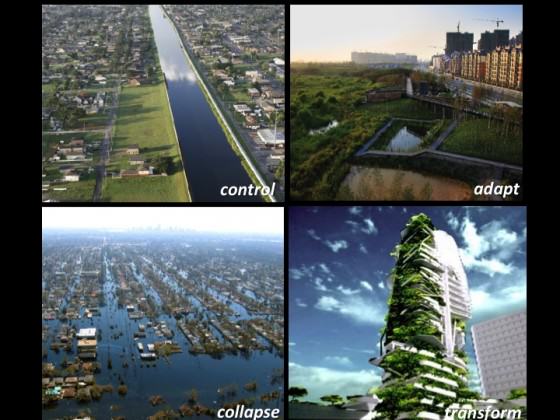
Futures Archetypes

Futures Archetypes. Credits: Upper left: 17th street canal, David Grunfeld Landov Media; Upper right: Qunli National Urban Wetland, Turenscape; Lower left: Hurricane Katrina – NOAA; Lower right: EDITT tower, Hamzah & Yeang

The concept of “planetary boundaries” offers a framework for humanity to operate safely on a planetary scale. Rockström et al (2009) developed the concept of planetary boundaries to inform us about the levels of anthropogenic change that can be sustained so we can avoid potential planetary regime shifts that would dramatically affect human wellbeing. The concept does not imply, and neither rules out, planetary-scale tipping points associated with human drivers. Hughes et al (2013) do address some the misconception surrounding planetary-scale tipping points that confuses a system’s rate of change with the presence or absence of a tipping point. To avoid the potential consequences of unpredictable planetary-scale regime shifts we will have to shift our attention towards the drivers and feedbacks rather than focus exclusively on the detectable system responses. Rockström et al (2009) identify nine areas that are most in need of set planetary boundaries: climate change; biodiversity loss; input of nitrogen and phosphorus in soils and waters; stratospheric ozone depletion; ocean acidification; global consumption of freshwater; changes in land use for agriculture; air pollution; and chemical pollution.

A different emphasis is proposed by those scientists who have advanced the concept of planetary opportunities: solution-oriented research to provide realistic, context-specific pathways to a sustainable future (DeFries et al. 2012). The idea is to shift our attention to how human ingenuity can expand the ability to enhance human wellbeing (i.e. food security, human health), while minimizing and reversing environmental impacts. The concept is grounded in human innovation and the human capacity to develop alternative technologies, implement “green” infrastructure, and reconfigure institutional frameworks. The potential opportunities to explore solution-oriented research and policy strategies are amplified in an urbanizing planet, where such solutions can be replicated and can transform the way we build and inhabit the Earth.

Imagining a Resilient Urban Planet

While these different images of the future are both plausible and informative, they speak about the present more than the future. They all represent an extension of the current trajectory as if the future would unfold along the path of our current way of asking questions, and our way of understanding and solving problems. Yes, these perspectives do account for uncertainty but it is defined by the confidence intervals around this trajectory. Both stories are grounded in the inevitable dichotomies of humans and nature, and technology vs. ecology. These views are at best an incomplete account of what is possible: they reflect a limited ability to imagine the future beyond such archetypes. Why can we imagine smart technologies and not smart behaviors, smart institutions, and smart societies? Why think only of technology and not of humans and their societies that co-evolve with Earth?

Understanding the co-evolution of human and natural systems is key to build a resilient society and transform our habitat. One of the greatest questions in biology today is whether natural selection is the only process driving evolution and what the other potential forces might be. To understand how evolution constructs the mechanisms of life, molecular biologists would argue that we also need to understand the self-organization of genes governing the evolution of cellular processes and influencing evolutionary change (Johnson and Kwan Lam 2010).

To function, life on Earth depends on the close cooperation of multiple elements. Biologists are curious about the properties of complex networks that supply resources, process waste, and regulate the system’s functioning at various scales of biological organization. West et al. (2005) propose that natural selection solved this problem by evolving hierarchical fractal-like branching. Other characteristics of evolvable systems are flexibility (i.e. phenotypic plasticity), and novelty. This capacity for innovation is an essential precondition for any system to function. Gunderson and Holling (2002) have noted that if systems lack the capacity for innovation and novelty, they may become over-connected and dynamically locked, unable to adapt. To be resilient and evolve, they must create new structures and undergo dynamic change. Differentiation, modularity, and cross-scale interactions of organizational structures have been described as key characteristics of systems that are capable of simultaneously adapting and innovating (Allen and Holling 2010).

To understand coevolution of human-natural systems will require advancement in the evolution and social theories that explain how complex societies and cooperation have evolved. What role does human ingenuity play? In Cities as Hybrid Ecosystems I propose that coupled human-natural systems are not governed only by either natural selection or human ingenuity alone, but by hybrid processes and mechanisms. It is their hybrid nature that makes them unstable and at the same time able to innovate. This novelty of hybrid systems is key to reorganization and renewal. Urbanization modifies the spatial and temporal variability of resources, creates new disturbances, and generates novel competitive interactions among species. This is particularly important because the distribution of ecological functions within and across scales is key to the system being able to regenerate and renew itself (Peterson et al. 1998).

The city that thinks like a planet: What does it look like?

In this blog article I have ventured to pose this question, but I will not venture to provide an answer. In fact no single individual can do that. The answer resides in the collective imagination and evolving behaviors of people of diverse cultures who inhabit a diversity of places on the planet. Humanity has the capacity to think in the long term. Indeed, throughout history, people in societies faced with the prospect of deforestation, or other environmental changes, have successfully engaged in long-term thinking, as Jared Diamond (2005) reminds us: consider Tokugawa shoguns, Inca emperors, New Guinea highlanders, or 16th-century German landowners. Or, more recently, the Chinese. Many countries in Europe, and the United States, have dramatically reduced their air pollution and meanwhile increased their use of energy and combustion of fossil fuels. Humans have the intellectual and moral capacity to do even more when tuned into challenging problems and engaged in solving them.

A city that thinks like a planet is not built on already set design solutions or planning strategies. Nor can we assume that the best solution would work equally well across the world regardless of place and time. Instead, such a city will be built on principles that expand its drawing board and collaborative action to include planetary processes and scales, to position humanity in the evolution of Earth. Such a view acknowledges the history of the planet in every element or building block of the urban fabric, from the building to the sidewalk, from the back yard to the park, from the residential street to the highway. It is a view that is curious about understanding who we are and about taking advantage of the novel patterns, processes, and feedbacks that emerge from human and natural interactions. It is a city grounded in the here and the now and simultaneously in the different time and spatial scales of human and natural processes that govern the Earth. A city that thinks like a planet is simultaneously resilient and able to change.

How can such a perspective guide decisions in practice? Urban planners and decision makers, making strategic decisions and investments in public infrastructure, want to know whether certain generic properties or qualities of a city’s architecture and governance could predict its capacity to adapt and transform itself. Can such a shift in perspective provide a new lens, a new way to interpret the evolution of human settlements, and to support humans in successfully adapting to change? Evidence emerging from the study of complex systems points to their key properties that expand adaptation capacity while enabling them to change: self organization, heterogeneity, modularity, redundancy, and cross-scale interactions.

A co-evolutionary perspective shifts the focus of planning towards human-natural interactions, adaptive feedback mechanisms, and flexible institutional settings. Instead of predefining “solutions,” that communities must implement, such perspective focuses on understanding the ‘rules of the game’, to facilitate self-organization and careful balance top-down and bottom-up managements strategies (Helbing 2013). Planning will then rely on principles that expand heterogeneity of forms and functions in urban structures and infrastructures that support the city. They support modularity (selected as opposed to generalized connectivity) to create interdependent decentralized systems with some level of autonomy to evolve.

In cities across the world, people are setting great examples that will allow for testing such hypotheses. Human perception of time and experience of change is an emerging key in the shift to a new perspective for building cities. We must develop reverse experiments to explore what works, what shifts the time scale of individual and collective behaviors. Several Northern European cities have adopted successful strategies to cut greenhouse gases, and combined them with innovative approaches that will allow them to adapt to the inevitable consequences of climate change. One example is the Copenhagen 2025 Climate Plan. It lays out a path for the city to become the first carbon-neutral city by 2025 through efficient zero-carbon mobility and building. The city is building a subway project that will place 85 percent of its inhabitants within 650 yards of a Metro station. Nearly three-quarters of the emissions reductions will come as people transition to less carbon-intensive ways of producing heat and electricity through a diverse supply of clean energy: biomass, wind, geothermal, and solar. Copenhagen is also one of the first cities to adopt a climate adaptation plan to reduce its vulnerability to the extreme storm events and rising seas expected in the next 100 years.

In the Netherlands, alternative strategies are being explored to allow people to live with the inevitable floods. These strategies involve building on water to develop floating communities and engineering and implementing adaptive beach protections that take advantage of natural processes. The experimental Sand Motor project uses a combination of wind, waves, tides, and sand to replenish the eroded coasts. The Dutch Rijkswaterstaat and the South Holland provincial authority placed a large amount of sand in an artificial 1 km long and 2 km wide peninsula into the sea, allowing for the wave and currents to redistribute it and build sand dunes and beaches to protect the coast over time.

New York is setting an example for long-term planning by combining adaptation and transformation strategies into its plan to build a resilient city, and Mayor Michael Bloomberg has outlined a $19.5 billion plan to defend the city against rising seas. In many rapidly growing cities of the Global South, similar leadership is emerging. For example, Johannesburg which adopted one of the first climate change adaptation plan, and so have Durban and Cape Town, in South Africa and Quito, Equador, along with Ho Chi Minh City Vietnam, where a partnership with the City of Rotterdam Netherlands has been established to develop a resilience strategy.

To think like a planet and explore what is possible we may need to reframe our questions. Instead of asking what is good for the planet, we must ask what is good for a planet inhabited by people. What is a good human habitat on Earth? And instead of seeking optimal solutions, we should identify principles that will inform the diverse communities across the world. The best choices may be temporary, since we do not fully understand the mechanisms of life, nor can we predict the consequences of human action. They may very well vary with place and depend on their own histories. But human action may constrain the choices available for life on earth.

Scenario Planning

Scenario planning offers a systematic and creative approach to thinking about the future by letting scientists and practitioners expand old mindsets of ecological sciences and decision making. It provides a tool we can use to deal with the limited predictability of changes on the planetary scale and to support decision-making under uncertainty. Scenarios help bring the future into present decisions (Schwartz 1996). They broaden perspectives, prompt new questions, and expose the possibilities for surprise.

Scenarios have several great features. We expect that they can shift people’s attention toward resilience, redefine decision frameworks, expand the boundaries of predictive models, highlight the risks and opportunities of alternative future conditions, monitor early warning signals, and identify robust strategies (Alberti et al 2013)

A fundamental objective of scenario planning is to explore the interactions among uncertain trajectories that would otherwise be overlooked. Scenarios highlight the risks and opportunities of plausible future conditions. The hypothesis is that if planners and decision makers look at multiple divergent scenarios, they will engage in a more creative process for imagining solutions that would be invisible otherwise. Scenarios are narratives of plausible futures; they are not predictions. But they are extremely powerful when combined with predictive modeling. They help expand boundary conditions and provide a systematic approach we can use to deal with intractable uncertainties and assess alternative strategic actions. Scenarios can help us modify model assumptions and assess the sensitivities of model outcomes. Building scenarios can help us highlight gaps in our knowledge and identify the data we need to assess future trajectories.

Scenarios can also shine spotlights on warning signals, allowing decision makers to anticipate unexpected regime shifts and to act in a timely and effective way. They can support decision making in uncertain conditions by providing us a systematic way to assess the robustness of alternative strategies under a set of plausible future conditions. Although we do not know the probable impacts of uncertain futures, scenarios will provide us the basis to assess critical sensitivities, and identify both potential thresholds and irreversible impacts so we can maximize the wellbeing of both humans and our environment.

A new ethic for a hybrid planet

More than half a century ago, Aldo Leopold (1949) introduced the concept of “thinking like a mountain”: he wanted to expand the spatial and temporal scale of land conservation by incorporating the dynamics of the mountain. Defining a Land Ethic was a first step in acknowledging that we are all part of larger community hat include soils, waters, plants, and animals, and all the components and processes that govern the land, including the prey and predators. Now, along the same lines, Paul Hirsch and Bryan Norton (2012) In Ethical Adaptation to Climate Change: Human Virtues of the Future, MIT Press, articulates a new environmental ethics by suggesting that we “think like a planet.” Building on Hirsch and Norton’s idea, we need to expand the dimensional space of our mental models of urban design and planning to the planetary scale.

Marina Alberti
Seattle

On The Nature of Cities

Note: The metaphor of “thinking like a planet” builds on the idea of cognitive transformation proposed by Paul Hirsch and Bryan Norton (2012) In Ethical Adaptation to Climate Change: Human Virtues of the Future, MIT Press.

Source: http://www.thenatureofcities.com/2013/09/27/building-cities-that-think-like-planets/

Saturday, May 18, 2013

Why smart growth?


Smart Growth Principles

Mix Land Uses
Take Advantage of Compact Building Design
Create a Range of Housing Opportunities and Choices
Create Walkable Neighborhoods
Foster Distinctive, Attractive Communities with a Strong Sense of Place
Preserve Open Space, Farmland, Natural Beauty and Critical Environmental Areas
Strengthen and Direct Development Towards Existing Communities
Provide a Variety of Transportation Choices
Make Development Decisions Predictable, Fair and Cost Effective
Encourage Community and Stakeholder Collaboration in Development Decisions

Health, schools, taxes, traffic, the environment, economic growth, fairness, opportunity—many of the things we care about—are all affected by development decisions. From the length of our daily commute to the price of a new home to the safety of our neighborhoods-what, where, and how we build have major impacts on our personal lives, our com munities, and our nation.

Growth presents a tremendous opportunity for progress. Communities around the country are looking for ways to get the most out of new development and to maximize their investments. Frustrated by development that requires residents to drive long distances between jobs and homes, many communities are challenging rules that make it impossible to put workplaces, homes, and services closer together. Many communities are questioning the fiscal wisdom of neglecting existing infrastructure while expanding new sewers, roads, and services into the fringe. And in many communities where development has improved daily life, the economy, and the environment, smart growth principles have been key to that success.

Growth is "smart" when it gives us great communities, with more choices and personal freedom, good return on public investment, greater opportunity across the community, a thriving natural environment, and a legacy we can be proud to leave our children and grandchildren.

When communities choose smart growth strategies, they can create new neighborhoods and maintain existing ones that are attractive, convenient, safe, and healthy. They can foster design that encourages social, civic, and physical activity. They can protect the environment while stimulating economic growth. Most of all, we can create more choices for residents, workers, visitors, children, families, single people, and older adults-choices in where to live, how to get around, and how to interact with the people around them. When communities do this kind of planning, they preserve the best of their past while creating a bright future for generations to come.

Adapted from the PDF "This is Smart Growth," published by ICMA and EPA in 2006.

Wednesday, May 15, 2013

Climate Change Adaptation Toolkit and User Guide: a comprehensive guide to planning for climate change adaptation in three steps


The impacts of climate change are already being experienced in our community from heat waves and intense bushfires to devastating floods. Despite adaptation being discussed for a number of years, organisations are still grappling with how best to respond to this complex problem.

Net Balance, in collaboration with RMIT and the City of Greater Geelong, has developed an Adaptation toolkit. The Toolkit will assist organisations to prioritise their climate risks and adaptation actions and make climate change risk consideration a part of their everyday operations.

Based on practical experience, the Toolkit takes organisations beyond risk assessments – exploring implications of uncertainty on risk and adaptation actions and supports embedding climate change within the decision making processes.

The Toolkit aims to support organisations to:
  • Integrate adaptation and support effective and efficient risk management
  • Be more responsive to climate change shocks and trends form linkages across different work areas, internally and externally
  • Make effective and consistent decisions regarding climate change.
The Toolkit consists of three tools, stepping the user through key considerations of climate change risks, and potential adaptation actions.

Tool 1: Exploring the Risk Context – explores in detail key climate change risks previously identified. The tool explores the interaction between the risk and their broader social, economic and environmental context. It also outlines a process for considering, overcoming or accepting, and documenting the uncertainty associated with each relevant climate change risks.

Tool 2: Developing Adaptation Actions – provides a process for identifying, exploring and evaluating adaptation options, to assist organisations to prioritise actions.

Tool 3: Screening for Climate Change Interactions - outlines a process for decision makers across an organisation to consider any interactions between a new proposal/project and climate change risks and adaptation actions.

The toolkit and user guide are available for free download.

Acknowledgments

The Climate Change Adaptation Toolkit is a comprehensive guide to planning for climate change adaptation in three steps. The impacts of climate change are already being experienced, generating a new series of risks for organisations. Climate change is a complex problem that requires a new integrated and collaborative risk management approach. The Climate Change Adaptation Toolkit has been developed by NetBalance in partnership with the City of Greater Geelong and RMIT University’s Climate Change Adaptation Program.

Monday, April 22, 2013

How a Community-Based Food System works.

It begins with small farms working with natural cycles and ends with fresh food and stronger communities in nearby cities.
Hover over the top banners to see How a Community-Based Food System works.


Everybody Eats1 link2 link3 link4 link
YES! MAGAZINE INTERACTIVE GRAPHIC, 2009


Clean energy such as solar, wind, and biogas provides clean power for farm machinery.

Closed-loop cycles mimic nature and eliminate waste. Nutrients are returned to soil.

Grass-fed livestock has a smaller carbon footprint and leaves grain for humans to eat.

Crop diversity increases yield, keeps soil fertile, helps fight pests.

Homegrown seed keeps old strains alive, produces new varieties adapted to local conditions.

Fact: Since 1900, 75 percent of vegetable varieties have disappeared worldwide.

No-till farming reduces soil loss and sequesters carbon. Edible prairie produces grain while building soil.

Fact: If all farmers in the U.S. used no-till, crop rotation and cover crops, they'd sequester 300 million tons of carbon a year.


Other characteristics: Fruit and nut orchards, farm waste converted to to biogas fuel or compost, manure converted to fertilizer, clean water runoff.


Regional Processing: Local cooperatives can replace giant corporate processors for frozen and canned foods. Food processing waste is composted and goes back to farms.

Short Haul Distribution: Using electric vehicles to move food from railheads and ports to markets in cities will result in cleaner air and a new automobile industry.

Fact: A regional diet uses 17 times less oil than the typical American long-distance diet.

Long-Haul Distribution: Use trains to transport goods over large distances.

Fact: Moving goods by rail instead of truck reduces fuel use by two-thirds.


Money spent locally increases a community’s economic health.

Fact: Every dollar that stays in a community has three times the effect of a dollar that goes to a distant corporate HQ.

Cooperatives allow farmers to share the cost of buying land and supplies, and to share labor and equipment.

Fact: Farms of 27 acres or less produce 10 times more dollar value per acre than larger ones.

Where we get our food: Farmers markets and community supported agriculture (CSA) leave out the big-retailer middleman. Small farmers make a living; communities get fresh, healthy, affordable food. Buy local food from farmers markets, urban food vans, co-ops and CSAs.


Lawns, abandoned lots, balconies, roofs, and even windowsills become gardens. Neighbors build community gardens and share the bounty at neighborhood feasts.

Fact: During WWII, Victory Gardens produced 40 percent of the vegetables people ate.

When you grow your own, use homegrown seeds, use garden waste to compost and allow household food scraps to be composted by worms.

pdf icon
Download pdf poster
of Everybody Eats.
Everybody Eats 11x17 poster thumbnail 11x17"
1.97mb


Sources:
FARMS OF 27 ACRES OR LESS ::
In the United States farms of 27 acres or less have more than ten times greater dollar output per acre than larger farms.
www.foodfirst.org


NO-TILL AGRICULTURE ::

http://researchnews.osu.edu/archive/notill.htm


75% OF VEGETABLE VARIETIES ::
www.fao.org


TRUCK VS. TRAIN ::
US Dept. of Transportation via Appalachian Regional Commission,
www.arc.gov


LOCAL DOLLAR ::
Institute for Local Self-Reliance,
www.newrules.org/retail/midcoaststudy.pdf


REGIONAL DIET USES 17 TIMES ::
A regional diet consumed 17 times less oil and gas than a typical diet based on food shipped across the country
www.alpha.dickinson.edu


VICTORY GARDENS ::
Michael Pollan, New York Times,
www.nytimes.com/2008/10/12/magazine/12policy-t.html?pagewanted=9